


Key Points:
- Data governance establishes ownership, classification, data standards, retention requirements, and rules for how data should be managed throughout its lifecycle.
- Information security protects data through access controls, encryption, monitoring, incident response, and controls that preserve confidentiality, integrity, and availability.
- Governance and security overlap around classification, access, and retention, but governance determines the requirements while security translates them into technical controls.
- Inactive and legacy data creates a particular gap because governance policies may remain in place while security monitoring, ownership, patching, and access reviews decline.
- Historical data needs both disciplines to remain effective after an operational system is retired, ensuring records remain governed, protected, accessible, and subject to appropriate retention and disposition.
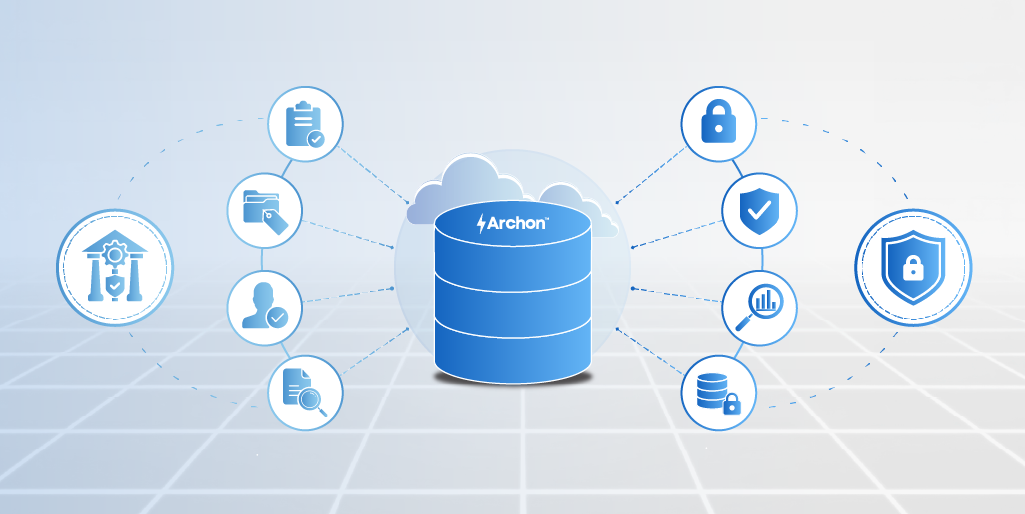
- Archon Data Store provides a governed and secured environment for historical data after it leaves active operational systems, supporting retention, access control, integrity, and application decommissioning.
Two teams, two budgets, two sets of KPIs, and most compliance mandates still lump them into one line: “governance and security.” They are not the same function, and treating them as interchangeable is usually why one team builds a comprehensive policy that nobody enforces, while the other locks data down so tightly that the business cannot use it for the purpose it was collected for in the first place.
The confusion is not really about definitions. Anyone can look those up. It is about ownership. Who signs off when a new team requests access to customer data? Who is notified when that access is misused?
Who is accountable when an auditor asks why a record from six years ago is still sitting in a system nobody logs into anymore? Data governance and information security answer different halves of that question, and once the boundary between them is clear, most of the internal friction disappears.
This distinction matters because every regulation an organization answers to, including GDPR, HIPAA, SOX, PCI DSS, and DPDPA, assumes both functions are operating and operating together.
Auditors do not ask whether a policy exists. They ask whether the policy was enforced, on a specific record, on a specific date. That question is where data governance and information security either meet cleanly or expose a gap that has existed for years.
What Is Data Governance?
Data governance is the set of policies, roles, and standards that determine how data is created, classified, owned, used, shared, and eventually retired. It functions as a decision-rights framework before it becomes anything else.
Someone has to own each data domain. Someone has to define what constitutes a “customer record” or a “financial transaction,” so departments are not working from conflicting definitions. Someone has to set the retention clock and decide when data is archived or deleted.
Governance is what makes data usable and trustworthy at scale. A data steward tagging a field as personally identifiable information, a policy requiring financial records to be retained for a defined period based on applicable requirements, or a data catalog that identifies the authoritative source for an analyst instead of a stale duplicate, all of these are governance functions in practice.
None of them, by themselves, prevent someone from copying that data onto a personal device or querying it from an account that should not have access. That enforcement step belongs to security, not governance.
Read More: Enterprise Data Governance: Framework, Challenges & Best Practices
Key Components of a Data Governance Framework
Most data governance programs, regardless of industry, are built around the same core components.
Data ownership assigns a named business owner to each major dataset, so decisions about that data are not left to whichever IT team happens to be maintaining the underlying system.
Data classification labels information by sensitivity, such as public, internal, confidential, or regulated, so downstream teams understand what they are handling without having to ask.
Metadata management tracks where data originated, what it means, how it relates to other datasets, and which business context applies to it.
Retention and disposition policy defines how long data must be kept based on record type, jurisdiction, regulatory obligations, legal requirements, and business needs, and what happens once that period expires.
Data quality standards ensure the information decisions are based on is accurate, complete, and current.
None of these components involve a firewall, an encryption key, or an intrusion alert. They are organizational decisions, documented and assigned to a person. This is what makes governance a strategic function rather than a purely technical one.
It also explains why governance programs tend to stall when they are run entirely out of IT without business ownership behind them. A policy the business never signed off on rarely survives day-to-day operations.
Also Read: AI Data Governance: Archiving, Retrieval & Compliance for LLM-Ready Enterprises
What Is Information Security?
Information security is the technical and procedural discipline responsible for protecting information against unauthorized access, disclosure, alteration, destruction, and disruption.
Encryption, access controls, firewalls, intrusion detection, and incident response all contribute to this objective. Security asks a narrower and more immediate question than governance: can this specific person, at this specific moment, perform this specific action on this specific dataset, and if not, how quickly is that detected?
Security is not concerned with whether a policy states that data should be deleted after a particular retention period. It is concerned with whether the data, wherever it resides and for however long it exists, remains protected from unauthorized access, corruption, and loss throughout that entire period.
This is the confidentiality, integrity, and availability model in practice, not merely on paper. Confidentiality ensures unauthorized parties cannot view the data. Integrity ensures nobody can alter it without that alteration being detected. Availability ensures authorized users can access it when needed.
The CIA Triad in Information Security
It is worth translating this triad into what it looks like day to day, since the term itself is often used without explanation.
Confidentiality is enforced through role-based access controls, multi-factor authentication, and encryption both at rest and in transit, so that even if an unauthorized party bypasses initial defenses, the data itself remains unreadable.
Integrity is enforced through checksums, digital signatures, and audit logging capable of establishing whether a record has been altered, which becomes critical when that record is used as evidence in a legal or regulatory matter.
Availability is supported through backup strategy, disaster recovery planning, and continuous monitoring that identifies outages or denial-of-service activity before they disrupt the business.
Security teams operate on a different rhythm from many governance activities. Governance may involve periodic policy reviews, classification updates, ownership reviews, and retention assessments, while security also has to respond continuously to access events, threats, vulnerabilities, and incidents.
The distinction is less about one team working periodically and the other working in real time than about the different decisions each function is responsible for making.
Data Governance vs. Information Security: Key Differences at a Glance
| Dimension | Data Governance | Information Security |
|---|---|---|
| Core question | Who owns this data, what does it mean, and what are we permitted to do with it? | Who is technically authorized to access it, how is it protected, and are we monitoring for misuse? |
| Primary output | Policies, data ownership, classification standards, retention rules | Access controls, encryption, monitoring, incident response |
| Time horizon | Strategic, spanning the full data lifecycle | Continuous protection, monitoring, and response |
| Typically owned by | Data governance council, chief data officer, business data stewards | CISO, security operations, IT security teams |
| Common tools | Data catalogs, metadata management platforms, retention schedules | SIEM platforms, identity and access management, encryption and DLP tools |
| Measured by | Policy coverage, classification accuracy, audit readiness | Detection speed, access control violations, incident response performance |
| Success looks like | Consistent, accurate, well-classified, appropriately retained data | No unauthorized access, controlled exposure, preserved integrity, rapid response |
| Fails when | Policies exist but are not translated into operational controls | Systems are protected but their contents, ownership, classification, or retention requirements are unclear |
Neither discipline functions well without the other. A retention policy has little value if it is not translated into an operational process that can archive or dispose of data at the appropriate point.
A well-encrypted system remains a liability if nobody has classified what it contains, since data cannot be appropriately protected if it has not first been identified and understood. This is why the two disciplines are so frequently mistaken for one another.
Both exist to protect an organization’s data, but they address different failure modes, and a program strong in one discipline while weak in the other still functions, in practice, as a weak program.

Where Data Governance and Information Security Overlap
On paper, governance and security appear to be clean, adjacent responsibilities. In practice, the overlap between them is where many compliance gaps originate, and rarely because either team performed poorly in isolation. The failure typically occurs because the handoff between the two was never designed as a single, connected workflow.
Data Classification Without Security Enforcement
Data classification is the clearest example of this overlap. Governance determines that a field contains sensitive personal information and labels it accordingly within a catalog or governance system. Security is expected to act on that classification by applying encryption, masking, or stricter access controls.
When classification work occurs in a spreadsheet, a wiki, or a catalog tool that never synchronizes with the systems security actually uses for enforcement, the label exists but the protection does not. A documented classification scheme that is not reflected in the technical controls protecting the data creates a clear gap between policy and enforcement.
Access Control Gaps Beyond Governance Visibility
Access control follows a similar pattern. Governance defines who should have access to a dataset based on role and business justification, often through a formal access request or periodic review process. Security implements and monitors that access, but only within the systems it has visibility into.
Any system outside that visibility, an old reporting database, a decommissioned ERP module still holding historical records, a file share with no assigned owner, falls into a space between governance and security. It remains technically covered by policy, since most access and retention policies are written broadly enough to apply to “all organizational data.”
It is not, however, actively protected or monitored, because nobody is watching a system that fell off the radar the moment its primary use case ended.
Retention Policies Security Teams Never Enforce
A third overlap receives less attention than classification and access, but can generate just as much operational friction: retention. Governance establishes the applicable retention period based on record type, jurisdiction, regulatory obligations, legal requirements, and business needs.
Once that period is defined, however, someone must enforce it technically, archiving or deleting data when appropriate and accounting for legal holds or other exceptions. Where that enforcement step is missing, organizations can end up retaining significantly more data than necessary, which increases the exposure associated with any future security incident.
Every record retained beyond its required period is additional data that may not need to remain exposed if something goes wrong.
None of these overlaps reflect a people problem that more meetings will resolve. They reflect a structural issue. Governance and security were designed as two disciplines with two owners, two tool stacks, and two reporting lines, applied to data that respects neither boundary. The problem becomes more pronounced when data leaves the active systems where both teams have clear visibility.
Also Read: 10 Data Retention Best Practices for Large Enterprises
What Happens When Data Becomes Inactive?
A common pattern emerges when organizations examine their historical data closely: the data receiving the least operational attention is often the data that has gone quiet.
A payroll system replaced three years ago but kept running for reporting purposes. A CRM instance retained from before the last acquisition. Financial records sitting in cold backups because deleting them felt riskier than retaining them.
A legacy claims processing system in healthcare, or an older core banking module, still running purely so that a historical record can occasionally be retrieved for an audit.
This data usually has a governance policy attached to it somewhere, a retention schedule stating how long it should be retained, a classification marked “confidential.” But because it no longer sits within an actively managed system, security teams may reduce how closely they monitor it.
Access reviews slow down. Credentials on a database three teams removed from its original owner stop being rotated. Patches stop being applied once vendor support for the platform ends. The governance rule technically remains in place, while security oversight can quietly lapse. This creates a gap between the way the data is governed on paper and the way it is actually protected.
Why Legacy Systems Carry Significant Compliance Risk
There is a specific reason this pattern can repeat across industries as different as banking, healthcare, and manufacturing. Legacy systems combine three risk factors that active systems may not carry simultaneously.
- First, they are under-resourced, since budget naturally flows toward the systems the business depends on today rather than those maintained purely for historical access.
- Second, they are under-monitored, since security tooling and attention gravitate toward systems with active user traffic rather than those queried occasionally.
- Third, and frequently overlooked, they can run on outdated infrastructure that is harder to patch, harder to audit, and in some cases no longer receiving vendor security updates.
Combined, these factors can create an environment where a governance policy is entirely accurate on paper, stating that a dataset is classified confidential and retained for a defined period, while the actual technical protection surrounding it has eroded. This is rarely a deliberate decision. It is often the result of nobody being explicitly assigned to continue protecting the data once its primary use case ended.
| Lifecycle stage | Governance posture | Security posture | Typical outcome |
|---|---|---|---|
| Active production data | Policies are actively applied and reviewed; ownership is clear | Continuously monitored with dedicated ownership, access controls, and regular security maintenance | Data remains well covered by both governance and security controls |
| Recently retired systems | Existing governance policies and retention requirements still apply, but ownership may begin shifting | Monitoring and security attention may be deprioritized as focus moves to active systems | Governance remains largely intact while security oversight begins to decline |
| Legacy backups, old file shares | Retention requirements may still exist, but policies are rarely revisited against the actual data | Access reviews and security monitoring are less consistent | Data remains governed in theory but may have limited active protection |
| Fully decommissioned applications | Historical data may have no clear active owner even though retention obligations remain | Little or no active protection or visibility may remain around the original environment | Highest risk of fragmented ownership, limited visibility, and inconsistent controls |
The sustainable fix is not asking security teams to indefinitely monitor an expanding list of legacy systems, which further stretches already limited resources. Nor is it asking governance teams to write more detailed policies for data that cannot easily be located, since a policy covering data nobody can find does little to reduce actual risk.
The more durable approach is removing the problem at its source: consolidating inactive data out of fragmented, unmonitored legacy environments and into an environment where governance and security controls can continue to apply after the original system is retired.
Why Historical Data Needs Both Governance and Security
Historical data does not stop being subject to governance requirements simply because it is no longer used every day. Retention obligations, ownership, classification, access requirements, legal holds, and disposition rules can continue to apply long after the operational system that created the data has been replaced.
At the same time, historical data remains a security asset. It can contain customer information, financial records, employee information, transaction histories, communications, or other regulated information. Moving it out of an active application does not remove the need to control who can access it, protect its integrity, monitor its use, or maintain its availability for legitimate business and regulatory needs.
This is where governance and security need to operate together. Governance determines what the historical record is, who owns it, how it should be classified, how long it must be retained, and what should happen when that period expires. Security ensures that the same record remains protected from unauthorized access or alteration and remains available to authorized users throughout its retention period.
The challenge is that traditional governance and security controls are often organized around active applications. Once an application is retired, the data can become fragmented across databases, backups, file shares, reporting environments, and other repositories. The organization may still have a retention policy and security requirements, but applying them consistently across those locations becomes increasingly difficult.
The objective, therefore, is not to merge governance and security into a single function. It is to provide a controlled environment where governance decisions and security controls continue to apply to the same historical data throughout its remaining lifecycle.
How Archon Data Store Brings Governance and Security to Historical Data
This is the specific gap Archon Data Store is designed to address. Governance and security tooling is often centered on data that remains active and housed within systems someone accesses and manages regularly.
When data becomes inactive, those controls can become harder to maintain consistently, particularly when the underlying application is approaching retirement or has already been decommissioned.
Archon Data Store moves structured and unstructured data out of retired, redundant, and soon-to-be-decommissioned systems into a single Lakehouse-based archive, providing a governed and secured environment for historical data after it leaves active operational systems.
| Common legacy environment gap | How Archon Data Store addresses it |
|---|---|
| Classification exists on paper but is not reflected in the archive environment | Metadata-driven governance applied at ingestion, with classification, access, and retention controls applied to archived data |
| Retention schedules nobody actively tracks | Policy-driven retention and legal hold orchestration across archived datasets |
| Legacy systems kept running solely to preserve access “just in case” | Application decommissioning, with historical data remaining searchable and available without keeping the legacy application operational |
| Data fragmented across 200+ legacy sources with inconsistent controls | Pre-built connectors consolidating data into one governed, WORM-compliant environment with consistent access controls and audit trails |
| No verifiable proof that archived data has not been altered | Cryptographic hashes and trusted timestamps establishing evidentiary integrity for archived records |
Closing the Legacy Data Gap Beyond the Definitions
Once the distinction between data governance and information security is clear, the harder question is where both functions can remain effective after the systems that originally housed the data are retired. That is rarely within the active systems an organization uses daily.
It is within the historical data sitting behind them: the retired SAP ECC instance holding a decade of transactional history ahead of an S/4HANA migration, the legacy EHR platform a healthcare provider cannot fully retire because clinicians occasionally need a historical patient record, the older core banking system still running solely to satisfy a regulator’s document request.
In each of these situations, a governance policy may already cover the data, and a security team may already carry responsibility for protecting it. What is missing is a single environment where both functions can continue operating on the same records under consistent controls, rather than governance policy referencing one system while security enforcement covers a narrower, disconnected portion of it.
Archon Data Store is built to serve as that environment: one location where historical data can be retained with its classification, retention requirements, access controls, and integrity protections applied together, so the gap between what governance decides and what security enforces is addressed as the data moves out of active systems.
Data governance and information security will always be two distinct functions, with different owners, different responsibilities, and different toolsets. They do not have to remain two separate blind spots.
For organizations with historical data scattered across systems no one fully owns anymore, closing that gap rarely requires another policy document or an additional system for an already stretched security team to monitor. It requires giving that data a governed and secure environment where both disciplines can continue to operate throughout its lifecycle.
Give Historical Data a Governed, Secure Home → Explore Archon Data Store


