

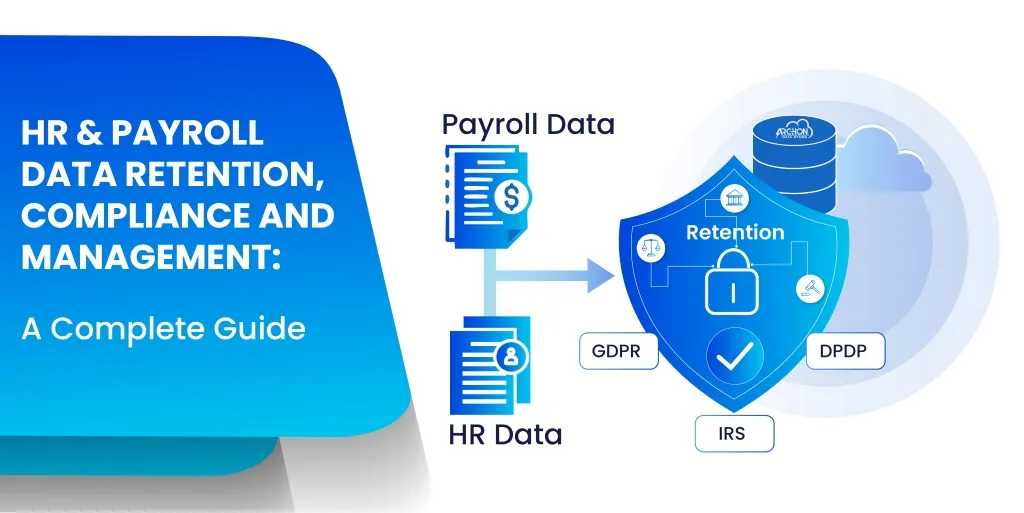

Is HR data and payroll records retention merely another way of storing files or another file management system? The truth is far from it. It is the foundation of security, compliance, trust, and financial accountability. What could happen if your organization got it wrong?
This is not a far-fetched hypothetical scenario. It has already happened to enterprises across industries – lawsuits, million-dollar penalties, reputational blows. All because HR data and payroll records weren’t retained and archived properly.
A mid-sized firm was sued by a former employee for unpaid overtime dating back six years. The employer failed to present the timecards and payroll registers, which had either been misplaced or buried deep in outdated systems.
The court ruled in favour of the employee, inferring the missing records would have supported the claimant. Resulted in a costly seven-figure settlement and reputational damage. This is the reality when retention fails.
What are Payroll Records?
Your payroll records document every aspect of employee compensation, taxes, deductions, benefits, and work hours across your organization. These records are essential for proving compliance during audits, resolving employee disputes, and supporting tax reporting obligations. As your workforce grows, retaining payroll data properly becomes critical for reducing legal, financial, and operational risk.
Payroll records are the documents employers use to track employee compensation, taxes, benefits, work hours, and deductions. These records include pay slips, timesheets, tax forms, direct deposit information, overtime calculations, benefits deductions, and payroll registers.
Why Does Right HR and Payroll Data Retention & Lifecycle Management Matter?
Payroll data retention is about protecting your enterprise’s integrity, staying compliant with modern evolving regulations, and ensuring regular operations. Prioritizing the right data retention and lifecycle management can make all the difference – gain better control over sensitive information, optimize costs, streamline workflows, and safeguard the organization’s reputation.
In the data lifecycle management strategy, one core issue stands out significantly! Failing to manage HR and payroll data across its entire lifecycle – Neither missing the records nor storing excess data. Getting this balance right is what keeps your enterprises efficient and ready for your future business continuity.
- Destroyed or inaccessible emails led Zubulake v.UBS Warburg to sanctions and costly verdicts. Jury awarded $29.2 million in damages, including $20.1 million in punitive damages: missing records = legal exposure
- Over-retained data by Equifax created a honeypot for cybercriminals and led to a data breach affecting 147 million people. Contributed to over $425 million settlements: excess data = increased data breach risk
Some hard-hitting facts and their numbers would declare just as loudly that HR and payroll records retention is existential.
- 60% higher risk of non-compliance – Businesses without a solid data retention and archival strategy
- Around $3.6 million – Average cost of non-compliance, far exceeding the proactive data management cost
- €14.5 million fine – a German firm was fined for GDPR non-compliance, since it had over-retained personal records longer than legally necessary
- 50% faster response – companies with strong data retention policies and strategies respond to legal requests
- 30% – storage cost savings
Why HR and Payroll Data Retention is Important? – Core Reasons
HR & Payroll data retention is a strategic, legal, and compliance defence. Not only safeguarding your enterprise financially, legally, and reputationally, but also ensuring employee trust and your business’s operational continuity.

Let’s be clear with the core reasons that affirm the importance of HR & Payroll data retention.
1. Audit Readiness and Tax Requirements
- Readily available payroll and financial records during audits and tax requirements ensure proper data retention
- Not meeting audit and requirements resulting in penalties, back taxes, and disallowed deductions to the organizations
- Particularly, maintaining substantiated salary payments, deductions, and employer contributions
2. Regulatory Compliance and Legal Needs
- Employment laws like FLSA, IRS, & EEOC require minimum retention periods mandatorily
- Penalties, litigation risks, or fines can be triggered for non-compliance. For example, failure to retain I-9 forms can lead to statutory non-compliance cases
3. Employee Rights and Claims
- Data retention is critical to resolving any employee dispute, claiming their rights, or tackling lawsuits like termination, discrimination, unpaid wages, or benefit disputes
- Defensible paper trail with reliable records retention can stand up to regulatory, legal, or audit inspections
4. Employee Benefits and Retirement Plans
- Retaining long-term records like ERISA plans, pension, PF, and gratuity helps an enterprise ensure employees can access rightful privileges and benefits even after decades
- Missing records can expose employers to liability and damage employee trust in the organization
5. Historical Reference and Business Operations
- Looking back at years of employee data can help with workforce planning and trend analysis
- Historical payroll records provide insights into equitable pay practices, internal financial control, and compensation history
- Historical data acts as an evidence base for internal consistency and fair practices
6. Data Security, Compliance, and Corporate Governance
- Responsible records retention supports meeting compliance requirements such as GDPR, PDPA, and data protection policies
- Accountability and transparency with strong retention policies
- Ensures ethical practices in HR and finance
What Compliance Regulations Are Required for What HR & Payroll Data?
Compliance requirements for HR and payroll records are not confined to one particular country’s regulations. Global enterprises must comply with the complex web of international and regional regulatory frameworks.
The table below summarizes the global HR & Payroll data retention compliance regulations that enterprises must know –
| Country | Compliance Regulation | Data/Record Type | Retention Period |
|---|---|---|---|
| United States | FLSA (Fair Labor Standards Act) | Payroll records | 3 years |
| IRS | Employment tax records | 4 years | |
| EEOC / ADA / ADEA | Personnel / payroll / until resolving disputes | 1 year / 3 years / dispute period | |
| ERISA | Benefits | 6 years | |
| OSHA | Injury & illness / Medical records | 5 years / 30 years | |
| I-9 (IRCA) | Eligibility verification | 3 yrs after hire / 1 yr after termination | |
| European Union | GDPR | Employees personal data, payroll, contracts | As long as necessary, must justify retention, delete securely when no longer required |
| National Labor Laws (Germany, France, Italy) | Payroll / Employment records | 6 to 10 years | |
| United Kingdom | HMRC Rules (UK) | Payroll / tax records | 6 years, dispute period |
| GDPR (UK) | Same as EU | Lawful retention | |
| India | ESI Act | Employee registers, accident books | 5 years |
| Payment of Wages Act & Minimum Wages Act | Payroll & wage registers | 3 years | |
| Income Tax Act | Payroll / Tax records | 8 years | |
| Provident Fund | PF / Pension / Retirement records | 7 to 10 years, lifetime for pension | |
| DPDP Act, 2023 | Employee personal data | As long as legally or contractually required | |
| Brazil | LGPD | Personal data | Needs justification for retention |
| Labor laws | Payroll / Employment-related records | 5 years | |
| Canada | CRA (Canada Revenue Agency) | Payroll / tax records | 6 years after tax year |
| Provincial Employment Standards Act | Employment / HR records | 2 to 6 years | |
| PIPEDA | Personal employee data | Secure destruction when no longer required | |
| Middle East (UAE & Saudi Arabia) | Labor Law | Employment / Payroll records | 2 years after termination (UAE) / 5 years (Saudi) |
Why Legacy Systems Drive the Need for HR & Payroll Data Retention?
How many enterprises continue to run legacy HR and payroll systems? Quite a lot. These platforms have been in place for decades and have been processing employees’ history. Once delivered immense value, now posing serious limitations.
Here are some of the notable legacy HR & Payroll systems still in use today
- PeopleSoft – HRMS/ERP suite, having a decades-old legacy still deployed on-premises by large-scale enterprises
- ADP EV5 – still holding tons of important HR and payroll data in maintenance / read-only mode, but often tricky to integrate, upgrade, and extract historical data
- JD Edwards – with finance and payroll functions, supported by Oracle in an older architecture
- Taleo – talent acquisition and performance management system, acquired by Oracle in 2012
- NHS Electronic Staff Record (ESR) – customized Oracle-based HR and payroll system used by the UK’s National Health Service; despite replacing dozens of older systems still considered a legacy platform
- Old ERP-integrated Modules – still in many enterprises’ usage, including on-prem versions of JD Edwards, Oracle Financials, SAP, etc.
- UKG (Kronos/UKG Pro) – enterprise HCM and workforce management platform increasingly involved in modernization projects where historical HR and payroll data must be retained during UKG migration to another HCM system.
Read more: A practical guide to PeopleSoft decommissioning and historical data retention.
Can you see a striking irony here? These legacy systems are functional but outdated. Yet they are the anchors, dragging the enterprises down.
The legacy HR and payroll systems contain critical historical data on employees and their payroll information, and therefore cannot be discarded. But at what cost? – this is the real question here.
- How much hefty maintenance and licensing fees are you still paying just to keep an outdated system afloat?
- How many hours of your IT team are stolen by these clunky systems for patching and backing up?
- Are you sacrificing your business growth for the legacy systems that don’t integrate with cloud and modern applications?
- How long will you endure the nightmare of high-risk compliance breaches from rigid data silos?
- Can you retrieve old data instantly, at least in minutes, if an auditor asks for records from 10 years ago?
What are the IRS payroll record retention requirements?
You must retain payroll tax records long enough to satisfy IRS audit and reporting requirements. Failure to maintain accurate records can create penalties, tax disputes, and difficulties during compliance reviews. Modern payroll environments also require you to maintain secure, searchable, and accessible electronic records that can be produced quickly when requested.
The Internal Revenue Service (IRS) requires employers to retain employment tax records for at least four years after the tax becomes due or is paid, whichever is later. These records help verify payroll tax filings, wage reporting, and employee compensation history.
The IRS recommends retaining records related to:
- Employee names, addresses, and Social Security numbers
- Wage and salary payments
- Tips and bonuses
- Tax withholding records
- Payroll tax deposits
- Copies of Forms W-2 and W-3
- Employment tax returns
- Fringe benefit records
- Timecards and attendance records
Employers should ensure payroll records remain:
- Easily searchable
- Securely stored
- Available during audits
- Protected from unauthorized access
The rise of digital payroll systems has also increased expectations around electronic recordkeeping, audit trails, and rapid retrieval during compliance reviews.
What are the Department of Labor’s recordkeeping requirements?
The U.S. Department of Labor (DOL), under the Fair Labor Standards Act (FLSA), requires employers to maintain payroll records for nonexempt employees for at least three years.
Records supporting wage calculations, including timecards, work schedules, and earnings calculations, generally be retained for at least two years.
The DOL requires employers to preserve records such as:
- Employee personal information
- Occupation and job classifications
- Hours worked each day and week
- Regular hourly pay rates
- Overtime earnings
- Additions or deductions from wages
- Total wages paid each pay period
- Payment dates and payroll periods
These records are critical during:
- Wage and hour investigations
- Overtime disputes
- Misclassification claims
- Labor audits
Incomplete payroll documentation can weaken an employer’s ability to defend against wage-related claims or prove FLSA compliance.
How long do you need to keep payroll records?
Payroll retention requirements vary significantly across U.S. states. While federal laws establish baseline retention periods, many states require employers to keep payroll records longer.
Employers operating across multiple states often adopt the longest applicable retention period to simplify compliance and reduce legal risk.
Payroll Record Retention Requirements by State (2026)
| State | Minimum Payroll Record Retention Period |
|---|---|
| Alabama | 3 years |
| Alaska | 3 years |
| Arizona | 4 years |
| Arkansas | 3 years |
| California | 3 years |
| Colorado | 3 years |
| Connecticut | 3 years |
| Delaware | 3 years |
| Florida | 3 years |
| Georgia | 3 years |
| Hawaii | 6 years |
| Idaho | 3 years |
| Illinois | 5 years |
| Indiana | 3 years |
| Iowa | 3 years |
| Kansas | 3 years |
| Kentucky | 3 years |
| Louisiana | 3 years |
| Maine | 3 years |
| Maryland | 3 years |
| Massachusetts | 3 years |
| Michigan | 3 years |
| Minnesota | 3 years |
| Mississippi | 3 years |
| Missouri | 3 years |
| Montana | 3 years |
| Nebraska | 4 years |
| Nevada | 2 years |
| New Hampshire | 3 years |
| New Jersey | 6 years |
| New Mexico | 1 year |
| New York | 6 years |
| North Carolina | 3 years |
| North Dakota | 3 years |
| Ohio | 3 years |
| Oklahoma | 3 years |
| Oregon | 2 years |
| Pennsylvania | 3 years |
| Rhode Island | 3 years |
| South Carolina | 3 years |
| South Dakota | 3 years |
| Tennessee | 3 years |
| Texas | 4 years |
| Utah | 3 years |
| Vermont | 3 years |
| Virginia | 3 years |
| Washington | 4 years |
| West Virginia | 2 years |
| Wisconsin | 3 years |
| Wyoming | 3 years |
Because state laws frequently change, your employers should periodically review labor department updates and legal guidance for jurisdictions where employees work.
What Challenges Enterprises Face with HR & Payroll Records Retention
Managing payroll retention across growing enterprises creates several operational and compliance challenges.

1. Fragmented Payroll Systems
Payroll data often exists across multiple HRMS, ERP, finance, and third-party payroll applications. During audits or employee disputes, retrieving historical payroll records from disconnected systems becomes time-consuming and error-prone. Data inconsistencies between platforms can also create compliance gaps and reporting inaccuracies.
2. Legacy Payroll Applications
After ERP modernization, mergers, or cloud migrations, organizations frequently keep outdated payroll systems running solely to access historical records. Maintaining these legacy applications increases infrastructure, licensing, support, and maintenance costs while exposing businesses to security and operational risks associated with unsupported technologies.
3. Compliance Complexity
Payroll retention requirements vary across IRS regulations, FLSA rules, state labor laws, GDPR, and other privacy mandates. Managing different retention periods, deletion timelines, and audit requirements across jurisdictions creates significant compliance complexity, especially for organizations operating in multiple states or countries.
4. Cybersecurity Risks
Payroll systems contain highly sensitive employee data, including Social Security numbers, banking information, salary records, and tax details. Over-retaining payroll data unnecessarily increases the volume of sensitive information exposed during a cyberattack or data breach, expanding both financial and reputational risk.
5. Poor Searchability
Historical payroll records stored in backups, spreadsheets, paper archives, or obsolete systems are often difficult to search quickly. During audits, litigation, or employee requests, delays in locating accurate payroll information can disrupt operations and increase compliance exposure.
6. Defensible Deletion Gaps
Many organizations continue retaining payroll data indefinitely because they lack automated retention and deletion policies. Without defensible deletion processes, businesses may retain unnecessary data longer than legally required, increasing storage costs, compliance risks, and exposure during legal discovery.
7. Audit Readiness
Producing complete and accurate payroll records during tax audits, labor investigations, or litigation can become difficult when records are duplicated, missing, or inaccessible. Poor audit readiness may lead to penalties, disputes, delayed investigations, and increased legal scrutiny.
Payroll data often exists across disconnected HR, finance, tax, and third-party applications, making retrieval and governance increasingly complicated. Without a centralized retention strategy, your organization may face rising compliance risks, security exposure, and unnecessary infrastructure costs.
Best Practices for Payroll Data Retention
You need more than basic storage policies to manage payroll retention effectively across modern enterprise environments. A strong retention strategy combines governance, security, automation, accessibility, and defensible deletion practices. By implementing structured payroll retention controls, you can reduce compliance risk, simplify audits, and lower the cost of maintaining historical payroll systems.
Establish a Formal Payroll Retention Policy
Create documented payroll retention schedules aligned with IRS, DOL, state labor, tax, and privacy regulations. A clearly defined policy helps standardize how payroll records are retained, archived, accessed, and deleted across the organization while reducing compliance risks and inconsistencies.
Centralize Payroll Archives
Consolidate historical payroll data from HRMS, ERP, and third-party payroll systems into a centralized, searchable archive repository. Centralized archiving simplifies data retrieval during audits and investigations while reducing dependency on multiple legacy applications.
Automate Retention and Deletion
Use automated retention policies to consistently manage archival timelines and defensible deletion processes. Automation helps organizations reduce manual errors, enforce compliance requirements, and prevent unnecessary over-retention of sensitive payroll data.
Maintain Audit Trails
Ensure payroll systems preserve detailed audit trails, including user access logs, edits, approvals, and historical changes. Comprehensive audit records improve transparency and help organizations respond quickly during compliance investigations or legal disputes.
Encrypt Sensitive Payroll Data
Protect employee payroll and tax information using encryption both in transit and at rest. Strong encryption controls help reduce the risk of unauthorized access, data exposure, and cybersecurity incidents involving sensitive employee records.
Restrict Access Using Role-Based Controls
Limit payroll data access to authorized HR, finance, legal, and compliance personnel using role-based access controls. Restricting access minimizes insider risks and helps organizations maintain stronger payroll data governance.
Regularly Test Data Retrieval
Periodically test archived payroll data retrieval processes to ensure records can be quickly searched and produced during audits, employee requests, or litigation. Fast and accurate retrieval improves audit readiness and operational efficiency.
Support Legacy Payroll System Decommissioning
Archive historical payroll records independently from legacy HR and payroll platforms so organizations can confidently retire outdated systems. This reduces infrastructure and maintenance costs while preserving secure access to historical payroll data for long-term compliance.

The Payroll Archiving & HCM Migration Playbook
Reduce the cost of maintaining legacy HCM systems while preserving secure, compliant access to historical payroll data.
Modernize HR & Payroll Systems with Archon Data Store
Shutting down outdated HR or payroll systems doesn’t mean losing years of critical HR and payroll data. Worried that retiring an old HRMS might mean compromising on data access and governance? ADS ensures that it doesn’t have to be that way. Legacy systems can be retired confidently with automated data ingestion tools.
Secure Legacy Payroll System Decommissioning
Retiring legacy HR and payroll systems should not mean losing access to historical payroll records. Archon Data Store (ADS) helps organizations securely preserve HR and payroll data for audits, compliance, legal disputes, and governance while confidently decommissioning outdated platforms.
Automated Payroll Data Migration & Validation
ADS automates the extraction, validation, and migration of payroll data from legacy HRMS and ERP systems. Structured and unstructured records are securely transferred using ETL workflows while maintaining data integrity, traceability, and compliance with regulations such as GDPR, FLSA, and DPDP.
Centralized Archiving for Long-Term Payroll Retention
Historical payroll records are archived in a centralized, searchable repository with secure access controls. This allows organizations to retrieve records instantly during audits or investigations without maintaining costly legacy systems.
Compliance-Driven Payroll Data Governance
ADS supports automated retention policies aligned with global and regional compliance requirements. Metadata-driven indexing simplifies audit reporting and improves payroll data governance across enterprise environments.
Protecting Sensitive HR & Payroll Information
Sensitive payroll data is protected using encryption, masking, role-based access controls, and audit trails. ADS helps organizations secure employee information while maintaining compliance with evolving privacy regulations.
Reducing Payroll Infrastructure & Storage Costs
By centralized archiving inactive payroll data into cost-efficient storage tiers, ADS helps reduce infrastructure, licensing, maintenance and compliance costs associated with legacy payroll applications.
Archon Data Store (ADS) enables you not just to manage data. It empowers you to transform how the inactive historical HR & payroll data supports your business growth, compliance, and operational efficiency.
What’s Next? Take Control of Your HR & Payroll Data
Now, the reality is clear that HR & Payroll data retention is no longer a back-office chore. It is a strategic necessity for the future of your business. To meet your data management needs, Archon Data Store (ADS) takes the complexity out of HR & payroll data archiving and retention by offering a comprehensive, automated, and secure solution.
Preserve your past to prepare for the future. Modernize your outdated legacy with a comprehensive data management ecosystem and move from reactive firefighting to proactive management.
Ready to transform your HR & Payroll data management strategy with ADS? Talk to our experts.
Frequently Asked Questions
Many organizations retain payroll records longer than minimum legal requirements due to:
- Litigation risks
- Pension disputes
- Tax audits
- Employee claims
- Long-term historical reporting needs
However, indefinite retention can increase cybersecurity and privacy risks, so organizations should balance compliance needs with defensible deletion practices.


