


Key Points:
- Generative AI is only as reliable as the enterprise data it retrieves, making AI data governance essential for trustworthy outcomes.
- Traditional data governance must evolve to support AI with stronger metadata, lineage, retrieval controls, and explainability.
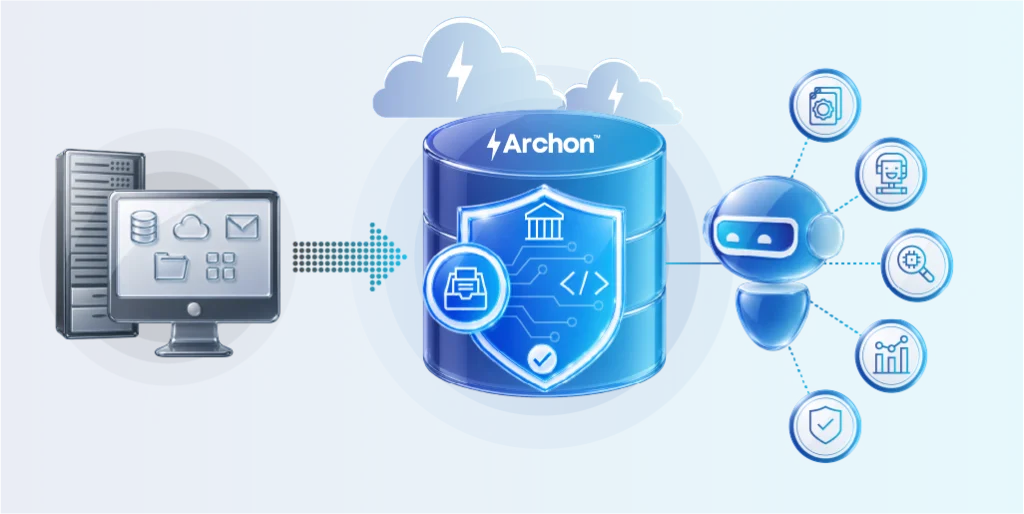
- A governed enterprise knowledge layer transforms historical and archived data into a secure, AI-ready foundation for enterprise search and RAG.
- Effective AI data governance combines data quality, retrieval governance, lifecycle management, and compliance to reduce risk and improve AI accuracy.
- Archon helps organizations build this trusted knowledge layer by archiving legacy data, preserving business context, and enabling secure, compliant AI retrieval.
A finance director asks the company copilot about a vendor contract. The copilot answers confidently, cites a clause, and gets the renewal terms wrong. Nobody notices until the vendor calls asking why the company is invoking a clause that expired two renewal cycles ago.
Stories like this are becoming common across enterprises that rushed to deploy copilots and RAG systems on top of data nobody had actually governed. The model itself usually works fine. What it was handed to work with did not.
Enterprises are pouring budget into LLMs, copilots, and retrieval-augmented generation, expecting these systems to understand the business the way a senior employee would. But a model can only be as sharp as the knowledge it’s allowed to see.
If that knowledge is scattered across forgotten databases, missing context, or buried in systems nobody has opened in a while, the AI will confidently produce answers that sound right and aren’t.
AI data governance is the discipline that closes this gap. It’s about preparing enterprise knowledge so AI can consume it securely, accurately, and without quietly inventing the parts that are missing. This blog walks through what that actually looks like in practice, where most governance programs quietly fall apart, and how archiving fits into fixing it.
What Is AI Data Governance?
AI data governance is the practice of ensuring data used throughout the AI lifecycle, whether for training, fine-tuning, retrieval, or inference, is trustworthy, contextual, secure, and governed by consistent policies. It establishes the controls needed to ensure AI systems use enterprise data accurately, responsibly, and in compliance with business and regulatory requirements.
Unlike traditional data governance, which was primarily designed to help people find and use data, AI data governance ensures that machines can retrieve, interpret, and generate outputs from enterprise data without compromising accuracy, security, or compliance.
AI Governance vs Data Governance vs AI Data Governance
These three terms often get used interchangeably, which causes most of the confusion in this space.
Data governance manages the lifecycle of enterprise data itself: quality standards, ownership, access rules, metadata, and retention policies.
AI governance manages how AI systems are developed, deployed, monitored, and controlled. It focuses on areas such as fairness, bias mitigation, explainability, model risk, and compliance with frameworks like the EU AI Act.
AI data governance connects the two. It ensures that data used throughout the AI lifecycle remains trustworthy, contextual, secure, and governed according to established enterprise policies, so AI systems can retrieve and use it responsibly.
Skip this middle layer and you end up with either a perfectly governed dataset that an AI still can’t use safely, or a well-governed AI model that’s quietly being fed ungoverned data.
Why Traditional Data Governance Isn’t Enough for AI
Traditional data governance was built for a world where people queried databases, read reports, and applied business judgment before acting on information. It asks who owns a dataset, who can access it, whether it’s accurate, and how long it should be retained. Those questions still matter. They’re simply no longer sufficient on their own.
Generative AI introduces a different challenge. Enterprise AI systems don’t just store or display information; they retrieve it, interpret it, combine it with other knowledge, and generate new outputs. That means governance must extend beyond protecting data to ensuring AI can use it safely, accurately, and in context.
Why LLMs Demand a Different Approach
A human analyst reading an old contract can often recognize, based on business context, that a superseded clause shouldn’t be treated as current policy. An LLM has no such instinct. Every retrieved chunk of text appears equally authoritative unless something explicitly tells the model otherwise.
That means the judgment a human once applied has to be encoded into the data itself through metadata, lineage, recency, authority, and business context. Governance now performs work that previously happened silently inside someone’s head.
Human-Centric vs Machine-Centric Governance
Human-centric governance assumes a person reviews information before acting on it. Machine-centric governance assumes AI is generating responses at a scale no human team could realistically review one by one.
That shift fundamentally changes how governance operates. Controls need to become more automated, retrieval-aware, and continuously enforced. A policy that worked perfectly well when twenty analysts manually generated reports can quickly break down when an AI assistant is answering hundreds or thousands of enterprise queries every day.
| Dimension | Traditional Governance | AI-Ready Governance |
|---|---|---|
| Built for | Human queries and static reports | Machine retrieval and generated responses |
| Primary focus | Storage, ownership, access control | Context, lineage, and retrieval accuracy |
| Compliance checks | Periodic audits | Checked at the point of retrieval, every time |
| Audit trail | Who accessed what, and when | What the AI retrieved, why it had access, which model/version generated the response, and what it produced |
| Policy structure | Largely static, reviewed annually | Adaptive, updated as models and use cases change |
| Risk surface | Limited to who can see the data | Extends to what the AI infers, summarizes, or generates from it |
Traditional governance protects enterprise data from misuse. AI data governance ensures AI can understand, retrieve, and use that data accurately, securely, and in context.
The Hidden Data Supply Chain Behind Every Enterprise LLM
Before a model produces a single answer, a long chain of invisible steps has already taken place. Most teams never see this chain because the interface hides it.
Enterprise knowledge typically sits scattered across legacy applications, old databases, content management systems, email archives, shared drives, and compliance archives that haven’t been touched in a long while.
A retrieval pipeline, usually RAG, pulls whatever it considers relevant when someone asks a question. The model then generates a response based entirely on what it retrieved, whether that information was current, complete, or already obsolete.
Here’s the detail most teams underestimate: historical enterprise data is frequently the most valuable input an AI system can get, not the least. An old contract, a closed support ticket thread, a retired engineering spec.
These aren’t dead weight sitting in storage. They’re institutional memory a generic model was never trained on, and they’re often exactly what separates a useful enterprise AI from one that sounds plausible but knows nothing specific about the business.
The problem is that this historical data is usually the worst-governed part of the entire stack. It sits in cold storage, disconnected from active systems, with metadata that may no longer reflect how the business actually uses it.
The Enterprise Knowledge Layer
You can think of this governed foundation as an Enterprise Knowledge Layer: the connective layer between governed enterprise data and the AI systems retrieving it. It isn’t a single product.
Rather, it’s a discipline of structuring, enriching, securing, and governing enterprise knowledge so it can be retrieved reliably, regardless of where it resides or which AI model is using it.

Without this layer, AI is only as reliable as the messiest system it happens to be connected to. With it, AI retrieves information from a governed, contextualized, and trustworthy foundation of enterprise knowledge rather than isolated systems and disconnected records.
The Five Pillars of AI Data Governance
Most governance guidance turns into an exhausting checklist of forty best practices nobody remembers past the first read. It’s more useful to organize the work around five pillars that actually hold the structure up.
Pillar 1: Data Quality and Context
Bad data produces bad answers at a much larger scale than before, because an AI model can generate hundreds of responses from one bad source before anyone notices the pattern. This pillar covers:
- Data integrity – whether the information is complete and internally consistent
- Business relationships – how datasets connect to each other across systems
- Data drift – changes in data values, distributions, or business context over time that can reduce AI reliability.
A pricing table that was accurate when archived can quietly become wrong currency, wrong terms, wrong assumptions, while still sitting there looking perfectly valid to a retrieval system.
Pillar 2: Metadata, Lineage, and Explainability
If an AI generates an answer, the organization needs to be able to trace exactly where that answer came from. This pillar covers:
- Provenance – where the data originated
- Traceability – everything that’s happened to it since
- Semantic metadata – whether the system understands what the data actually means, not just where it physically sits
Most enterprises have plenty of metadata describing file location and file type. Very few have metadata describing business meaning, and that gap is exactly where AI retrieval goes wrong.
Pillar 3: Security, Privacy, and Access Control
Role-based access control and sensitive data protection aren’t new concepts. What’s new is applying them at the point of retrieval, not just at the point of storage.
An AI model answering a query on behalf of a specific employee shouldn’t be able to surface anything that employee couldn’t already see through normal access.
This sounds obvious until you look at how most RAG implementations are actually configured, where the retrieval layer often has broader access than any single human user ever would.
Pillar 4: Lifecycle, Retention, and Compliance
Retention schedules and legal holds don’t pause just because an AI system is involved. If a record is deleted or disposed of under a retention policy, organizations must ensure that any downstream indexes, embeddings, or vector stores are updated accordingly.
Otherwise, the AI may continue retrieving information that should no longer be available. This is a gap almost nobody is checking for right now, and it’s the kind of thing that surfaces during a legal discovery request rather than during a routine audit.
Pillar 5: Retrieval Governance
This is the pillar most governance conversations skip entirely, and it’s arguably the one that matters most.
Retrieval governance governs the policies that determine what an AI system is allowed to retrieve, expose, and cite, while ensuring every response remains explainable and auditable.
It’s the difference between “the AI said this” and being able to show precisely what the AI retrieved, why it had access to that material, and how that material led to the specific answer it gave.
An organization can have strong data quality and rich metadata and still end up with a system that retrieves the wrong document for the wrong person at the wrong moment, simply because nobody built a governance layer around retrieval itself.
How to Build an AI Data Governance Framework That Actually Operationalizes
Understanding the five pillars is the easy part. Most programs stall when it’s time to turn pillars into something a team can actually run day to day. A working framework needs four things in place at once:
- Governance across the full AI lifecycle – applied from ingestion, through whatever training or retrieval use the data sees, all the way to eventual retirement or deletion. A framework that only governs data on the way in and ignores what happens once a model starts using it isn’t really a framework. It’s a one-time cleanup project wearing a governance label.
- Clear data stewardship – owned by a specific person, not a quarterly steering committee that reviews a slide deck and moves on. The enterprises that get this right usually tie stewardship to business units rather than centralizing it entirely within IT, because the people who understand what a dataset means for the business are rarely the same people maintaining the infrastructure it sits on.
- Policy enforcement built into the systems themselves – a retention policy or access rule that exists only in a governance document gets followed inconsistently at best. Built into the data architecture, the same rule gets enforced automatically every time.
- Continuous monitoring, not periodic review – AI systems and the data feeding them change constantly: new sources get connected, old systems get decommissioned, usage patterns shift. Treating governance as a project with a finish line guarantees it falls out of date almost immediately after launch.
Where Recognized Frameworks Fit In
A handful of established frameworks give structure to this work instead of forcing every enterprise to design a governance program from scratch.
The NIST AI Risk Management Framework (AI RMF) works as a flexible playbook for managing AI risk, built around identifying, measuring, and managing risk rather than mandating specific documentation. It’s voluntary, which makes it a reasonable starting point for enterprises that want a structured approach without committing to a certification process.
ISO/IEC 42001 is the first international standard for an AI management system, following the same structured pattern as ISO 27001: leadership commitment, risk assessment, defined controls, internal audits, and continual improvement. It applies to organizations developing, providing, or using AI-based products or services.
For enterprises that already run an ISO 27001 program, this tends to be a far more natural extension than building something unrelated from scratch. Organizations can also choose to pursue certification to demonstrate that their AI management system aligns with the standard.
The EU AI Act sits in a different category entirely. Unlike NIST AI RMF and ISO/IEC 42001, it is a legally binding regulation that introduces risk-based obligations for AI systems placed on or used within the European Union.
Because implementation timelines and regulatory guidance continue to evolve, organizations should verify the latest requirements when planning their compliance programs.
These frameworks aren’t mutually exclusive. Many organizations use them together, combining NIST AI RMF for AI risk management, ISO/IEC 42001 for operational governance, and the EU AI Act to meet applicable regulatory obligations.
Why Most Enterprise AI Data Governance Initiatives Quietly Fail
The failures rarely come from one big mistake. They come from a handful of steps that felt optional in the moment and turned out not to be:
- AI gets built before the data is ready. Teams deploy a chatbot or copilot, and only mid-rollout does it become clear that the data behind it has no consistent structure across the systems it’s pulling from.
- Enterprise knowledge stays fragmented. Systems that were never designed to talk to each other keep operating in isolation, and nobody owns the job of connecting them.
- Metadata and lineage go missing. Nobody in the organization can explain where a given piece of data actually came from or whether it still reflects current reality.
- Legacy systems never get retired. They stay online purely so someone can occasionally pull a record out of them, quietly draining budget and adding security exposure the longer they keep running.
- Backups get mistaken for AI-ready data. A backup exists to restore a system after failure. It was never designed to be searched, queried, or interpreted by a model in the first place, which makes this a particularly expensive misunderstanding.
- Retrieval has no governance applied to it at all. The model can pull whatever it finds relevant, with no check on whether it actually should have access to that material for that particular query.
If enterprise knowledge isn’t governed, the AI sitting on top of it can’t really be trusted either, no matter how capable the underlying model is.
Before solving these challenges, organizations should understand where they stand. Assessing the maturity of their data governance, archiving, retrieval, and compliance capabilities helps identify the gaps that need to be addressed before scaling enterprise AI.

Once those gaps are clear, the next step is building a trusted enterprise knowledge foundation that AI can rely on.
How Archon Builds the Trusted Knowledge Layer for Enterprise AI
Historically, enterprise archives existed primarily to satisfy retention policies, reduce infrastructure costs, and enable legacy application retirement. Generative AI changes that equation.
The same archived records that once served only compliance teams are now becoming some of the most valuable sources of enterprise knowledge for enterprise search, RAG, and AI assistants. In other words, archiving is no longer just about preserving data. It’s about preserving business context and preparing enterprise knowledge for future AI use.
Archon Data Store’s Lakehouse architecture reflects a broader shift in enterprise archiving. As organizations prepare data for analytics and AI, archives are no longer expected to serve only compliance requirements.
They also need to preserve governed, searchable enterprise knowledge. The same principles that make archived data defensible to a regulator, including structure, traceability, and controlled access, are the exact principles that make that same data usable by AI systems. This isn’t a coincidence. Defensibility and AI readiness rely on much of the same groundwork.
Consolidation comes first. Archon pulls data out of legacy applications, aging databases, ECMs, and file systems into a single, structured archive instead of leaving it spread across systems that nobody fully maintains anymore.
This is the part of the work that almost never gets mentioned once a project wraps, quietly mapping which systems hold what, what format it’s in, and what actually needs to move. It’s also the part that determines whether everything built on top of it later actually works.
Context travels with the data rather than getting stripped away in transit. Where a record originated, which system it was tied to, and how it relates to other records in the business all stay attached when data moves into the archive.
This is precisely the enriched business metadata and lineage that Pillar Two depends on, and it’s usually the first thing lost in a rushed migration.
Retention obligations stay enforced automatically. Compliance doesn’t pause because an AI system wants to retrieve something. Retention schedules and legal holds remain enforced at the data layer regardless of which application or model is requesting access.
Access to archived information remains auditable, providing stronger evidence of governance during internal audits, regulatory reviews, and compliance investigations.
Access stays governed at the point of retrieval, not just at login. Role-based access control applies to every retrieval event, so if a model is retrieving information on behalf of a specific user, it only surfaces what that user is already permitted to see under existing policy.
This closes exactly the gap described in Pillar 3, where retrieval layers often quietly have broader access than any individual user would.
The result is a trusted, governed knowledge foundation that supports enterprise search today while providing a reliable foundation for retrieval-augmented generation (RAG) and future AI initiatives, without requiring a separate, expensive data preparation project.
| Enterprise AI Challenge | What’s Actually Happening | How Archon Addresses It |
|---|---|---|
| Fragmented enterprise knowledge | Data spread across legacy systems with no shared structure | Consolidates everything into a single, centralized archive |
| Missing context and lineage | Records lose business meaning once they’re moved or archived | Preserves metadata and business relationships through migration |
| Compliance risk | Retention and legal hold obligations get harder to track at scale | Enforces retention schedules, legal holds, and full audit trails automatically |
| AI retrieval risk | Retrieval systems often have broader access than any human user | Enables governed, policy-driven access at the point of retrieval |
| Preparing enterprise data for AI | Archived data often lacks the structure and context needed for enterprise search and AI initiatives | Creates a searchable, metadata-rich knowledge foundation that supports enterprise search, analytics, and AI initiatives |
Enterprise archiving has quietly stopped being just a compliance strategy filed away in the back office. It’s becoming the foundation that decides whether enterprise AI works at all.
AI Data Governance Across Regulated Industries
Governance challenges don’t show up the same way in every industry, and the stakes shift considerably depending on what’s actually being governed.
In healthcare, patient data carries some of the strictest privacy obligations of any sector, and clinical records frequently need to be retained for decades rather than years. An AI system retrieving patient history needs governance that can prove, every single time, that access was appropriate for that specific query and that the data retrieved was authorized, traceable to its source, and appropriate for the intended use.
In financial services, regulatory retention requirements, full auditability, and the ability to reconstruct a trade or transaction long after the fact aren’t optional extras, they’re the baseline. An AI model summarizing trading activity has to be working from data whose lineage can withstand a regulator’s questions, not just a casual internal review.
In manufacturing, engineering records and product lifecycle knowledge often span multiple product generations and several disconnected systems. The governance challenge here is keeping historical design data from quietly drifting out of sync with current specifications before an AI model uses outdated information to answer what looks like a straightforward engineering question.
In government, public records carry transparency obligations and long-term preservation requirements that often outlast typical private-sector retention rules by a wide margin. Governance here has to account for public accountability as a first-class requirement, not an afterthought layered on top of internal risk management.
The common thread across every one of these sectors is that governance has to match the actual stakes involved, not a generic template borrowed from a less regulated industry.
Where AI Data Governance Is Headed Next
A handful of shifts are already underway and worth planning for now rather than reacting to later:
- Archives move from passive storage to active infrastructure. The old model, where an archive exists purely to satisfy a retention rule, is giving way to archives built specifically to be queried by AI systems on a regular basis.
- Vector databases need governance too. Embeddings stores will need the same retention rules, access controls, and audit trails currently applied to source data, rather than sitting as a separate, ungoverned layer outside the main archive.
- AI-generated content needs its own governance. Summaries, reports, and other AI-generated material will need lineage and retention rules just like the source data that fed them, since most organizations right now govern inputs carefully and ignore outputs entirely.
- Retrieval audit trails become compliance evidence. Being able to show what an AI retrieved, why it had access to that information, and how the response can be traced back to its source is moving from a nice-to-have to something regulators, auditors, and internal governance teams are increasingly likely to expect.
- Policy-aware AI agents emerge. Agents that take actions rather than just answer questions will need to check governance policy before acting, not after, which matters considerably more once an agent can actually do something on the business’s behalf.
- Enterprise knowledge becomes a strategic asset. Organizations treating their archive as something worth investing in, rather than something to minimize spend on, are the ones whose AI initiatives will actually deliver something real.
AI governance doesn’t begin with the model. It begins with the enterprise knowledge that model depends on every time it generates a response. Organizations building a trusted, governed knowledge layer now are the ones that will be able to deploy AI that’s accurate, explainable, and genuinely compliant. Everyone else will end up governing the same data anyway, just later, under far more pressure, and probably during an audit rather than on their own schedule.
If your enterprise knowledge isn’t AI-ready yet, that’s not a reason to wait. It’s the reason to start now.
See how Archon helps build an AI-ready knowledge layer →


