


TL; DR
Metadata is foundational for data archiving, enabling fast retrieval, regulatory compliance, and security across enterprise systems.
The core metadata types are descriptive, structural, administrative, and more; serve distinct functions in archiving workflows.
Metadata-driven archiving reduces audit response time from weeks to hours while lowering storage costs by 60–80%. AI-enriched metadata management automates classification, compliance tracking, and threat detection at enterprise scale.
Archon Data Store™ consolidates metadata-driven archiving for both structured data (databases, ERP) and unstructured content (emails, documents).
Every organization talks about data, but very few talk about ‘data of data.’ Modern enterprises store terabytes of information, but when it comes to retrieving, validating, or auditing that information, critical context is often missing. It is this hidden layer that quietly powers every enterprise decision, compliance audit, and AI initiative.
That missing context lives in one crucial layer: metadata.
It gives meaning, lineage, and traceability to every piece of business information. Let’s unpack what metadata is, and how it shapes governance and archiving in the modern enterprise ecosystem.
What is Metadata?
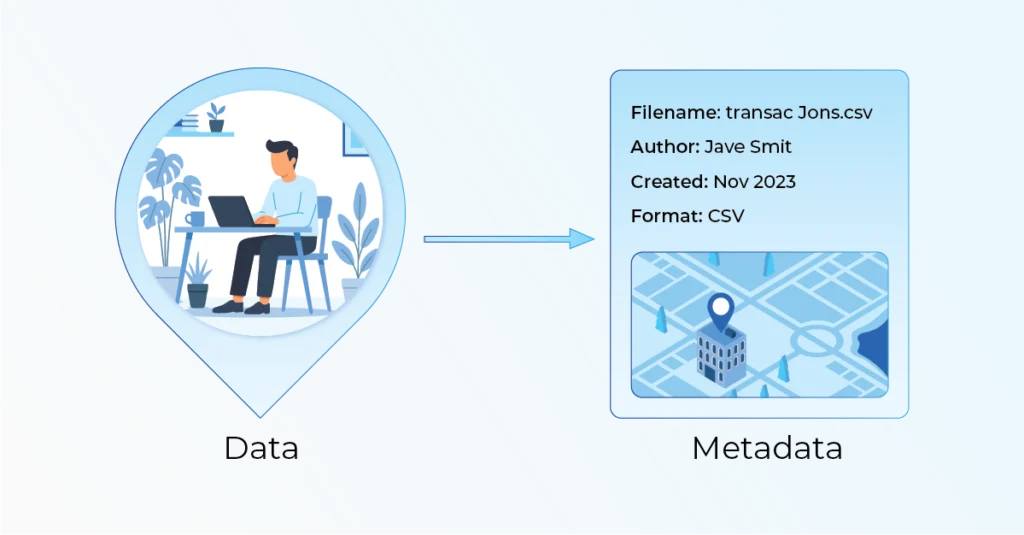
Metadata is “data about data;” structured information that describes, explains, and provides context about your actual data.
Metadata provides answers to critical questions about your data:
- How was it collected?
- When was it created, and when was it last modified?
- Who owns it and who can access it?
- What assumptions or transformations were applied?
- How does it relate to other datasets?
- What are the definitions of individual variables?
- What retention policies apply?
In simple terms, metadata acts as a digital label that transforms raw information into organized, searchable, and compliant records. Without metadata, archived data becomes virtually useless; impossible to find, verify, or comply with regulatory requirements.
In enterprise data management, metadata is the backbone of data governance, archiving, and compliance strategies. Organizations that lack proper metadata management spend as much as 40% more on data management than those with metadata-driven approaches.

Without metadata, data becomes incomprehensible. For instance, a spreadsheet containing numbers means nothing unless metadata tells you whether those numbers represent sales revenue, customer IDs, or transaction dates.
Types of Metadata in Enterprise Data Management
Organizations use six distinct types of metadata, each serving critical functions in the archiving lifecycle.
1. Descriptive Metadata – Making Data Discoverable
| Metadata Type | Descriptive Metadata. Making Data Discoverable |
|---|---|
| Description | Helps users find and identify data without accessing the content. Includes titles, authors, keywords, and summaries. |
| How It Helps in Enterprise Archiving | Speeds up search and retrieval of archived records by tagging key identifiers, enabling compliance teams to locate files, emails, or records instantly. |
| Examples |
|
2. Structural Metadata – Defining Data Organization
| Metadata Type | Structural Metadata. Defining Data Organization |
|---|---|
| Description | Describes how data elements are structured and related, defining the architecture that connects datasets and records. |
| How It Helps in Enterprise Archiving | Maintains data relationships and hierarchy during archiving, ensuring systems can accurately reconstruct and retrieve linked records or conversations. |
| Examples |
|
3. Administrative Metadata – Enforcing Governance and Compliance
| Metadata Type | Administrative Metadata. Enforcing Governance and Compliance |
|---|---|
| Description | Governs access, retention, and lifecycle management of archived data, including ownership, permissions, and security details. |
| How It Helps in Enterprise Archiving | Ensures regulatory compliance by controlling who can access, modify, or delete records and by enforcing retention schedules, legal holds, and security classifications. |
| Examples |
|

4. Technical Metadata – Supporting Data Format and Storage
| Metadata Type | Technical Metadata. Supporting Data Format and Storage |
|---|---|
| Description | Defines the format, encoding, and storage properties of data to ensure it is accurately processed and accessed across systems. |
| How It Helps in Enterprise Archiving | Preserves file integrity and compatibility during long-term storage and migration, ensuring archived data remains usable and accessible across platforms. |
| Examples |
|
5. Operational Metadata – Tracking Data Flow and Dependencies
| Metadata Type | Operational Metadata. Tracking Data Flow and Dependencies |
|---|---|
| Description | Captures how data moves through systems, including dependencies, transformations, and processing details. |
| How It Helps in Enterprise Archiving | Provides visibility into data lineage and process history, helping teams validate archived data accuracy, troubleshoot issues, and maintain continuity during migrations. |
| Examples |
|
6. Preservation Metadata – Ensuring Long-Term Usability
| Metadata Type | Preservation Metadata. Ensuring Long-Term Usability |
|---|---|
| Description | Ensures archived data remains accessible and usable over time by tracking backups, migrations, and preservation actions. |
| How It Helps in Enterprise Archiving | Maintains data authenticity and readability for decades by recording format changes, storage media, and backup history, preventing data loss or obsolescence. |
| Examples |
|
Metadata: Data Governance Operating Engine for Data Lifecycle
Data governance is the framework that defines how organizations manage data throughout its lifecycle. Metadata is the operational engine of data governance, enabling policies to be consistently enforced across enterprise systems.
Learn how Archon Data Store automates compliance and cuts archiving costs by 60–80%.
How Metadata Powers Governance at Every Stage of Data Lifecycle
Step 1: Data Creation – Establishes traceability, so you always know who created the data, when, and under what schema
Whenever new data is captured or uploaded, metadata defines its origin, authorship, structure, and upload context
Step 2: Data Storage & Organization – Creates a searchable framework that categorizes and connects data for governance.
As data enters enterprise systems, metadata organizes it with searchable labels, manages relationships, maps dependencies, and applies version control to form the foundation for all governance actions.
Step 3: Data Access & Retrieval – Transforms storage into dynamic intelligence for faster discovery and audits.
Metadata allows users and compliance teams to instantly query attributes like author, date, or retention tag, enabling rapid eDiscovery and accurate audit responses.
Step 4: Data Archiving & Preservation – Maintains authenticity and accessibility for long-term compliance.
As data moves to archival storage, preservation metadata retains its format, access rights, and retention history to ensure usability and regulatory defensibility even decades later.
Step 5: Policy Enforcement – Automates retention, deletion, and compliance monitoring across the data lifecycle.
Metadata simplifies governance by tracking lineage, surfacing risks, and enforcing security and retention policies consistently across enterprise systems.
How Metadata Improves Data Archiving & Retention Strategy?
Metadata transforms archiving from passive storage into active, intelligent information management. Here’s how metadata performs critical functions in the archiving lifecycle:
1. Improving Data Retrieval and Access
Metadata dramatically accelerates the time needed to find archived data. By tagging content with descriptive, structural, and administrative metadata, users can retrieve specific documents, records, or transactions through simple keyword searches or complex queries without manually sifting through millions of files.

Metadata enables searches using business logic like “all customer records tied to legal holds” or “all patient data matching HIPAA retention requirements” rather than relying on file names or directory paths that quickly become stale and unreliable.
2. Supporting Compliance and Regulatory Adherence
Metadata is the primary mechanism for proving compliance with regulatory mandates. Regulators and auditors require evidence that:
- Data was retained for the mandated period
- Access was controlled and tracked
- Records were not altered or deleted prematurely
- Sensitive information was properly protected
Metadata provides this evidence by maintaining:
- Lineage Trails: Documenting creation, modification, access, and deletion dates shows compliance with retention laws
- Access Logs: Recording who accessed archived data, when, and from which system creates an audit trail that demonstrates proper governance and detects unauthorized access
- Change Records: Tracking modifications to archived data (or preventing them via WORM storage) proves records haven’t been tampered with, which is required by the SEC and FINRA
Effective Role of Metadata in Compliance Regulations
| Regulation | Industry | Requirement | Metadata Impact |
|---|---|---|---|
| GDPR | All (EU focus) | 5-7 year retention for personal data | Metadata tracks data subject, consent dates, access |
| HIPAA | Healthcare | 6-10 year retention for patient records | Metadata logs access to PHI and modification history |
| SOX | Finance | 7 year retention for audit records | Metadata ensures immutability and audit trail |
| SEC 17a-4 | Financial Services | Indefinite retention in WORM format | Metadata enforces write-once-read-many compliance |
| FINRA | Financial Services | 6 year retention for communications | Metadata captures email headers, timestamps, participants |
| FOIA | Government | Indefinite retention for public records | Metadata enables rapid retrieval for public requests |
3. Enhancing Data Security Through Metadata Management
Metadata is a critical layer of defense against data breaches, insider threats, and ransomware. By recording access controls and monitoring unusual patterns, metadata helps organizations detect and prevent unauthorized data manipulation.
Security Functions of Metadata:
- Access Control Enforcement: Metadata records permissions, encryption status, and classification levels. Organizations can restrict sensitive data (PII, IP, trade secrets) to authorized roles only.
- Threat Detection: If metadata shows an unusual pattern (e.g., a file accessed 20 times in 30 seconds), security teams can investigate potential data exfiltration.
- Data Integrity Verification: WORM (Write Once, Read Many) storage, managed through metadata, prevents data from being altered or deleted, protecting against ransomware that targets backups.
- Forensic Reconstruction: In the event of a breach, metadata allows organizations to trace exactly which files were accessed, by whom, and when; this enables rapid incident response.
Example: A healthcare organization detects that an administrative assistant accessed 500 patient records in one hour, which is far exceeding normal behavior. Metadata will reveal the employee who was exfiltrating data, and it enables early detection that prevents a massive HIPAA breach and regulatory fines.
Is your Metadata enough to make your data ‘Self-standing’? Learn strategies for making metadata your data’s most critical enabler in audits, analytics, and compliance.
Metadata-Driven Data Archiving Strategy for Enterprises
Building a metadata-driven archiving strategy requires aligning technology, governance, and operations. Here’s how to approach it:
Step 1: Define Your Metadata Schema and Standards
Before implementing any archiving platform, organizations must define:
- What metadata fields are mandatory (e.g., retention date, legal hold status, data classification)
- What metadata is optional (e.g., project code, cost center, business context)
- Naming conventions and controlled vocabularies to ensure consistency
- Integration with regulatory requirements (GDPR, HIPAA, SOX, FINRA)
💡Best Practice: Adopt established metadata standards like Dublin Core or ISO 19115 as your baseline, then customize for your industry and regulatory environment.
- Dublin Core: A simple and widely adopted international metadata standard with 15 core elements designed to describe a broad range of digital and physical resources for improved discovery and interoperability.
- ISO 19115: An international standard specifying how to describe geographic information and services with structured metadata for consistent cataloging, sharing, and management of geospatial data.
Step 2: Automate Metadata Capture and Classification
Manual metadata tagging is error-prone and doesn’t scale. Organizations should:
- Auto-extract system metadata (creation date, author, file type) at the point of archiving
- Leverage AI to classify data by sensitivity level (public, internal, confidential, restricted)
- Apply retention rules automatically based on data type and regulatory mandate
- Tag PII and regulated data to enforce encryption and access controls
Automation reduces manual effort by 70% and ensures consistent governance across all archived data.
Step 3: Implement Metadata-Based Search and Discovery
Once metadata is captured, organizations need tools to access it:
- Full-text indexing of descriptive and structural metadata for keyword search
- Faceted search (filter by date, author, department, classification, retention date)
- Natural language query capability for non-technical users (“Show me all contracts expiring in 2025”)
- Role-based access control to ensure users see only data they’re authorized to access
Step 4: Monitor, Audit, and Evolve
Metadata strategies must adapt as data volumes grow, regulations evolve, and business needs change:
- Regular audits of metadata quality and completeness
- Version control for retention policies and metadata schema changes
- Alerts for compliance violations (e.g., data retained past expiration date)
- Analytics on data usage to optimize storage tier placement (active vs. cold)
Transform your data into a compliance asset with Archon.
Building a Metadata-Driven Archiving Strategy: Implementation Roadmap
| Phase | Timeline | Activities | Metadata Role |
|---|---|---|---|
| Assessment | Weeks 1 to 4 | Inventory data sources, map regulatory requirements, catalog current metadata gaps | Define what needs to be archived and why |
| Design | Weeks 5 to 8 | Select archiving platform, define metadata schema, plan integration points | Establish metadata capture, classification, and retrieval methods |
| Implementation | Weeks 9 to 16 | Deploy platform, migrate legacy data, configure policies, train teams | Extract and validate metadata from legacy systems |
| Optimization | Weeks 17+ | Monitor performance, audit metadata quality, optimize storage tiers, iterate | Continuously improve classification accuracy and governance |
How Archon Data Store Leverages Metadata for Intelligent Archiving
Archon Data Store is built around metadata-driven archiving, combining the strengths of Enterprise Information Archiving (EIA) and Enterprise Data Archiving (EDA) into a single platform.
Application-Aware Metadata Extraction
Unlike generic archiving solutions, Archon understands the structure of enterprise applications:
- SAP/ERP: Extracts metadata, including GL account, cost center, document number, and approval workflow
- Salesforce: Captures account name, opportunity stage, close date, and customer relationship hierarchy
- Oracle/SQL Databases: Preserves table relationships, transaction IDs, audit logs, and schema dependencies
- Unstructured (Emails, Documents): Indexes sender, recipient, subject, attachment metadata, and embedded classifications
This application-aware approach ensures metadata relationships are preserved during archiving, which are critical for eDiscovery, audit, and analytics.
Compliance-First Metadata Governance
ADS automatically tags archived data with regulatory metadata:
- Retention period based on data type and jurisdiction (e.g., GDPR 5 years, HIPAA 10 years, SOX 7 years)
- Legal hold status for litigation-related records
- Sensitivity classification (public, internal, confidential, restricted/PII)
- Immutable audit logs showing who archived, accessed, or deleted records
Tiered Storage with Metadata Optimization
Archon Data Store™’s metadata engine automatically places data in the right storage tier:
- Hot Archive (Active Tier): Frequently accessed data, optimized for fast retrieval
- Warm Archive: Less-frequently accessed data, balanced cost/performance
- Cold Archive: Rarely accessed data (10+ years old), maximum cost savings
Metadata-driven policies trigger automatic movement between tiers, ensuring compliance without manual intervention.
AI-Enriched Metadata Management
Archon™’s next-generation capabilities include:
- Intelligent Classification: AI detects sensitive data (PII, financial records, health information) and auto-tags for governance
- Metadata Enrichment: Adds business context to unstructured content, making archives more searchable and valuable
- Predictive Compliance: Anticipates retention policy expirations and regulatory changes, triggering proactive actions
See Archon™ in Action
Learn how metadata-driven archiving streamlines GDPR, HIPAA, and SOX compliance in minutes.
The Future of AI-Driven Metadata Management
Metadata is no longer just a descriptive layer; it’s the engine powering the next wave of data innovation. It transforms static archives into dynamic, intelligent systems that enable AI-driven insights, governance automation, and rapid compliance responses.
With increasing volumes of enterprise data and evolving regulations, metadata becomes an indispensable fuel for intelligent search, analytics, and regulatory automation.
Organizations that treat metadata as a core asset and not an afterthought will lead the next phase of data intelligence and archiving innovation.
Enabling AI and Predictive Insights: AI models increasingly rely on rich metadata for understanding context, relationships, and data lineage. The emerging discipline of AI metadata management involves using machine learning to automatically classify, enrich, and establish relationships within metadata.
For example, advanced metadata management platforms can auto-tag sensitive data, assess risk levels, and forecast retention needs without manual intervention.
Looking ahead, metadata-enabled systems like Archon™ are poised to evolve into gateways connecting traditional archives with AI-based discovery engines.
Archon Data Store™ consolidates metadata-driven archiving for both structured and unstructured data, enabling organizations to move beyond siloed, fragmented approaches.
By treating metadata as a strategic asset rather than a compliance checkbox, enterprises can transform their relationship with data and make it discoverable, secure, compliant, and valuable.
Ready to move beyond siloed archives and costly legacy systems? Talk to our team about how Archon Data Store can help you unify enterprise data archiving in one compliance-first, cost-optimized platform.
Frequently Asked Questions
Metadata is information that describes other data, such as the author, creation date, or file format of a document.
Example: For a photo, metadata might include the photographer’s name, date taken, and camera settings.
The three main types are:
- Descriptive metadata – identifies and finds data.
- Structural metadata – organizes data relationships.
- Administrative metadata – supports management, including permissions and retention.


