


TL;DR
Organizations that store data in data lakes are overwhelmed with unclassified and redundant information, leading to increased costs, compliance challenges, and complexity. Despite providing scalability and flexibility, data lakes can become unmanageable without proper governance and lifecycle management.
Sooner uncontrolled data becomes a storage burden. Migrating this data from the data lake to a secure, intelligent archival system allows organizations to categorize, retain, and manage information efficiently.
With Archon Data Store, organizations can streamline storage, automate retention, and maintain compliance through built-in governance and policy enforcement. It transforms cluttered data lakes into compliant, insight-ready ecosystems where data is treated as an asset.
Enterprises that started with terabytes of operational data a few years ago, now manage petabytes of data spread across clouds and formats.
Organizations stored everything in rigid data warehouses that were structured yet lacked speed. So, it made data users wait for reports and queries to run and fetch past data for future decisions. Furthermore, data grew along with business and storage systems started to explode. Businesses also realized they weren’t just running out of space; they were running out of insight.
To adapt, the industry evolved from data warehouses to data lakes – a paradigm shift that promised agility over rigidity. Data lakes didn’t demand that every dataset fit neatly into a predefined schema. They welcomed raw, unstructured, and semi-structured data alike.
Over time, these data lakes became the enterprise backbone for analytics and AI.
The data lake market is expected to reach around USD 59.89 billion by 2030.
But here’s the catch: a data lake without governance or lifecycle management can quickly become a data dump, cluttered, costly, and nearly impossible to navigate.
Historical reports meddle with new transactions. Redundant files multiply. Temporary files turn permanent residents. This leads to data bloats. Also, compliance deadlines sneak up.
What started as a strategic asset begins to feel like a storage burden.
Even the smallest disturbance: a corrupted file, a missing tag, or a broken schema, can send ripples through a data lake, disturbing the harmony.
So, what is the fix? Smart and Intelligent data archiving from the Data Lake is a strategic way to streamline the cluttered data. Archiving from a data lake helps organizations retain only what matters, preserve compliance-ready records, and free up valuable storage
Let’s explore why data governance, compliance, and secure archiving is essential for enterprise data.
Understanding the Data Lake Landscape for Effective Archiving Strategy
Data lakes were developed to accommodate all types of data formats and scales using budget-friendly cloud storage solutions like S3, ADLS, or GCS. Computing processes were separated, allowing for optional schema configurations.
Data lake is an ecosystem of layers that manage how data is ingested, stored, processed, governed, and consumed.
Before migrating data from a data lake to an archival platform, it’s crucial to understand its architecture. With this, organizations can skip the risk of breaking lineage and losing context during migration.
1. Ingestion Layer
Responsible for collecting and bringing data from diverse sources — databases, IoT devices, ERP systems, CRM tools, or streaming platforms. Ensures data integrity and applies initial metadata tagging.
2. Storage layer
The core layer of the data lake where raw data is stored in its native format – structured, semi-structured, or unstructured. Here data is often divided into zones: Raw, Processed, and Curated, for lifecycle management.
3. Processing Layer
Handles data transformation, cleansing, and enrichment for analytics. Converts schema-on-read data into optimized formats (e.g., Parquet, ORC) to improve performance.
4. Metadata & Governance Layer
Manages data cataloging, lineage tracking, access control, and compliance. This layer prevents the lake from becoming a “data swamp” by maintaining order and accountability.
5. Consumption Layer
This layer acts as an interface for data users, analysts, data scientists, and applications. The consumption layer provides query access via SQL engines or direct connections to analytics tools.
While data lakes promise flexibility and scalability, they can easily lose their value without the right structure and discipline. What starts as a smart storage strategy can soon turn into a data swamp if left unmanaged.
Effective data archiving keeps data lakes lean, compliant, and insight-ready by preserving only what matters and retiring the rest securely.

Why Enterprises Should Migrate Their Data from a Data Lake to an Archival Platform
As enterprises generate data at striking speed, their data lakes quickly become overloaded, filled with aging, redundant, or inactive information. Storing everything in high-performance systems not only inflates costs but also makes analytics slower and compliance harder to maintain.
Migrating data to a dedicated archival platform helps organizations separate what is actively used from what must be securely retained. It ensures scalability, governance, and long-term accessibility while keeping production environments efficient and cost-optimized.
How Different Industries Benefit from Data Lake Archiving
- In finance and banking, institutions must comply with strict regulations like the SEC, FINRA, SOX, and GDPR, which demand tamper-proof and easily retrievable data. Archiving with governance layers ensuring long-term data integrity and compliance-ready audit access to the data migrated from data lakes.
- In the healthcare sector, hospitals and research institutions generate vast volumes of sensitive medical data, from patient histories to diagnostic imaging. Keeping this on active storage not only strains capacity but also increases exposure risks under HIPAA and regional privacy laws. Archiving sensitive healthcare data migrated from the data lake in a secure, compliant repository with encryption and retention controls helps meet HIPAA and regional privacy laws.
- Manufacturing companies encounter a unique set of challenges due to the overwhelming influx of data from IoT sensors, machinery logs, and production systems. Adopting tiered data archiving for migrated data to separate real-time IoT data from historical logs improves system performance and analytics efficiency.
- For retail and e-commerce, data spikes during promotions or peak seasons put immense pressure on infrastructure. When transactional and customer data are transferred from the data lake, automated archiving policies classify and store low-access or seasonal data in cost-efficient tiers, optimizing performance and spending.
- Legal and public sector organizations are expected to maintain transparent, easily retrievable records for years. Deploying governed archival systems for data migrated from the data lake with audit-ready access controls ensuring transparency, traceability, and long-term data retention.
- Even IT and technology enterprises aren’t immune; their code repositories, log files, and backups accumulate rapidly across multiple environments. Archiving log files, code repositories, and backups from the data lake, structured deduplication, and retention policies streamline storage, reduce costs, and strengthen data security.
Across all these industries, the message is clear: migrating data from data lakes to a dedicated archival platform is mandatory to ensure compliance, optimize costs, and maintain control over ever-growing enterprise data.
From Data Lake Challenges to Archiving Solutions
As data scales, challenges like rising costs, cluttered storage, and compliance risks creep in. But every challenge has a smarter way out.
Here are the possible archival solutions that could overcome your data lake challenges:
| Data Lake Challenges | Archiving Solutions |
|---|---|
| Uncontrolled data growth increases storage costs and slows query performance. | Archiving trims redundant data, so queries run faster on a smaller, cleaner dataset, cutting both storage costs and processing time. |
| Lack of data classification makes it hard to identify specific data when it is required. | Archival platforms use metadata tagging and data discovery tools to classify data by type, age, and usage. |
| Broken data lineage in data lake causes compliance and audit issues. | Archival solutions help maintain lineage tracking and integrate governance tools to preserve data context during archiving. |
| Compliance and retention complexity cannot align with evolving regulations, which increases regulatory risks. | Data migration and archival remove redundant data and apply rule-based governance for archived data with built-in retention and deletion policies aligned to global standards. |
| Data retrieval delays from data lake. | Data archiving uses indexing and rich metadata catalogs to enable query-based retrieval and contextual search across archived dataset. |
| High cloud storage and compute costs. | Archival solutions adopt tiered storage architecture separating hot, warm, and cold data for cost efficiency. |
| Lack of governance policies leads to data duplication, unauthorized access, and regulatory non-compliance. | Archiving data from data lake helps establish strong data governance with access control, audit trails, and policy enforcement to ensure security, consistency, and compliance. |
When Enterprises Finally Turn To Data Lake Archiving
Most archiving initiatives start when an enterprise faces a turning point. An audit request, a cloud bill raise, or a merger and acquisition (M&A) could be a trigger:
- Auditing unorganized data often exposes gaps in data access and retention.
- Rising cloud expenses push teams to archive old or unused datasets.
- During mergers or acquisitions, data consolidation requires an organized archiving solution.
Each initiative reinforces why proactive archiving is essential.
You have two options to manage your data lake:
Manage your data clutter without classification and data structure. Manually apply policies and implement various data lake management tools for different purposes.
(OR)
Migrate your data to a smarter archival platform to automate data management, data retention policy application and conduct regular audit trails, all in one platform.
What’s your take, different tools or a cost-efficient one? Continue reading to discover a smarter choice.
How to Design a Governance Framework for Archiving Data from a Data Lake
The data governance framework defines how data is classified, retained, stored, and audited to ensure performance, compliance, and transparency across the entire lifecycle.
Classifying Data by Criticality and Lifecycle
- Categorize data as active, semi-active, or inactive.
- Prioritize storage and protection based on business impact.
- Simplify lifecycle tracking and automation.
- Ensure proper handling across all stages of the data lifecycle
Applying Retention Policies and Automated Rules
- Set retention timelines aligned with regulations and business needs.
- Automate archival and deletion to minimize manual errors.
- Ensure consistent enforcement across data platforms.
Establishing Auditability and Immutability in Archived Zones
- Maintain detailed logs for every archival action.
- Enforce immutability to prevent unauthorized edits or deletions.
- Ensure archived data is verifiable and legally defensible.
- Build compliance and trust into long-term storage.
How Can Enterprises Effectively Govern Archived Data?
As enterprises scale, managing archived data becomes increasingly complex.
Without proper governance, archived data can quickly lose its integrity, accessibility, and compliance value.
Here’s a simple roadmap to effectively govern archived data.
Establish Clear Data Ownership and Policies
Define who owns what data, who can modify it, and under what conditions. Clear data ownership ensures consistency, minimizes duplication, and lays out the foundation for compliance across global regulations like DPDPA, GDPR, HIPAA, PDPL, DIFC and CCPA.
Implement Role-Based Access Controls
Role-Based Access Control (RBAC) helps ensure that sensitive information remains accessible only to authorized personnel.
Governance facilitates the automation of permissions, usage monitoring, and seamless maintenance of audit trails.
Ensure Metadata & Lineage
Governance begins with metadata – tracking data origin, usage, and context.
- Automate metadata capture at ingestion to record source, type, and ownership.
- Implement lineage tools that trace data flow from origin to usage for full visibility.
- Use centralized catalogs to keep metadata consistent and searchable.
Automate Compliance and Retention
Manual compliance doesn’t work on a scale. Automate audit trails and data retention rules to meet regulations like CCPA, GDPR, and HIPAA. Governance frameworks ensure data isn’t kept longer than required, reducing risk and cost simultaneously.
Maintain Data Quality
Governance is only as strong as your data quality. Use monitoring tools to validate and clean data continuously.
Leverage AI for Intelligent Archiving Governance
Artificial intelligence and machine learning can elevate governance efforts by automatically identifying classified data, detecting sensitive information, and recommending policies based on patterns of usage. Intelligent archiving governance not only ensures compliance but also eliminates manual supervision.
Archon Data Store — The Intelligent Layer for Archiving and Governance
Archon Data Store acts as the archiving and governance solution that positions it’s stand above the data lake. It brings structure, compliance, and long-term efficiency to massive datasets. It ensures that every file, regardless of age or format, remains searchable, compliant, and cost-efficient throughout its lifecycle.
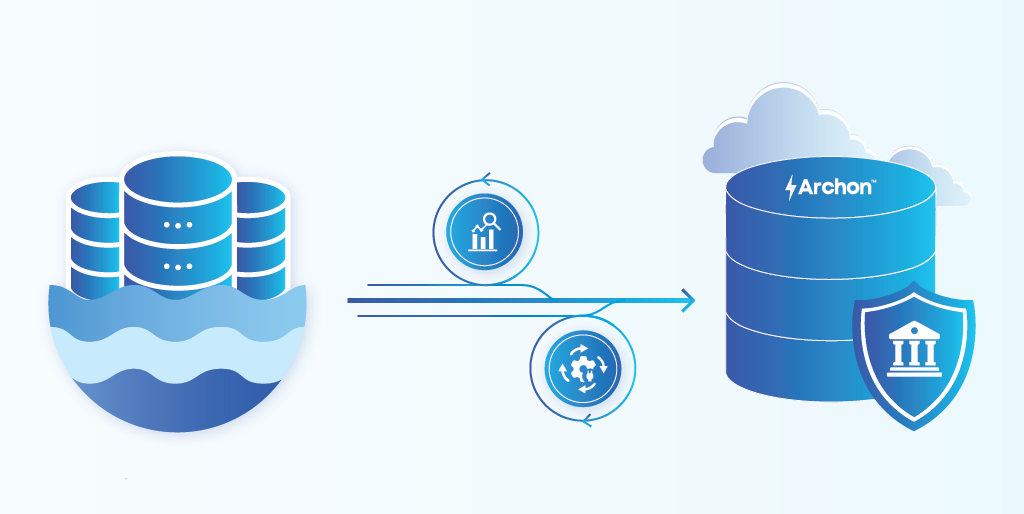
Data from the enterprise data lake is migrated to Archon Data Store, before which Archon Analyzer and Archon ETL ensure seamless transformation, analysis, and governance.
Archon Analyzer performs deep assessment and discovery before migration, scanning data assets, mapping dependencies, flagging compliance-sensitive information, and identifying redundant datasets to optimize effort and cost.
Archon ETL ensures a seamless, accurate migration by extracting, transforming, and validating complex data types, maintaining referential integrity, and guaranteeing schema and logic consistency in the Archon Data Store environment.
Extending Control Beyond the Data Lake
Data lakes store everything; Archon Data Store makes sense of it. It provides governance and retention policies beyond storage, managing classification, compliance, and lifecycle actions across all enterprise data. With a unified governance layer, it bridges the gap between flexibility and regulation.
Smart Decisions on What to Archive, When & How
Effective archiving isn’t about guesswork; it’s about intelligence. Archon, with its AI-enabled data activity patterns, determines what should move to archival storage and when, ensuring decisions are precise and cost-saving.
- Access frequency – AI-driven identification of inactive datasets for archiving based on usage patterns.
- Modification history – Detecting ‘cold data’ and ensuring active vs. inactive data segregation.
- Data lineage tracking – Full traceability of data movement and transformation.
- Storage-to-compute ratio – Cost optimization strategy by intelligently shifting infrequently used data to lower-cost tiers.
- Schema evolution – Handles legacy or outdated data structures without disrupting live systems.
Next-Generation Approach to Data Lake Archiving
Consider Archon data store as a next-gen archiving solution, transforming data archiving into a strategic governance function. By uniting automation, compliance, and intelligence, it prevents data sprawl and builds the foundation for a truly governed data ecosystem, one that is compliant, cost-efficient, and insight-ready.
Let’s not wait until your data lake overflows. Transition smoothly and archive wisely with Archon Data Store. Begin your archiving process today.


