


Key takeaways:
- A data retention policy defines what to keep and for how long. A data retention strategy defines how to enforce it at scale. Enterprises that treat them separately often fail at both.
- Policy ownership is fragmented across legal, compliance, IT, and business teams — and policies go stale as regulations, systems, and data types evolve faster than governance can keep up.
- GDPR fines have surpassed €6 billion. India’s DPDPA carries penalties up to ₹250 crore. CCPA fines now reach ~$8,000 per intentional violation. The cost of getting retention wrong is climbing fast.
- A mature retention strategy delivers measurable enterprise impact: reduced storage spend through tiering, freedom to decommission costly legacy systems, faster audit response, and business value from historical data.
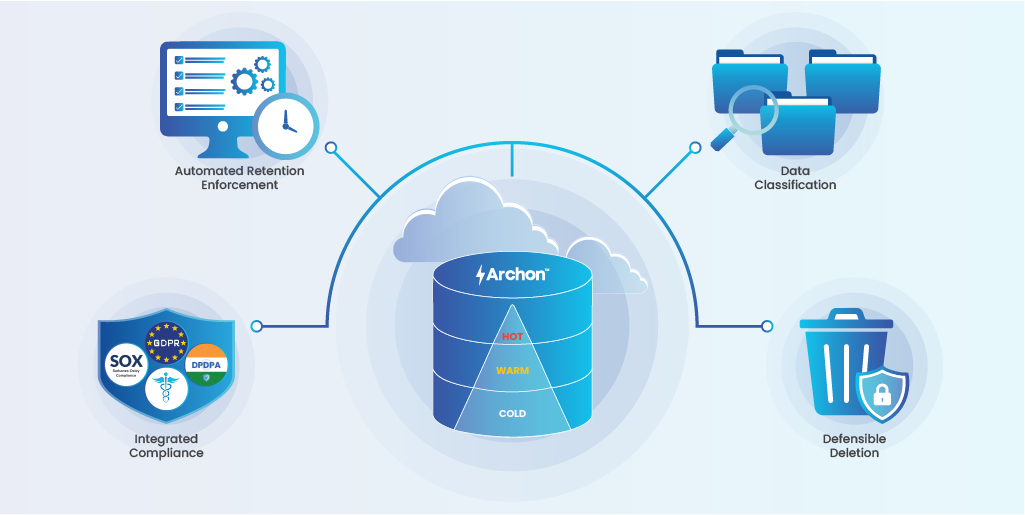
- Archon Data Store bridges the gap — providing a centralized archive, automated retention enforcement, sub-second search, legacy system connectors, and analytics-ready historical data in a single platform.
Global data creation is projected to reach approximately 221 zettabytes in 2026 alone. That is 221 billion terabytes of data produced in a single year. And it is not slowing down.
For enterprises managing customer records, financial transactions, regulatory filings, engineering blueprints, and decades of legacy application data, the question is no longer whether to manage data retention.
The question is whether your organization has the right data retention policy and the data retention strategy to enforce it without bleeding money, inviting regulatory penalties, or drowning under the weight of data it no longer needs.
Yet most enterprises still treat data retention as a documentation exercise. They draft a policy that defines retention periods, hand it to the compliance team, and assume the job is done. The reality is far more complex.
✅ A data retention strategy tells you how to keep it—where, at what cost, and with what technology.One is governance. The other is architecture. You need both, and they must work together.
This guide breaks down both concepts, shows where they intersect, maps the regulatory landscape that drives retention decisions, and outlines the data retention best practices that separate mature enterprise programmes from those still operating on spreadsheets and good intentions.
What is a Data Retention Policy?
A data retention policy is a formal, documented set of rules that define what data your organization collects, how long each category of data must be retained, and what happens to it when the retention period expires. It is fundamentally a governance and compliance instrument; the legal backbone of how an enterprise manages its data lifecycle.
A well-constructed data retention policy answers five core questions:
- What data do we collect? Structured records, unstructured files, emails, application logs, content management assets, and more.
- How is it classified? By sensitivity level, data type, business function, and applicable regulation.
- How long do we keep each category? Defined by regulation, contractual obligation, or business needs.
- Who can access? Role-based permissions, department-level controls, and audit requirements.
- What is the disposition process? Defensible deletion, legal review, approval workflows, and audit trails.

Without a data retention policy, enterprises operate in one of two risky modes:
- Over-retention – where they keep everything indefinitely and inflate storage costs, compliance exposure, and breach surface area
- Under-retention – where they delete records prematurely and face regulatory penalties or legal discovery failures
Why Most Enterprises Struggle to Enforce Their Retention Policy
Most enterprises stop at the policy level. They define retention periods, classify data categories, and perhaps create a retention schedule. But the policy sits in a shared drive while the actual data spreads across hundreds of applications, multiple cloud environments, on-premises systems, and legacy archives that nobody fully understands.
There is also a staleness problem. Regulations change-GDPR receives enforcement updates, India’s DPDPA rules continue to evolve, and Al-specific legislation is emerging globally. Systems change as enterprises migrate to the cloud and adopt new applications.
Data types evolve as Al-generated logs, real-time streaming data, and new content formats enter the landscape. Yet retention policies are rarely updated at the same pace, leaving enterprises enforcing rules that no longer reflect their regulatory or operational reality.
On top of this, policy ownership is fragmented. Legal defines regulatory requirements. Compliance interprets those regulations into operational rules. IT is expected to implement enforcement.
Business teams own the data itself. No single function has end-to-end accountability, leading to conflicting priorities, delays in defining or updating policies, and gaps that only surface during an audit or litigation event.
A policy that says “retain financial records for seven years” is meaningless if the enterprise cannot:
- Locate those financial records across SAP, Oracle, flat files, and email attachments
- Enforce the retention period consistently across all systems
- Prove, with an audit trail, that the policy was applied and that deletion was defensible
- Place a legal hold that overrides automated deletion when litigation arises
- Ensure that data subject to conflicting regulations is handled correctly (for example, GDPR demands deletion, but SOX demands retention of the same record)
Most enterprises lack a complete inventory of their data landscape, making consistent enforcement nearly impossible. This is where the data retention strategy becomes essential.
Struggling to enforce retention across fragmented systems?
Archon Data Store centralizes policy enforcement across SAP, Oracle, SharePoint, legacy systems, and more.
The Data Retention Strategy: Turning Policy into Practice
A data retention strategy is the architectural and operational plan for how the policy gets executed at scale. It covers storage architecture, technology selection, automation, integration, and cost optimization. If the policy is the law, the strategy is the enforcement mechanism.
Here is what a well-executed data retention strategy delivers to the enterprise:
- Reduced storage spend without sacrificing access: Research shows the average organization wastes 28–35% of its cloud budget on idle or underutilized resources. A tiered data storage model—hot, warm, and cold—automatically migrates data based on access frequency, so the business pays high-performance rates only for data that demands it.
- Elimination of data silos that block compliance: When SAP data lives in one system, PeopleSoft data in another, and email archives in a third, enforcing a unified data retention policy becomes impossible. A centralized archive architecture consolidates data from decommissioned applications, active systems, and content repositories into a single governed platform.
- Freedom to retire costly legacy systems: Enterprises continue running SAP ECC, PeopleSoft, JD Edwards, and mainframe systems—often solely to access historical records. A decommissioning plan extracts that data into a modern archive, preserving business context and regulatory compliance while eliminating millions in annual maintenance, licensing, and infrastructure costs.
- Consistent policy enforcement at scale: Manual retention management breaks down at enterprise scale. Automated retention enforcement applies rules systematically at ingestion, triggers disposition workflows with approval gates, and maintains complete audit trails—removing human error from the compliance equation.
- Regulatory confidence through immutability: For financial services, healthcare, and government, regulators require proof that archived data has not been tampered with. Write Once Read Many (WORM) compliant storage, tamper-proof audit trails, and chain of custody validation give enterprises the evidence they need to satisfy SEC 17a-4, HIPAA, and similar mandates.
- Faster response to audits, litigation, and discovery: When a regulator requests records or legal counsel needs documents for discovery, the enterprise cannot afford to spend weeks searching fragmented archives. Sub-second search and retrieval across petabytes of archived data turns audit response from a crisis into a routine operation.
- Business value from historical data: Decades of customer transactions, manufacturing records, and financial data should not sit dormant. When archived data remains queryable for business intelligence, trend analysis, and AI workloads, it transforms from a compliance cost into a competitive asset.
Two organizations can have identical retention policies on paper. The one with a mature retention strategy will spend less on storage, respond faster to audits, decommission legacy systems sooner, and extract more value from historical data. The strategy is where enterprises either gain or lose their competitive advantage.
Data Retention Policy and Data Retention Strategy: How They Work Together

The following comparison highlights how the data retention policy and the data retention strategy complement each other and why enterprises need both working in tandem.
| Dimension | Data Retention Policy | Data Retention Strategy |
|---|---|---|
| Definition | Governance document defining what data to keep, for how long, and why | Architectural and operational plan for executing retention at scale |
| Concerned department | Legal, compliance, records management, executive leadership | IT architecture, data engineering, infrastructure, and operations teams |
| Core focus | Regulatory compliance, legal defensibility, risk mitigation | Cost optimization, system consolidation, scalability, and performance |
| Key deliverables | Retention schedules, classification schemes, and disposition rules | Storage tiering models, archive platforms, ETL pipelines, search infrastructure |
| Answers the question | “What should we keep and for how long?” | “How do we technically enforce retention across all systems?” |
| Regulatory alignment | Maps data categories to specific regulations (GDPR, HIPAA, SOX, DPDPA) | Implements controls that satisfy those regulations in practice |
| Without the other | A document that cannot be enforced | Technology without governance or legal grounding |
The bottom line: A data retention policy without a strategy is a compliance risk. A data retention strategy without a policy is architecture without direction. Enterprises need both integrated and aligned, and if treated as separate initiatives, often fail at both.
The Regulatory Landscape: Data Retention Periods Every Enterprise Must Know
One of the most frequent questions enterprises face is: “How long should we keep this data?”
The answer depends on the regulation, the data type, and the jurisdiction. The stakes are significant.
Cumulative GDPR fines have surpassed €6 billion across more than 2,500 cases as of 2025, with an average fine exceeding €2 million. India’s Digital Personal Data Protection Act (DPDPA) carries penalties up to ₹250 crore. And CCPA enforcement in California continues to intensify, with the California Privacy Protection Agency (CPPA) increasing per-violation fines to approximately $2,663 for unintentional and $7,988 for intentional breaches as of 2025.
The following table summarizes key data retention periods across major regulatory frameworks.
| Regulation / Standard | Jurisdiction | Key Retention Requirements |
|---|---|---|
| GDPR | EU / EEA | Personal data must not be kept longer than necessary for its original purpose (storage limitation principle). No fixed period is prescribed; organizations must justify retention periods. |
| HIPAA | United States | Medical records: typically, 6–10 years, depending on the state. HIPAA-specific documentation (policies, risk assessments): minimum 6 years. |
| SOX | United States | Financial audit records: minimum 7 years. Audit work papers: 7 years. Electronic communications related to audits: 5 years. |
| SEC / FINRA | United States | Broker-dealer records: 3–6 years. Communications: 3 years minimum. Records must be stored in WORM (non-rewritable, non-erasable) format. |
| DPDPA | India | The purpose limitation principle is similar to GDPR. Personal data must be erased once the purpose is fulfilled or consent is withdrawn. Penalties up to ₹250 crore. |
| ISO 27001 | International | Requires documented retention policy with defined periods, secure disposal, and regular reviews. No specific durations are prescribed. |
| RBI Guidelines | India | KYC records: minimum 5 years after the business relationship ends. Transaction records: 5–10 years. |
| CCPA / CPRA | California, US | Businesses must disclose retention periods at or before data collection. Data must be proportionate to the purpose. Privacy rights requests are honored within 45 days. |
Handling Multi-Jurisdictional Conflicts
Enterprises operating across geographies frequently encounter conflicting retention requirements. For example, GDPR may demand deletion after purpose fulfillment, while SOX mandates seven-year retention of the same financial record.
A mature data retention strategy resolves these conflicts through selective purging: the ability to apply granular, field-level, or record-level disposition that satisfies both requirements simultaneously.
For example, personally identifiable fields can be anonymized to comply with GDPR while the underlying financial record is preserved to satisfy SOX.
Where selective purging is not feasible, the longest applicable retention period is applied, and the rationale is documented for audit defensibility.
Navigating GDPR, HIPAA, SOX, and DPDPA simultaneously?
Archon automates multi-jurisdictional retention with selective purging, legal holds, and defensible disposition.
Data Retention Across Industries: How Requirements Differ
Banking and Financial Services
SEC, FINRA, SOX, and RBI guidelines mandate strict retention of transaction records, communications, and audit trails for 3–10 years. WORM compliance is mandatory.
The strategy must accommodate immutable storage, multi-jurisdictional compliance, and integration with core banking platforms.
Healthcare and Pharmaceuticals
HIPAA requires retention of medical records for 6–10 years, while clinical trial data often must be retained for 15+ years.
The strategy must handle large unstructured datasets (imaging, lab results) alongside structured patient records, often from legacy clinical systems.
Manufacturing and Industrial
Quality records, supply chain data, environmental compliance records, and engineering documents must be retained for regulatory and operational purposes. Legacy ERP systems often hold decades of production data.
The strategy focuses on decommissioning these systems while preserving data for quality audits, warranty claims, and operational analytics.
Government and Public Sector
Government entities operate under records management mandates that require long-term preservation, public access provisions, and strict data sovereignty controls. Data residency requirements are non-negotiable.
The strategy must support on-premises deployment and geo-fenced storage.
Technology and SaaS
Technology companies face GDPR, CCPA, and emerging AI regulations. Data minimization is a core principle, but customer data, usage logs, and AI model outputs must be retained to meet contractual and regulatory obligations.
The strategy must handle cloud-native environments, high data volumes, and AI-generated content retention.
What to Look for in an Enterprise Data Retention Solution
When evaluating data retention solutions, enterprises should assess these capabilities against their specific policy and strategy requirements:
| Capability Area | What to Evaluate |
|---|---|
| Data source coverage | Can it ingest structured, semi-structured, and unstructured data from ERP systems (SAP, Oracle, PeopleSoft), CMS platforms (SharePoint, Documentum), databases (SQL Server, DB2, Teradata), mainframes, and cloud applications? |
| Legacy connectors | Does it offer pre-built connectors for legacy systems like AS400, IBM CMOD, Lotus Notes, Mobius, and mainframes? |
| Storage tiering | Does it support configurable hot, warm, and cold tiers with automated migration between them? |
| Data compression | What compression ratios does it achieve? Columnar formats like Parquet can deliver up to 80% compression. |
| Data Compaction | Does it support periodic data compaction to consolidate small files, evenly distribute data based on size, and optimize query performance over time? |
| Retention and hold management | Can it apply multiple retention policies, manage legal holds that override retention, and execute defensible disposition with full audit trails? |
| Immutability and chain of custody | Does it provide WORM-compliant storage, read-only enforcement, and chain of custody validation? |
| Encryption and access control | Does it encrypt at both the entity and hardware levels? Role-based access control with granular permissions? |
| Search and retrieval | Sub-second search across petabytes? Ad-hoc, cross-application, templated, and content-based searches with metadata driven retrieval? |
| Analytics and BI integration | BI tool connectivity? Operational, strategic, and analytical dashboards? |
| ETL and migration | Automated end-to-end migration pipelines with parallel processing and built-in validation? |
| Scalability | Petabyte-scale with independent scaling of storage and compute? |
| Cloud and on-premises | Support for both deployment models with seamless cross-location access? |
Evaluating data retention solutions for your enterprise?
See how Archon Data Store checks every box – from legacy connectors and WORM compliance to sub-second search and Bl integration.
How Archon Data Store Brings Policy and Strategy Together
Archon Data Store is an enterprise-grade archive platform designed to unify data retention policy enforcement with the architectural execution of a data retention strategy.
Unlike tools that address only compliance or only storage, Archon operates at the intersection—providing a single platform that manages the complete data lifecycle from ingestion through retention, legal hold, analytics, and defensible disposition.

Here is what this looks like in practice:
- Centralized archive of record: Consolidates structured, semi-structured, and unstructured data from across the enterprise into a single metadata-driven repository. SAP, PeopleSoft, Oracle, SharePoint, email systems, flat files—all governed under consistent retention policies.
- Legacy decommissioning at scale: Archon ETL provides pre-built connectors to Teradata, Lotus Notes, AS400, IBM CMOD, Mobius, mainframes, Salesforce, and dozens more. Retire costly legacy systems while preserving data, metadata, and business relationships.
- Configurable storage tiering: Accelerated archive (hot), standard archive (warm), and deep archive (cold) with one-click migration. Parquet compression delivers up to 80% reduction in storage footprint.
- Compliance built in: Retention policies, legal holds, defensible disposition, immutability, chain of custody validation, encryption at entity and hardware level, and role-based access control—all native to the platform.
- Sub-second search across petabytes: Distributed computing architecture enables templated, ad-hoc, cross-application, predefined ERP/CRM, and content-based searches on documents, video, and audio.
- Analytics-ready historical data: Native BI tool integration and operational, strategic, and analytical dashboards turn archived data into a competitive asset.
- Data Bunker for maximum security: Air-gapped segregation, tokenization, transparent data encryption, and comprehensive audit trails for the most sensitive enterprise data.
Data Retention Strategy Best Practices for Enterprise Implementation
Here are the data retention best practices that separate mature enterprise programmes from those still relying on ad-hoc, manual approaches.
1. Build the Policy Before Choosing the Platform
Technology should follow governance, not the other way around. Start by mapping every data category in your enterprise to a regulatory requirement, a business purpose, or both.
Define classification schemes, retention periods, and disposition rules before evaluating any data retention solution. This ensures your technology investment is guided by actual compliance needs rather than vendor feature lists.
2. Centralize Your Archive to Eliminate Silos
One of the costliest enterprise anti-patterns is maintaining separate retention systems for each application. SAP data lives in one silo. PeopleSoft data in another. Email archives in a third. SharePoint content in a fourth.
This fragmentation multiplies storage costs, makes cross-system search nearly impossible, and creates compliance blind spots.
A modern data retention strategy consolidates all retained data into a central archive of record. This single platform ingests structured, semi-structured, and unstructured data from across the enterprise, applies consistent retention policies, and provides unified search and retrieval.
Archon Data Store is purpose-built for this—it serves as a metadata-driven, centralized repository that eliminates data silos and provides a 360-degree view of enterprise data regardless of source system.
3. Implement Storage Tiering to Control Costs
The majority of enterprise IT organizations spend over 30% of their budget on data storage, backups, and disaster recovery. Storage tiering addresses this by classifying data into access-frequency tiers: hot (frequently accessed, high-performance storage), warm (occasionally accessed, moderate-cost storage), and cold (rarely accessed, lowest-cost archive storage).
A well-designed data archival and retention policy maps each data category to the appropriate tier and automates migration as data ages.
Archon’s tier manager supports all three tiers with one-click migration between them. Combined with Parquet’s columnar compression delivering up to 80% reduction in source data size, this approach dramatically reduces storage costs while maintaining retrieval performance.
4. Automate Retention, Disposition, and Legal Holds
Manual retention management does not scale. Enterprises with thousands of applications and petabytes of data cannot rely on spreadsheets and calendar reminders to enforce retention periods. Automation must cover three critical workflows:
- Retention application: Policies are applied automatically based on metadata, data classification, and business rules at the point of ingestion.
- Defensible disposition: When a retention period expires, an automated workflow identifies eligible records, generates a purge candidate list, routes it for approval, and executes deletion with a full audit trail.
- Legal holds: When litigation is anticipated, holds override automated deletion across all relevant data sources, with cascading hold management and granular scoping.
Archon’s compliance service handles all three natively by creating and managing retention and hold policies, applying them to data systematically, and executing disposition workloads with full auditability.
5. Ensure Immutability and Chain of Custody
For industries like financial services (SEC Rule 17a-4), healthcare, and government, archived data must be immutable. Once ingested, data cannot be modified, overwritten, or deleted until the retention period expires.
A robust data protection retention policy mandates WORM compliance, and the underlying strategy must deliver it through read-only access controls, cryptographic verification, and tamper-proof audit trails.
Chain of custody validation ensures data integrity at every stage: row-count matching, column matching, table-level verification, and end-to-end audit trails that document every action from ingestion through disposition.
6. Plan for Legacy System Decommissioning
Legacy systems represent one of the highest hidden costs in enterprise IT. Organizations continue to run SAP R/3, PeopleSoft, JD Edwards, Lotus Notes, AS400, and mainframe systems—often solely to maintain access to historical data.
These systems consume infrastructure resources, require specialized maintenance, and pose escalating security risks as vendor support declines.
Still running SAP R/3, PeopleSoft, or AS400 just for data access? Retire the application, keep the data searchable and compliant.
A data retention strategy must include a decommissioning plan that extracts data from legacy applications, preserves business context and relationships through metadata, loads it into a modern archive, and retires the original system.
Archon ETL provides pre-built connectors to legacy systems that most platforms cannot reach—AS400, IBM CMOD, Lotus Notes, Mobius, mainframes, Teradata, and more—enabling enterprises to retire costly legacy applications while preserving data integrity and accessibility.
7. Make Archived Data Analytically Useful
Traditional archiving treated historical data as dormant storage. Modern enterprises recognize that archived data holds significant analytical value.
Decades of customer transactions, manufacturing records, clinical trial data, and financial performance metrics can fuel business intelligence, predictive modelling, and AI-driven insights.
A forward-looking data retention strategy ensures that archived data is stored in analytics-ready formats and can be queried by modern BI tools without requiring extraction or transformation.
Archon connects natively with BI tools and provides operational, strategic, and analytical dashboards that turn decades of archived data into actionable business insights.
8. Address Data Residency and Sovereignty
For multinational enterprises, data retention must account for residency requirements. GDPR mandates that EU citizens’ data be processed and stored within approved jurisdictions. India’s DPDPA and several Middle Eastern regulations impose similar location requirements.
A data retention strategy must support geo-fenced storage, region-specific policy enforcement, and controls that prevent cross-border data movement without authorization.
9. Prepare for AI and GenAI Data Retention
Regulators are beginning to treat AI-generated content, prompts, model outputs, and interaction logs as business records subject to retention requirements.
The EU AI Act and emerging frameworks globally are creating new obligations around AI transparency and accountability. A modern data retention strategy must accommodate these emerging requirements, capturing and retaining AI-related data with the same rigor applied to traditional business records.
The Path Forward: Policy, Strategy, and the Right Platform
With global data volumes approaching 221 zettabytes, regulatory penalties climbing into the billions, and legacy systems consuming disproportionate IT budgets, enterprises need more than a policy document and more than a storage platform.
They need an integrated approach that connects governance with architecture, compliance with cost optimization, and historical data preservation with analytical value creation.
The most effective enterprise data retention programmes combine a clearly defined data retention policy with a technically robust data retention strategy, executed through a platform that can handle the full complexity of enterprise data environments.
Archon Data Store was built to be that platform—from legacy system decommissioning and centralized archiving to automated retention enforcement, sub-second search, and analytics-ready historical data. Archon bridges the gap between what enterprises must do and how they actually do it.
Ready to align your data retention policy with a strategy that actually works?
See how Archon Data Store can centralize your archive, decommission legacy systems, and enforce retention at enterprise scale.


