


You’ve hired the ML engineers. You’ve picked the vector store. You’ve even got a RAG prototype running. But if you haven’t asked where your historical enterprise data actually lives and whether it’s usable—your AI strategy has a gap, no model can fix. And the clock is ticking.
Key takeaways
- Your AI pipeline is only as good as the data it can reach, and most enterprise historical data is trapped in retired systems, proprietary formats, or cold storage your ML tooling can’t touch.
- Enterprise RAG underperforms not because of chunking or embeddings, but because the knowledge base is shallow, typically 12–18 months from a handful of active systems.
- Immutability at ingestion isn’t a compliance luxury. If your training data can be silently modified or purged, model reproducibility is impossible to guarantee.
- AI governance is converging with data governance. The EU AI Act, HIPAA, SOX, and FINRA are all moving toward requiring provenance and chain of custody for training data.
- Automation workflows that depend on data in systems on the decommission roadmap have a time-limited lifespan, and they’ll fail silently.
- Archiving as AI infrastructure means open formats, cryptographic integrity, cross-application retrieval, and full historical depth; not just cheap storage you hope you never need.
Let’s be direct. If you’re heading up AI or automation at an enterprise, data archiving is not a word that lives in your vocabulary. It lives in the compliance team’s vocabulary.
You think about models, pipelines, embeddings, retrieval quality, and latency. You think about whether your infrastructure can scale. You don’t think about where records from four ERP generations ago are sitting.
You should. Because that’s where your training signal is—and increasingly, where your regulatory exposure is too.
The uncomfortable truth facing most enterprise AI initiatives right now is that the data they need—genuinely longitudinal, cross-system, historically deep, factually grounded—is not in the data warehouse. It’s not in the Lakehouse.
It’s not queryable by your ML tooling. It’s in systems that have been retired, half-decommissioned, or left to run on life support because no one wanted to own the migration.
Or it was “archived” in the loosest possible sense: moved to cold storage in a proprietary format, accessible only through a vendor interface that hasn’t been updated since 2016.
That’s not a storage problem. That’s an AI readiness problem masquerading as someone else’s responsibility.
“The enterprises winning at AI aren’t the ones with the best models. They’re the ones who can actually trust their training data and prove it when asked.”
Why RAG on Enterprise Data Keeps Underperforming
Most enterprise RAG (Retrieval-Augmented Generation) implementations hit the same ceiling: retrieval quality is poor, answers lack depth, and the system confidently returns incomplete context.
Teams iterate obsessively on chunking strategies, prompt engineering, and embedding models. Those variables matter but they’re rarely the root cause.
The actual problem is that the knowledge base is shallow. You’ve indexed 18 months of content from three systems.
The contracts, correspondence, ERP transactions, compliance documents, and HR records from the five years before that—the ones that would give a retrieval system genuine enterprise memory—aren’t there. They were never ingested. Because they were never accessible in a usable form.
Consider what a truly effective enterprise RAG system requires: not just recent documents, but the full lifecycle of every relevant system. Policy documents from regulatory audits three years ago.
Customer contracts that predate the current CRM. ERP transaction records that span multiple SAP versions. Without those, your retrieval pipeline is answering enterprise questions with a fraction of the evidence it needs.
A RAG system is only as good as the breadth and depth of what it can retrieve. Breadth plus depth in an enterprise context means pulling from the full history of every relevant system, not just what’s currently live. That’s an archiving infrastructure question wearing an AI costume.
“Shallow archives produce shallow AI. The knowledge gap in your RAG system isn’t a retrieval problem, it’s a data access problem.”
The Horizon Problem Nobody Talks About
Your active operational systems hold roughly 12 to 24 months of data. Your data warehouse might go back further, but it’s aggregated—summarized, transformed, stripped of the granular transactional detail that makes models actually useful.
Ask your data team what the oldest raw invoice record in your analytics environment looks like. Then ask where the five years before that live.
If you’re building models that need to understand multi-year customer behavior, full employee lifecycle patterns, long-horizon financial sequences, or clinical histories—the signal you need is in systems that predate your current stack.
IDC research puts the proportion of enterprise data classified as “dark” (created but never analyzed or used) at over 55%. For AI initiatives, that dark data isn’t merely wasted; it’s a structural disadvantage against competitors who have found a way to surface it.
The question isn’t whether that historical data exists. It almost certainly does. The question is whether it’s in a state your AI pipelines can reach i.e., complete, consistent, and in formats your tooling can natively consume.
The Real Question
Not “do we have historical data?” — you almost certainly do. The question is: “Is that data complete, trustworthy, retrievable, and in a format our pipelines can actually consume?” Most enterprises cannot answer yes to all four.
The Immutability Imperative: Why Integrity Is a Model Quality Issue
Here’s what the most AI leads underestimate until something breaks: the quality of your AI outputs is directly tied to the integrity of your training data and not just its volume or recency.
If records in your training dataset have been modified post-ingestion, if retention schedules have purged records without documentation, or if data has been migrated between systems with undocumented transformations, your model has learned from a corrupted signal.
The outputs will be wrong in ways that are extremely difficult to diagnose, because the error is baked into the data layer, not the model layer.
Immutability at ingestion, enforced through cryptographic hashing and write-once storage, means you can prove that the records your model trained on are identical to the records as they were created. That’s not a compliance luxury. It’s a model quality guarantee.
Without it, every model retrain is a question mark. Did the underlying data change? Were records altered, corrected, or purged between runs? You don’t know. And in regulated industries—financial services, healthcare, government—that uncertainty is not acceptable.
Data Integrity as Model Quality
If your training data isn’t immutable, you cannot guarantee model reproducibility. The same dataset, re-ingested six months later, may produce a different model because the records may have changed. This is the integrity gap that no amount of model versioning solves.
Model Governance Is About to Land on Your Desk
AI governance frameworks are converging with data governance requirements in a way that will make your compliance team’s problems, your problems too, on a faster timeline than most organizations are prepared for.
The EU AI Act. Emerging US federal executive guidance. Sector-specific obligations under HIPAA, SOX, and FINRA.
They’re all moving toward a common requirement: you must be able to explain what data trained or informed a model’s output. That means provenance. That means knowing whether the records your model learned from have been altered since ingestion. That means demonstrating an unbroken chain of custody from the source system to the training pipeline.
This isn’t theoretical. The EU AI Act’s requirements for high-risk AI systems include mandatory data governance documentation, traceability of training data, and the ability to demonstrate that data quality standards were met.
Article 10 specifically requires that training data be “relevant, sufficiently representative and to the best extent possible, free of errors.” You cannot demonstrate compliance with that standard without data lineage which requires an archiving infrastructure that tracks provenance from source to model.
If your training data came from systems without integrity controls—no immutability at ingestion, no cryptographic hashing, no audit trail—you have a governance gap that no amount of model cards or documentation will fix when a regulator asks the hard questions.
The Automation Pipeline’s Hidden Dependency
Intelligent automation, whether RPA, agentic AI, or decision automation, frequently needs to look up historical records to make or validate decisions. Prior approvals. Past claims. Legacy customer records. Historical payroll data. Contract terms from agreements signed years ago.
If that reference data lives in a system being decommissioned, or is accessible only via a brittle API to a dying application, your automation pipeline has a fragile dependency baked in.
The automation works until the underlying system it depends on is switched off, migrated, or fails. At that point, automation fails too, often silently.
This is one of the most underappreciated risks in enterprise automation programmes. Organizations invest significantly in building automation workflows, only to discover that those workflows depend on data in systems that are on the decommission roadmap.
A proper archive with cross-application search and open-format access removes that dependency without losing the data.
What “Well-Archived” Actually Means for AI Workloads
This is where the practical distinction lives. There’s archiving as most enterprises have done it:” move it somewhere cheap, hope you never need it, accept that retrieving it will take three weeks and a support ticket. And then there’s archiving as an AI infrastructure. They are not the same thing.
| Data Property | Why It Matters for AI / Automation |
|---|---|
| Immutability at ingestion | Training data integrity; model reproducibility across runs; regulatory defensibility |
| Cryptographic hashing | Proof that data hasn’t drifted between training cycles; forensic audit trail |
| Open formats (Parquet, Delta) | Native ML tooling consumption — no ETL overhead or format translation on the AI side |
| Cross-application retrieval | Unified knowledge base across retired and active systems; full-depth RAG pipelines |
| Full historical depth | Long-horizon models; lifecycle pattern recognition; richer, more accurate embeddings |
| Structured + unstructured | Multimodal training pipelines; transactions alongside documents and correspondence |
| Retention + hold metadata | AI governance; auditable lineage for regulatory review; defensible model documentation |
| Ledger anchoring/notarization | Evidentiary trust for legal proceedings, regulatory inquiries, and AI audit trails |
If your current archiving infrastructure has most of those properties, you have an AI asset you are almost certainly underutilizing. If it doesn’t—if it’s a legacy tape backup, a proprietary cold store, or a vendor-locked system that predates your current cloud stack—you have data, but you can’t use it. And that is a worse position than not having it, because everyone assumes the asset exists.
The Operational Architecture Argument
Running AI workloads on production systems is an operational risk you don’t need to take. Query-heavy training jobs and inference workloads compete directly with transactional throughput. The result is degraded application performance, expensive infrastructure scaling, or both.
A properly architected archive, built on a Lakehouse foundation, optimized for read-heavy analytical access, creates a clean separation. Operational systems handle live transactions.
The archive layer becomes the canonical, read-optimized data source for AI and automation pipelines. This extends the same architectural principle behind data mesh and Lakehouse design patterns back in time, across every system the business has ever run, with the integrity controls that AI governance now requires.
Don’t train your models on your production database. Don’t query your operational systems for AI retrieval. Separate concerns architecturally — that’s what an enterprise-grade archive layer is built for.
Is Your Data Infrastructure Actually AI-Ready?
The question for your next architecture review isn’t “do we need an archive?” It’s: “Does our data infrastructure give our AI initiatives access to the full depth and breadth of enterprise history in a form that is trustworthy, retrievable, immutable, and defensible?”
If you cannot answer that with confidence, the gap isn’t in your models. It’s underneath them.
Those eight properties mentioned above: immutability, cryptographic hashing, open formats, cross-application retrieval, full historical depth, structured and unstructured support, retention metadata, and ledger anchoring — are the checklist.
If your current archiving infrastructure doesn’t tick most of them, the gap between your AI ambitions and your data reality is wider than you think.
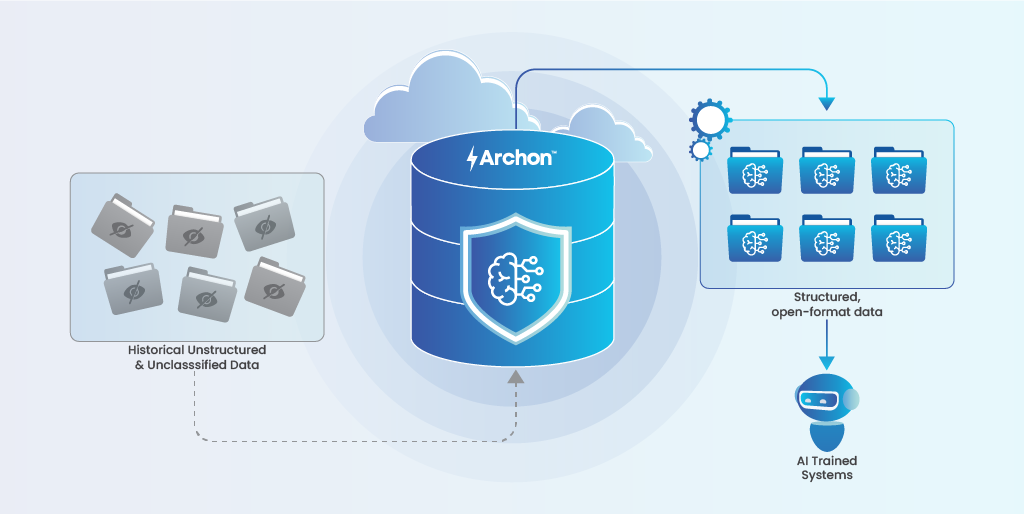
That’s the problem Archon was built to solve. Not by bolting another tool onto your stack, but by giving AI and automation teams a single Lakehouse-based archive layer that spans every system the enterprise has ever run across 200+ source connectors with the integrity controls, open-format access, and governance infrastructure.
NEXT STEP
Is Your Data Infrastructure Actually AI-Ready?
See how Archon’s Lakehouse-based archive gives AI and automation teams access to the full depth of enterprise history.


