


Key Points:
- A data audit evaluates how data is collected, stored, accessed, governed, retained, protected, and used across an organization.
- Data audits help organizations improve visibility, strengthen compliance, reduce risk, and prepare for regulatory reviews.
- Common audit failures occur when organizations cannot prove policy enforcement through evidence, audit trails, and documentation.
- Continuous audit readiness is more effective and less costly than reactive audit preparation before every review.
- Archon helps close the audit readiness gap through enterprise data discovery, classification, retention management, audit trails, and evidence retrieval.
Most organizations do not struggle with audits because they lack policies. They struggle because when an auditor walks in and asks a direct question, no one can find the answer fast enough.
- Where is your sensitive data stored?
- Who has access to it right now?
- Can you pull an access log from eighteen months ago before the end of the week?
These are not trick questions. They are standard audit requests. And yet, across industries, the gap between having a governance framework on paper and being able to prove it is working remains one of the most costly and persistent problems in enterprise data management.
The consequences are not abstract. GDPR penalties can reach up to €20 million or 4% of annual global turnover, whichever is higher, depending on the nature and severity of the violation.
Legal holds that cannot be fulfilled on time create litigation exposure. Internal audits that surface data inconsistencies erode executive confidence in reporting. And the staff time consumed by reactive, last-minute evidence gathering before every audit cycle is a recurring tax that most organizations underestimate significantly.
A data audit is how you close that gap. This blog explains what a data audit actually involves, why the common failure modes happen even in well-governed organizations, what a practical readiness posture looks like, and how to assess where your organization stands today.
What Is a Data Audit?
A data audit is a systematic review of how data is collected, stored, accessed, retained, protected, and used across an organization. It is not a one-time event triggered by a regulatory inquiry. Done properly, it is a recurring governance activity that gives you a verified, documented picture of your data estate and the controls operating over it.
The core objective is straightforward: understand what data you have, confirm it is being handled according to your policies and applicable regulations, and produce evidence that demonstrates this to anyone who asks, whether that is an external regulator, an internal compliance function, a customer conducting due diligence, or a legal team responding to litigation.
It is worth distinguishing a data audit from a financial audit, because the two are often conflated. A financial audit reviews the accuracy of financial records and statements and produces an opinion on whether those statements present a true and fair view.
A data audit is broader in scope. It examines the entire lifecycle of organizational data, from how it enters your systems to how it is eventually disposed of, and whether governance, security, and compliance controls are functioning as designed at every stage. The two can overlap when financial data is subject to regulatory retention requirements, but they are distinct exercises with different scopes, methodologies, and outputs.
Why has this become more critical in the last several years? The answer has several dimensions. Data volumes have grown to the point where informal governance is no longer operationally viable. Regulatory requirements across jurisdictions have attached real financial penalties to governance failures.
The surface area of enterprise data has expanded dramatically, with data now living simultaneously across cloud platforms, SaaS applications, on-premise databases, legacy systems, collaboration tools, and email archives. And the bar set by regulators for what constitutes demonstrable compliance, as opposed to merely claimed compliance, has risen steadily.
Why Data Audits Matter
The case for data audits is not primarily about avoiding fines, even though regulatory compliance is one of the most common triggers for initiating one. The deeper value is operational visibility, and what that visibility enables across the organization.
Improve Data Visibility
Understand what data exists, where it resides, who owns it, and how it flows across the organization. This sounds straightforward until you account for the reality of most enterprise data estates: cloud platforms, on-premise databases, legacy archives, SaaS applications, collaboration tools, and email systems all holding data in parallel, often without a unified view across any of them.
Data visibility is not a reporting exercise. It is the foundation on which every other governance and compliance activity depends. You cannot classify, protect, or retain what you cannot see.
Strengthen Regulatory Compliance
Data audits support compliance efforts across the frameworks that govern how organizations collect, store, process, and dispose of personal and sensitive data:
- GDPR, which requires demonstrable accountability over the personal data of EU residents, not just claimed compliance
- HIPAA, which mandates audit controls, access restrictions, and documented safeguards over electronic protected health information (ePHI)
- PDPA, which requires organizations to collect, use, disclose, retain, and protect personal data responsibly, while meeting obligations related to consent, security, accountability, and retention
- DPDPA, which requires organizations to process personal data lawfully, provide appropriate notices, obtain valid consent where required, safeguard personal data, and support data principal rights
Each of these frameworks has one thing in common: they require evidence, not assurances. A data audit is how that evidence gets produced and maintained.
Identify Compliance and Governance Gaps
Identify governance, security, privacy, and retention gaps before they become compliance issues. The risk landscape around enterprise data is not static. Access permissions drift as roles change.
Data accumulates beyond its retention period when disposal is not automated. Sensitive data migrates to systems where classification and controls have not followed it. A data audit surfaces these gaps while there is still time to address them without the pressure of a regulatory inquiry or a breach response driving the remediation.
Improve Data Quality and Trust
Ensure business decisions are based on accurate, complete, and reliable information. Poor data quality is expensive in ways that rarely appear on a single balance sheet line. Inaccurate customer records affect sales and service outcomes.
Inconsistent financial data undermines reporting integrity. Duplicate records distort analytics. A data audit that surfaces quality issues creates the opportunity to correct them at the source, rather than allowing bad data to propagate through downstream processes and decisions indefinitely.
Support Trusted Analytics and AI
As organizations increasingly rely on analytics and AI-driven systems, the quality and governance of the underlying data become critical. Models trained on incomplete, inaccurate, or poorly governed data can produce unreliable outputs that influence business decisions without making underlying flaws obvious.
Data audits help validate data quality, uncover inconsistencies across sources, and ensure that data used for analytics and AI is accurate, appropriately classified, and traceable.
This is becoming increasingly important as regulators place greater scrutiny on AI systems and the data that powers them. Organizations must be able to demonstrate where their data came from, how it was governed, and whether it can withstand audit scrutiny. Data audits help provide that assurance.
Prepare for Internal and External Audits
Maintain the evidence and documentation required for compliance reviews. Internal audit functions, external regulators, certification bodies, and customers conducting due diligence all ask variations of the same question: can you prove that your controls are working?
The organizations that answer that question quickly and completely are the ones that have been maintaining their evidence continuously, not the ones that started looking for it after the request arrived.
Types of Data Audits
Not all data audits look the same. The scope and focus depend on what you are trying to verify, what triggered the audit, and what your most significant risk areas are.
In practice, a comprehensive enterprise audit will touch elements of several categories, but understanding what each type is designed to examine helps in scoping the work correctly.
Data Quality Audit
Reviews whether your data is accurate, complete, consistent, and reliable. This type matters most when operational or strategic decisions depend heavily on data, and when errors in that data have measurable downstream consequences.
A quality audit examines data against defined standards, identifies anomalies and inconsistencies, and assesses whether the processes that produce and maintain data are functioning as intended.
Data Security Audit
Evaluates whether access controls, encryption standards, monitoring mechanisms, and data protection measures are functioning correctly. The central question is whether unauthorized parties could access data they should not be able to access, and whether your organization would detect it if they did.
This type of audit often surfaces credential management issues, overly broad permissions, gaps in encryption coverage, and monitoring blind spots.
Data Compliance Audit
Assesses whether your practices meet the requirements of applicable regulations and standards. This is the most externally driven type, typically triggered by a regulatory requirement, a customer contractual obligation, or an upcoming external review. It maps your actual controls and practices against the specific obligations imposed by frameworks like HIPAA, PDPA, GDPR, or DPDPA, and identifies where gaps exist.
Data Governance Audit
Examines whether your ownership structures, stewardship processes, accountability mechanisms, and policy adherence are working as intended. Governance audits tend to surface organizational and process gaps rather than purely technical ones.
Common findings include unclear data ownership, policies that exist but are not followed, and stewardship roles that are assigned on paper but not actively exercised.
Data Retention Audit
Verifies that your retention schedules are actually being followed in practice, that records are disposed of on time according to documented policy, and that defensible deletion processes are in place for data that should no longer be held. This type is particularly important in industries with strict regulatory retention requirements, and in any organization that is managing legacy data accumulated over many years.
The Enterprise Data Audit Process
A data audit is not a single task. It is a structured process with distinct phases, and shortcutting phases tends to produce incomplete or unreliable results.

Step 1: Define Audit Scope and Objectives
Start with precision about what you are auditing. Vague scope produces vague findings. Define:
- Which systems and repositories are in scope
- Which business units and geographies are covered
- Which data types and classifications are being examined
- Which regulatory frameworks you are validating against
- What specific questions the audit is designed to answer
The scope definition also determines resource requirements. A full enterprise-wide audit across dozens of systems is a different undertaking from a targeted compliance audit on a single business unit. Being explicit about scope at the outset prevents scope creep and ensures that findings are actionable rather than general.
Step 2: Create a Data Inventory
You cannot audit what you cannot see. This step involves discovering and documenting data across all repositories within scope. The inventory should capture:
- What data exists and in what format
- Where it resides, including primary systems, archives, and secondary repositories
- Who owns it at the business level
- What classification it carries, if any
- What systems process or have access to it
This is often where organizations encounter their first significant finding: the gap between what they believed their data estate contained and what it actually contains. Shadow IT systems, data that was migrated but never cleaned up from source systems, and archives that contain data beyond their retention period are all common discoveries at this stage.
Step 3: Classify Sensitive and Regulated Data
Once you have an inventory, classify what is in it. This means identifying which data elements are personal, confidential, financially sensitive, healthcare-related, or subject to specific regulatory requirements. Classification is what makes the rest of the audit meaningful. Without it, you cannot assess whether your controls are appropriately calibrated to the risk level of the data they are supposed to protect. Unclassified data is effectively ungoverned data.
Step 4: Review Access Controls and Permissions
Who can access what, and is that access appropriate given the person’s current role and the sensitivity of the data? This step involves reviewing access rights across systems in scope and validating that permissions reflect current roles and responsibilities. Common findings include:
- Stale permissions from role changes that were not reflected in system access
- Overly broad access granted during a project and never revoked
- Orphaned accounts belonging to former employees or contractors
- Shared credentials that make individual accountability impossible to establish
Access review at enterprise scale is almost always more complex than it appears at the outset, particularly when permissions are managed differently across systems and there is no central identity governance layer.
Step 5: Evaluate Retention and Disposal Practices
Compare your actual retention practices against your documented schedules. The question is not whether you have a retention policy. The question is whether that policy is being enforced. Specifically:
- Is data being retained for the periods required by regulation and business policy?
- Is data being disposed of when those periods expire, or is it accumulating indefinitely?
- Are disposal events being recorded in a way that creates a defensible audit trail?
- Are legal holds being applied correctly to preserve data that is subject to litigation or investigation?
This step frequently surfaces a significant gap between the retention schedule in the policy document and the reality in production systems, particularly in organizations that have grown through acquisition or that operate legacy systems with limited lifecycle management capability.
Step 6: Assess Compliance Controls
Review the specific controls that support your regulatory obligations, jurisdiction by jurisdiction and framework by framework. This is not a general review of whether controls exist. It is a detailed assessment of whether the controls that exist map to the specific obligations imposed by each applicable framework, and whether they are operating effectively.
For GDPR, this includes examining consent management mechanisms, data subject rights request handling, breach detection and notification processes, records of processing activities, and data transfer safeguards for cross-border flows. For HIPAA, it includes technical safeguards, audit log maintenance, access control documentation, and business associate agreement coverage. For PDPA and DPDPA, it includes consent frameworks, data minimization practices, and individual rights request processes.
Step 7: Document Findings and Risks
Every observation, gap, and inconsistency found during the audit needs to be documented, along with an assessment of its risk level and a recommended remediation approach. The documentation is the deliverable. An audit that produces verbal findings with no written record has produced nothing that survives scrutiny. Findings should be categorized by severity, assigned an owner, and given a target remediation date.
Step 8: Implement Corrective Actions and Monitor Progress
An audit report that sits on a shelf has no value. Findings need to be assigned to specific individuals, tracked through a defined remediation process, and reviewed regularly until gaps are closed. This is also where the transition from point-in-time audit to continuous monitoring begins. Controls that are remediated should be monitored to ensure they do not drift back out of compliance.
Why Data Audits Fail Even When Policies Exist
This is worth examining carefully, because it is genuinely counterintuitive. Organizations that have invested in governance frameworks, compliance programs, security controls, and documented policies still produce poor audit results. The reason is almost never that policies are missing. It is that execution has drifted away from what the policies describe, and no mechanism exists to detect that drift until an audit surfaces it.
The most common failure modes follow a pattern:
Data spread across too many systems
Enterprise data estates are rarely designed. They accumulate. Cloud platforms, SaaS applications, on-premise databases, collaboration tools, email archives, legacy systems, and departmental shadow IT all contribute data that exists outside the reach of the governance design. When audit processes are not built to reach all of these, data in those systems simply does not get reviewed.
Sensitive data that cannot be located
Data inventories, where they exist, tend to be built once and not maintained. Systems change, data migrates to new platforms, new repositories appear. An inventory that was accurate two years ago may now miss significant portions of the current estate. When sensitive data cannot be located reliably, it cannot be governed reliably.
Manual access reviews that do not scale
Access reviews conducted manually across large, heterogeneous system estates are slow, inconsistent, and easy to deprioritize when teams are under operational pressure. When reviews are delayed or skipped, permissions accumulate over time, and the gap between who should have access and who does grows wider.
Retention policies that exist on paper but are not enforced
In the absence of automated enforcement mechanisms, retention policy compliance depends on people remembering to act on schedule. In practice, this means inconsistent enforcement. Data accumulates beyond its required retention period because the process for disposing of it requires manual effort that gets deferred indefinitely.
Audit evidence that is scattered and slow to compile
Documentation of compliance activities is often spread across departments, tools, and formats, making it slow and expensive to compile when it is actually needed. When an auditor requests evidence and the response takes weeks, that is itself a finding.
The common thread across all of these is the gap between policy and execution. Auditors evaluate evidence, not intentions. A governance framework that cannot be demonstrated with evidence is not a compliance control. It is documentation of what should have happened.
The Hidden Cost of a Data Audit
Most conversations about audit risk focus on the end outcome: the regulatory penalty, the failed certification, the enforcement action. What gets far less attention is the cost that accumulates well before any of that, quietly, across every audit cycle.
Time: Weeks Lost to Evidence Gathering
When an organization is not in a continuous readiness posture, audit preparation becomes a large, disruptive, recurring exercise. Compliance teams stop working on control improvement and start building evidence packages. IT teams get pulled into access reviews and log extractions. Security teams produce records under time pressure. Legal steps in to manage last-minute risk exposure. Business teams field data ownership questions that should have been resolved months earlier.
None of this produces new capability. It simply reconstructs, under pressure, a picture of your data estate that should have been maintained all along.
Productivity: Your Best People, Diverted
The people best positioned to answer audit questions are typically the same people most critical to ongoing operations. When those individuals spend two to four weeks on audit preparation, that time comes directly out of control design, automation work, data quality improvement, and retention policy refinement. Everything pauses while the audit preparation runs.
Risk: Manual Processes Create Inconsistencies
Manual evidence gathering is inconsistent by nature. When different team members compile documentation independently, under time pressure, using different methods, the result often contains gaps and contradictions. Those inconsistencies become findings. In a regulatory context, an inconsistent audit trail can be more damaging than a clearly documented gap, because it suggests the organization does not have a reliable grip on its own data.
Opportunity Cost: The Governance Work That Never Gets Done
Every hour spent preparing for an audit is an hour not spent building the infrastructure that would make the next audit easier. Organizations that stay in a reactive preparation cycle tend to stay there, because breaking out of it always seems to conflict with the audit that is already approaching.
The cost of poor audit readiness rarely announces itself as a penalty. It accumulates as diverted staff, deferred governance work, and compounding risk. The penalty, if it comes, is simply the moment that cost becomes visible to the outside world.
That is roughly what reactive audit prep costs most enterprises. Here is how Archon gets that time back.
Audit Preparation vs. Audit Readiness
These two things are often treated as synonymous, but they describe fundamentally different organizational states with very different cost profiles.
Audit preparation is what organizations do when an audit begins. It is reactive. Teams are pulled away from their regular work to locate and compile evidence. Systems are reviewed under time pressure. Gaps that have been accumulating for months or years are discovered at the worst possible moment. The cost is high, the risk is real, and the findings tend to be more numerous than they would have been in a continuous readiness posture.
Audit readiness is a continuous operational state. It means:
- The data inventory is current and actively maintained, not rebuilt from scratch before each audit
- Data classification is consistently applied and reflects current data holdings
- Access reviews are conducted on schedule and documented
- Retention policies are enforced through controls, not manual effort
- Audit trails are maintained in a form that can be retrieved quickly and are tamper-evident
- Evidence can be produced within hours, not weeks
The investment required to achieve genuine audit readiness is front-loaded. You need to build the inventory, implement classification, automate retention enforcement, and establish continuous monitoring. But the ongoing cost of maintaining that posture is substantially lower than the recurring cost of reactive preparation, and the risk profile is dramatically better.
The Data Audit Readiness Gap and How to Measure It
The readiness gap is the distance between believing your organization is compliant and being able to prove it with documentary evidence when asked.
Organizations often assume readiness because policies exist, controls are in place, and procedures are documented. The gap surfaces when those assumptions are tested. An incomplete inventory means the audit cannot cover what it should.
Unclassified data means controls cannot be calibrated to the right risk level. Inconsistent retention enforcement means policy adherence cannot be demonstrated. Fragmented audit trails mean that even if things were done correctly, proving it becomes a significant challenge.
This gap tends to be invisible until an audit, a breach, a regulatory inquiry, or a legal hold request forces it into view. At that point, closing it quickly is expensive and high-risk. The organizations that manage this well have chosen to invest in readiness continuously rather than address it in crisis mode.

Where Do You Stand? Use This Scorecard
Score one point for each honest “Yes.” The intent is not a perfect score on the first pass. It is to identify exactly where the gaps are.
- Do you maintain an up-to-date data inventory that reflects your current estate?
- Is sensitive and regulated data classified consistently across your systems?
- Are data owners clearly assigned for all primary data domains?
- Can you identify who currently has access to sensitive data in each major system?
- Are retention schedules actively enforced, not just documented?
- Are audit trails maintained across systems that handle regulated data?
- Can audit evidence be produced quickly in response to a request?
- Are compliance controls reviewed at defined intervals?
- Are remediation actions from previous audits tracked to closure?
- Is audit readiness monitored continuously between formal audit cycles?
0 to 3: High risk. Significant gaps likely exist across inventory, classification, and evidence readiness.
4 to 7: Moderate risk. Core structures may be in place but enforcement and continuity are inconsistent.
8 to 10: Audit-ready posture. Focus shifts to maintaining and monitoring rather than building from scratch.

Most compliance guides repeat the same five points everyone already knows.
Ours does not. Read the Data Security and Compliance Guide for the parts of audit readiness that rarely make it into a checklist.
Enterprise Data Audit Compliance Checklist
Use this as a working reference across your audit cycle, not just at the point of an external review. It is organized by domain so you can assign ownership clearly across teams.
Governance
Start here. If ownership and inventory are unclear, everything downstream becomes harder to validate.
- Data inventory maintained and current, not rebuilt before each audit
- Data ownership assigned across all primary domains
- Classification framework implemented and consistently applied
- Governance policies documented, accessible, and actively followed
Security
Access and monitoring controls need to be verified, not assumed. Permissions drift over time without active review.
- Sensitive data identified and classified
- Access controls reviewed on a defined schedule, with results documented
- Audit trails enabled on all systems handling regulated data
- Monitoring mechanisms in place to detect anomalous access or activity
Compliance
Map your actual controls to your specific regulatory obligations. General frameworks are not a substitute for this mapping.
- GDPR obligations mapped to specific, verifiable controls
- HIPAA safeguards documented with evidence of operating effectiveness
- PDPA requirements reviewed against current data handling practices
- DPDPA requirements assessed and gaps addressed
Retention
A retention policy that is not enforced is not a compliance control. Validate that schedules are operational, not just documented.
- Retention schedules enforced through automated or regularly audited controls
- Disposal procedures documented and recorded when executed
- Legal hold processes in place and tested before they are needed
Audit Readiness
This domain pulls the others together. The test is whether you can produce evidence quickly, consistently, and without disrupting operations.
- Evidence repository maintained in a retrievable, organized form
- Findings from previous audits tracked through to documented closure
- Compliance reviews conducted at defined intervals, not only when triggered externally
- Continuous monitoring established to detect drift between policy and practice
Closing the Data Audit Readiness Gap with Archon
The infrastructure challenge behind audit readiness is real, and it is not solved by policy alone. When data is distributed across dozens of systems, many of which were built or acquired at different times for different purposes, maintaining visibility and control requires purpose-built capability.
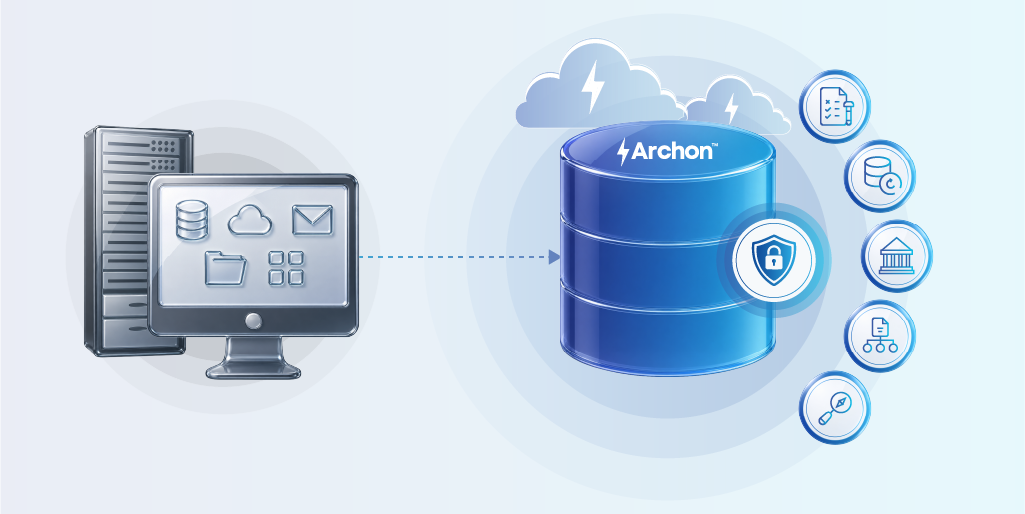
Archon Data Store is an enterprise data archiving platform built on Lakehouse architecture. It is designed to help organizations manage structured and unstructured data at scale across the full data lifecycle, and it addresses several of the most persistent failure points in audit readiness directly.
Discovery across enterprise systems gives organizations genuine visibility into data regardless of where it resides, including legacy systems, archived repositories, and cloud platforms that sit outside traditional governance reach.
Classification capability identifies personal, confidential, and regulated data consistently, so that access controls, retention rules, and compliance monitoring can be applied at the right level of granularity. Retention enforcement closes the gap between documented schedules and actual practice, with automated lifecycle management and recorded disposal events that produce a defensible audit trail.
Immutable audit trails built on WORM storage, cryptographic hashing, and trusted timestamps ensure that access and activity records are tamper-evident and retrievable on demand. Cross-application search and evidence retrieval capabilities reduce the time and effort required to respond to audit requests from weeks to hours.
The result is a shift from reactive audit preparation to continuous audit readiness, where visibility, governance controls, and evidence are maintained as an ongoing operational capability rather than assembled under pressure when an audit cycle begins.
Conclusion
A data audit is not a compliance formality. It is the mechanism by which an organization validates that its governance practices are actually working, identifies where they are not, and builds the evidence base needed to demonstrate accountability to regulators, customers, auditors, and internal stakeholders.
The organizations that perform best during audits are not the ones that respond fastest when an audit begins. They are the ones that never stopped maintaining the visibility, controls, and documentation that make audit readiness a default state rather than an emergency exercise.
If any of the questions in this blog were difficult to answer with confidence, that is the starting point. Identify the gaps, scope the work, and treat audit readiness as an ongoing operational capability rather than an event that occurs once a year under pressure.
If you had to produce full audit evidence tomorrow, would you be ready?
If the honest answer is “not quite,” that is exactly the conversation we should have. Book a walkthrough!


