


TL;DR:
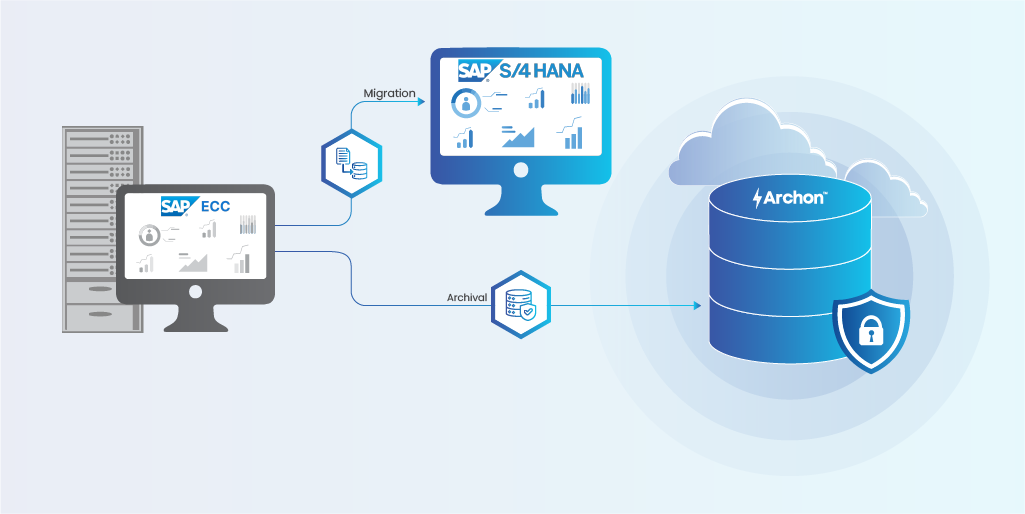
Legacy SAP ECC systems hold decades of data, increasing costs, migration complexity, and compliance risk. With ECC support ending in 2027, S/4HANA migration is unavoidable, but not all data needs to move.
Early archiving removes inactive data from production while keeping it accessible for audits and business needs. This reduces migration scope, shortens cutovers, controls infrastructure costs, and ensures compliance. Key use cases include pre-migration archiving, selective data migration with external archiving, and post-migration (ongoing) archiving in S/4HANA.
Modern solutions like Archon Data Store (ADS) preserve historical data with context, searchability, and governance, making archiving a strategic foundation for S/4HANA success.
December 31, 2027.
That date may feel distant. For many organizations, it isn’t.
SAP ECC systems that went live around 2008 or earlier now carry nearly two decades of operational data. Financial postings, purchase orders, invoices, HR records, manufacturing history, and layers of custom logic built for business processes that no longer exist. All of it remains embedded in systems nearing the end of their supported life.
As ECC support winds down, the transition to SAP S/4HANA becomes unavoidable. What organizations still control is not whether they move, but how intentionally they manage their data as part of that transition.
Most organizations approach S/4HANA with structured plans: conversion paths, timelines, governance, and budgets. Yet one foundational question is often deferred: What data actually needs to move from ECC to S/4HANA?
Answering this early ensures that the migration remains strategic, reduces risk, and avoids unnecessary complexity.
Defining the Right Data Scope for S/4HANA
A successful move to S/4HANA depends on making clear decisions about data scope early in the journey. The challenge is not data retention itself, but determining which data must remain in the active system and which can be managed outside the production footprint. This often includes addressing large document repositories and opportunities to reduce SAP SOFFCONT1 table size before migration.
Enterprise teams typically balance several considerations:
- Operational requirements for recent transactional data
- Ongoing access to historical ECC data for audits, reporting, and reference
- Regulatory retention obligations across regions
- The volume of inactive data embedded in legacy systems
Industry experience shows that data migration is consistently one of the most complex and underestimated aspects of moving to S/4HANA, largely because these decisions shape the overall scope and execution of the transition.
SAP archiving offers a structured and reliable way to support these decisions. By separating inactive and historical data from the live system, while keeping it governed, searchable, and accessible, organizations can focus the S/4HANA environment on data that actively supports the business. This simplifies cloud migration execution, supports compliance, enables historical insight, and allows system decommissioning with confidence.
Taken together, these considerations make one thing clear: archiving is not a single action taken at one point in time, but a set of choices that shape how data is handled throughout the transition to S/4HANA. Depending on timing, business priorities, and legacy complexity, organizations typically adopt different archiving approaches during migration.
What SAP Data Archiving in S/4 Hana Looks Like in Practice
1. Pre-Migration Archiving (Before the Move)
Inactive and historical data is archived from SAP ECC before conversion or system landscape transformation.
What it does
- Reduces the data volume that needs to be converted to S/4HANA
- Shrinks the technical migration scope, including tables, custom code, and testing
- Simplifies cutover and lowers overall migration risk
When it fits
- Long-running ECC systems with decades of accumulated data
- ECC landscapes where historical data remains in the system due to limited data housekeeping and weak data volume management practices
- Organizations aiming to minimize the S/4HANA data footprint from day one
Key consideration: Archived data must remain accessible for audits and reporting; otherwise, ECC cannot be retired.
2. Selective Data Migration
Only a defined subset of active, operational, and selective historical data is migrated to S/4HANA, while remaining historical data is archived and managed outside the live system.
What it does
- Provides precise control over how much history enters S/4HANA
- Aligns different retention requirements across finance, HR, sales, and operations
- Enables a faster transition with a cleaner target system
When it fits
- Organizations adopting redesigned processes or greenfield S/4HANA landscapes
- Scenarios where historical access is required, but operational use is minimal
Key consideration: Strong governance and searchability are essential to preserve business context across archived data, especially when managing historical financial records associated with the ACDOCA table in SAP.
Read more: SAP S/4HANA migration approaches (Greenfield, Brownfield, and Bluefield explained)
3. Post-Migration (Ongoing) Archiving in S/4HANA
Archiving is implemented after go-live to continuously manage data growth within the S/4HANA system.
What it does
- Prevents the S/4HANA database from growing unchecked
- Keeps performance and infrastructure costs predictable over time
- Supports long-term compliance and retention enforcement
When it fits
- Organizations prioritizing speed to go-live
- Landscapes with continuous or high transaction volumes
Key consideration: Without ongoing archiving, S/4HANA systems gradually inherit the same data volume challenges as ECC.

How Enterprise Landscapes Inform Archiving Decisions
With archiving approaches defined, the next step is understanding how they fit into the broader enterprise landscape.
Most organizations operate across multiple SAP and non-SAP systems, including CRM platforms, supply chain applications, HR systems, custom reporting environments, and ERPs acquired through mergers and acquisitions. Historical data across these systems continues to support audits, reporting, and business insight, making consistent access and governance an important consideration.
These requirements become especially important during business unit separation, where organizations must maintain access to historical data while separating applications, processes, and records.
Data across these systems typically falls into categories:
- Master data that establishes business structure and relationships
- Transactional data that supports day-to-day operations
- Historical data associated with completed periods or inactive entities
- Regulatory data retained to meet compliance requirements
A secure, compliance-enabled archiving approach helps organizations decide early which data stays in S/4HANA and which is managed externally, without losing accessibility, context, or governance. S/4HANA remains focused on active operations, while historical and regulatory data remains accessible, governed, and compliant across the enterprise.
How Archiving Strengthens S/4HANA Migration Strategy
When archiving is planned early in the S/4HANA journey, it delivers clear, measurable benefits across migration, operations, and compliance.
Reduced migration scope
Only data that actively supports business processes is moved to S/4HANA, simplifying conversion and reducing validation effort.
Simplified cutovers
By removing inactive data from the migration process, downtime is focused on critical operations, making the transition smoother.
Predictable infrastructure costs
Smaller active datasets lower licensing, hardware, and ongoing operational costs.
Enhanced compliance and audit readiness
Retention rules and legal holds are consistently enforced, ensuring historical data remains accessible and governed.
Early, disciplined decisions about data help organizations achieve a more efficient migration, stronger compliance, and a cleaner S/4HANA environment. The next step is exploring the technical tools and policies that make this strategy practical and sustainable across complex enterprise landscapes.
SAP Archiving Solutions: Technical and Policy Approaches
SAP provides native archiving through Archive Development Kit (ADK) and standard archiving objects, which are stable, well-integrated, and widely used. SAP Information Lifecycle Management (ILM) adds governance by defining retention rules and legal hold behavior.
Archived data can be stored on-premise or in compliant cloud repositories. While moving data out of production is straightforward, the key challenge is making archived data easily accessible across large, complex landscapes. File-based archives often require IT involvement for retrieval, which can slow audits, reporting, and compliance processes.
These native tools provide a strong foundation, but as organizations scale across multiple SAP and non-SAP systems, geographies, and regulatory frameworks, there is a need for faster, more flexible, and business-friendly access to historical data. This is where modern enterprise archiving comes in.
Read More: SAP ADK vs Archon: Comparing Native SAP Archiving with Modern Enterprise Archiving Platforms
Where Modern Enterprise Archiving Is Headed and How Archon Supports It
Modern archiving platforms treat archived data as an information layer rather than a collection of files, addressing the challenges of multi-system landscapes. This approach:
- Preserves business relationships across archived objects
- Makes historical data searchable outside the source system
- Applies retention and access controls centrally
- Empowers business users to access data without IT dependency
Archon Data Store (ADS) extends SAP’s native archiving model by integrating with mechanisms such as ADK and ArchiveLink. Inactive data is extracted from the production system, reconstructed with full business context, and stored in a governed, searchable repository. Users can access historical records without relying on SAP archive transactions or legacy systems. This enables organizations to reduce the S/4HANA data footprint, retire legacy systems confidently, and stay audit-ready.
Key stages of the Archon process:
- Identify and archive inactive data from SAP using standard mechanisms, ensuring only compliant data is selected.
- Ingest archived data into ADS while preserving full business context and connections between related objects.
- Store data in a governed, searchable repository with retention rules and access controls applied centrally.
- Enable business and audit teams to access historical data efficiently, supporting reporting, audits, and compliance.
Archiving as a Strategic Foundation for S/4HANA Success with Archon
High-impact data decisions are most effective when made early in the S/4HANA journey. Organizations should start by evaluating:
- Which data actively supports business operations
- Which retention obligations apply across regions
- Who needs historical data and how quickly
By answering these questions upfront, archiving reduces risk rather than reacting to it later. Archon Data Store demonstrates how organizations can retire legacy systems while maintaining governed, business-friendly access to historical SAP data. This approach ensures audit readiness, compliance, and a streamlined S/4HANA environment.
Archiving is not the final step of migration. It is one of the earliest decisions that shapes whether S/4HANA delivers long-term value. Planning deliberately ensures historical data remains usable, accessible, and compliant well beyond go-live.
Start mapping your SAP data and archiving approach today to simplify your S/4HANA transition.


