


Key Points:
- Greenfield fits businesses that want a clean SAP S/4HANA start with redesigned processes and fewer legacy constraints.
- Brownfield fits businesses that want to preserve what already works and move to SAP S/4HANA with less disruption.
- Bluefield fits businesses that need a selective transition, keeping some processes intact while changing others.
- The right choice depends on business goals, process complexity, timeline, and data strategy, not just technical preference.
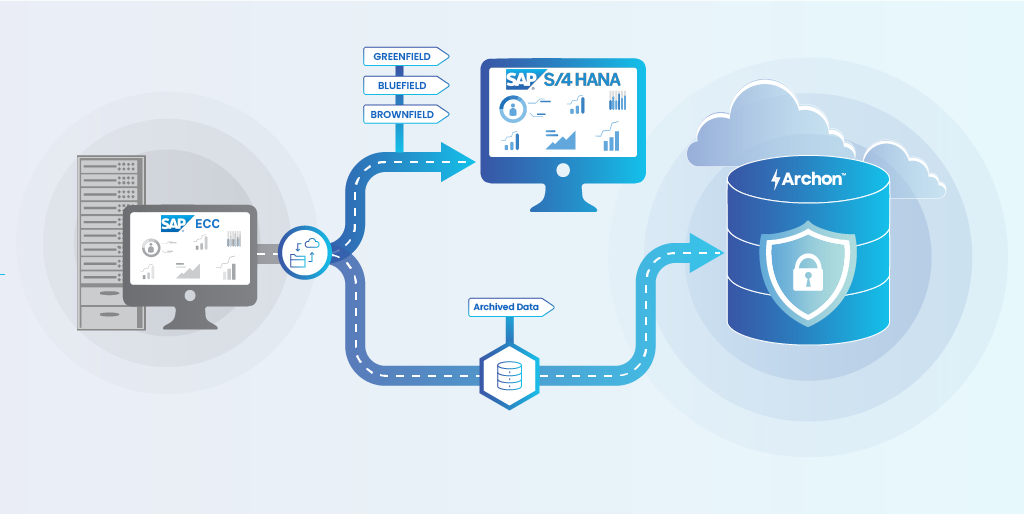
- Archon supports a cleaner move to SAP S/4HANA by keeping historical SAP data accessible without overloading the new environment.
SAP ECC end-of-support timelines have made SAP S/4HANA migration a near-term priority for many enterprises, but the harder decision often comes before the move itself: choosing the right migration path.
For most SAP teams, the real debate is migration approach best aligns with their modernization strategy and whether RISE with SAP is the right transformation model to support that journey.
- Should you take a clean-slate Greenfield implementation?
- Preserve what already works through a Brownfield migration?
- Or choose a more selective Bluefield migration that balances continuity with change?
The answer is rarely straightforward because each path leads to a very different outcome for process design, customization, historical data, archiving strategy, and long-term system complexity.
The better question is not which model is most popular. Which one best fits what your business needs to preserve, improve, and leave behind?
That is what should drive the decision.
How to Choose Between Greenfield, Brownfield, and Bluefield in SAP
Before comparing the three approaches, it helps to simplify the decision.
Ask one question first: What do you want to preserve, and what do you want to change?
That question matters because SAP S/4HANA migration is not just a technical move. It is a business decision.
Some organizations want a cleaner operating model with standardized processes, fewer customizations, and a chance to reset years of complexity.
Others want to protect what already works, reduce disruption, and move faster with less change. Many fall somewhere in between.
That is why the migration path is not really about picking from three labels. It is about deciding how much of the current SAP environment still serves the business well, how much should be modernized, and which data needs to remain active in SAP S/4HANA versus which historical data can remain accessible through archiving.
Once that becomes clear, the migration path usually becomes clearer, too.
A practical way to frame the decision
Instead of comparing migration models feature by feature, start with two practical questions:
- How much process change does the business want?
- How much of the current SAP environment should be preserved?

How to read this:
If your priority is redesign, simplification, and standardization, the decision tends to move toward Greenfield. If your priority is continuity, speed, and protecting existing investments, it tends to move toward Brownfield.
If you need a selective transformation without starting from scratch, Bluefield usually sits in the middle.
This framing is more useful than a simple feature comparison because it connects the decision to what enterprise teams actually care about: business change, risk, timeline, and long-term operating fit.
Greenfield vs Brownfield vs Bluefield in SAP: What Changes in Practice
At a high level, the difference between Greenfield and Brownfield in SAP comes down to one core choice: whether you are redesigning the environment from the ground up or converting what already exists into SAP S/4HANA.
Bluefield sits between those two, but it is best understood as a selective transition model rather than simply a midpoint.
Greenfield: build the future-state ERP environment
A Greenfield migration is a new SAP S/4HANA implementation.
Instead of carrying the existing ERP environment forward as-is, the organization designs a new S/4HANA landscape around its future-state processes, data model, and operating priorities.
This approach is often chosen when:
- The current SAP environment is heavily customized
- processes vary too much across business units
- There is a strong push toward standardization
- Leadership wants transformation, not just migration
Greenfield is not just “start over.” It is a chance to rebuild with intention.
For the right organization, that can be valuable. It creates room to simplify process flows, retire outdated custom logic, align with SAP best practices, and reduce long-term complexity.
Brownfield: convert the existing SAP environment
A Brownfield migration is a system conversion from the existing SAP ECC environment to SAP S/4HANA.
The goal here is not to redesign everything. It is to move to S/4HANA while preserving the current structure as much as possible.
This approach is often chosen when:
- existing processes are stable and effective
- customizations are still valuable to the business,
- the organization wants lower disruption
- timelines to be tighter, and the change appetite is lower
Brownfield is often described as the faster route, but its real value is continuity.
It allows organizations to protect what is already working while still moving onto the S/4HANA platform. For companies that have built strong process maturity over time, that can be the right move. Similar considerations apply during an Oracle to SAP s/4HANA migration, where balancing modernization with business continuity is a key success factor.
Bluefield: transform selectively without starting from scratch
Bluefield sits between the two.
It is commonly used to describe a selective transition approach where organizations move to SAP S/4HANA while choosing what to keep, what to redesign, and what data to carry forward.
This approach is often considered when:
- Some business processes should remain intact
- Some areas need redesign or simplification
- Only selected organizational units, data sets, or process scopes should move in a specific way
- The business wants more flexibility than Brownfield, without the full reset of Greenfield
Bluefield tends to appeal to organizations with complex landscapes, merger and divestiture activity, regional variation, or mixed business priorities across functions.
In some SAP discussions, teams may also hear the term Greyfield implementation or Greyfield SAP, often used informally to describe a selective or hybrid transition.
In most enterprise planning conversations, however, Bluefield is the more commonly used label for that middle-ground approach.
What Is the Right SAP S/4 HANA Migration Approach for Your Business?
This is where the decision becomes more practical.
A useful way to choose is to evaluate the migration through four business lenses.
1. How much business change are you actually ready for?
Every leadership team wants modernization. Not every organization is positioned to absorb the same level of change at the same time.
If the business is already managing process harmonization, global template work, operating model redesign, or large-scale transformation, a Greenfield approach may align well because the organization is already prepared for broader change.
If stability is the priority and change capacity is limited, Brownfield may be the more realistic fit.
Bluefield becomes relevant when change is needed, but only in selected areas.
2. How much of your current SAP environment still creates value?
Not all customizations are technical debt. Some still support real business differentiation.
The goal is not to preserve everything or replace everything. The goal is to identify what still matters.
If the current design supports the business well, Brownfield may protect that investment.
If the current environment has become difficult to maintain, fragmented across regions, or overbuilt through years of exceptions, Greenfield may create a cleaner long-term foundation.
If the answer varies by process, geography, or business unit, Bluefield often becomes more relevant.
3. What timeline and disruption level can the business absorb?
The right migration path has to fit the business timing.
A company planning a major finance transformation, shared services redesign, or process standardization initiative may intentionally choose a broader Greenfield journey.
A company under deadline pressure, resource constraints, or a need to reduce change fatigue may prefer a Brownfield path that keeps the move more controlled.
Bluefield often becomes attractive when the business wants to phase change more selectively.
4. What belongs in live S/4HANA, and what does not?
This is one of the most overlooked parts of the decision.
Many teams assume the migration discussion is only about how to move to S/4HANA. In practice, it is also about what should remain in the live production environment once you get there and what should be managed through archiving outside the live system.
Not every historical record needs to be carried into day-to-day S/4HANA operations, especially when a well-defined data archiving strategy can keep older records accessible without overloading the new environment.
In many cases, organizations choose to separate current operational data from older historical records that still need to remain accessible for audit, reporting, business reference, or compliance, often through data archiving rather than keeping everything in the live S/4HANA environment.
That can influence migration scope, project complexity, performance considerations, and even how quickly legacy systems can be retired.
This is especially important in large, long-running SAP environments where data volume and legacy application dependencies are already part of the equation.
Greenfield, Brownfield, or Bluefield: A Simple Fit Check
If you want a fast way to pressure-test the decision, use this framework.
Greenfield is often the best fit when:
- The current SAP landscape is highly customized and difficult to simplify incrementally
- Process standardization is a major business goal
- Leadership wants a future-state operating model, not just a technical upgrade
- The organization is willing to invest more up front for a cleaner long-term design
Brownfield is often the best fit when:
- Core processes are stable and already support the business well
- Existing customizations still matter operationally
- The priority is continuity with lower disruption
- The organization wants a more direct move to S/4HANA while protecting current investments
Bluefield is often the best fit when:
- The business needs a selective transformation rather than an all-or-nothing move
- Some processes should be redesigned, while others should remain intact
- There are regional, organizational, or carve-out complexities
- The migration strategy needs more flexibility than a pure Greenfield or Brownfield model
This is not a rigid formula. It is a practical starting point.
The strongest decisions usually come from matching the migration approach to business readiness, process reality, and long-term operating goals, not from defaulting to the most familiar label.
The Planning Mistake That Can Derail SAP S/4HANA Migration
One of the most common mistakes is choosing the migration method too early.
Teams often begin with the technical label: Are we doing Greenfield, Brownfield, or Bluefield?
That sounds like progress, but it can send the project in the wrong direction.
The better sequence is:
- Define the target-state business intent
- Decide what should change and what should stay
- Clarify the historical data and archiving strategy
- Then choose the migration approach that best supports those decisions
When that order is reversed, the project becomes harder than it needs to be.
For example:
- A Greenfield plan can become more complex if the business has not aligned on what the future-state process model should look like.
- A Brownfield path can preserve more than intended if no one has challenged whether current customizations still deserve to stay.
- A Bluefield strategy can lose clarity if the selective scope is not defined precisely.
The point is simple: the migration method should support the strategy, not replace it.
This is often where migration planning becomes more effective, because the right approach is easier to choose once the business priorities and data boundaries are clear.
How Archon Supports Greenfield, Brownfield, and Bluefield Strategies
Once the migration path is chosen, another important question remains:
What should stay in live SAP S/4HANA, and how will the business retain access to historical data after the move through archiving?
This is where Archon becomes relevant.
Across Greenfield, Brownfield, and Bluefield projects, organizations often need to keep historical SAP and non-SAP data accessible through archiving, even when legacy systems are being retired.
That may include data needed for compliance, audit response, legal discovery, finance reference, operational lookups, or long-term business history.
Archon helps address that layer of the transition.
It supports organizations that want to:
- preserve access to historical application data through archiving without keeping legacy systems running
- reduce dependence on retired SAP and non-SAP environments
- separate active operational data from long-term retained records
- support application decommissioning and legacy SAP decommissioning
- keep business-critical history available for governance and reference after migration
This matters because SAP S/4HANA migration is not only about moving into a new platform. It is also about deciding how to simplify what stays behind.
That is why Archon is relevant across all three approaches:
- In Greenfield, it can help when the business wants a clean operational start in S/4HANA without losing access to historical records from older systems.
- In Brownfield, it can support long-term data rationalization and legacy retirement decisions that may happen alongside or after the conversion.
- In Bluefield, it can help where selective migration creates a clear need to separate active data from retained history.
In other words, Archon does not replace the migration decision. It helps organizations make that decision more practical by giving them a stronger way to manage historical data and legacy application retirement around it.
Choosing the Right SAP Migration Path
There is no single best SAP S/4HANA migration path.
Greenfield, Brownfield, and Bluefield can all be the right choice, depending on what the business is trying to achieve.
The best decision comes from answering four key questions:
- How much change does the business actually want?
- How much of the current SAP environment still creates value?
- How much disruption can the organization realistically absorb?
- What data truly belongs in live S/4HANA after the move, and what should remain accessible through archiving?
Clear answers make the migration path and project much easier to shape.
If you are evaluating your move to SAP S/4HANA, now is the right time to assess not just the migration model, but also what should be preserved, what should be simplified, and what historical data should remain accessible through archiving after the transition.
That is what turns a migration choice into a stronger long-term ERP strategy.
Planning an SAP S/4HANA move?
Archon can help keep historical SAP data organized and accessible throughout the transition. Talk to our experts!


