


Key Points
- Enterprises struggle to balance compliance and performance as legacy SAP systems accumulate years of financial and tax data that must be retained and accessed.
- Section 128 mandates at least eight years of accessible financial records in India, making long-term data retention and availability a legal necessity.
- SAP DART extracts critical financial and transactional data into audit-ready, read-only files for regulatory compliance.
- DART helps reduce system load and improve audit readiness by offloading data while ensuring quick and reliable access during inspections.
- The effectiveness of DART depends heavily on proper configuration, including data selection, performance tuning, validation, and archive integration.
- During DART implementation, SAP teams commonly face challenges such as configuration errors, localization complexity, validation gaps, and inefficient manual processes.
- Archon enhances DART by adding secure storage, compliance controls, and long-term accessibility, turning extraction into a complete compliance solution.
For many enterprises across various industries, it is a daily reality to face the same challenge. How to stay compliant while managing the relentless growth of financial and tax data? How to retain and access years of this data without overburdening the SAP systems?
Not long ago, A major consumer goods company found itself drowning in financial data. Their SAP systems were buckling under the weight of every transaction, every tax record, and every audit trail that had to be stored. The risk of compliance had also become high. Consequences? Regulatory penalties and a reputational blow.
Instead of waiting for a crisis, the company took a smarter route by turning to SAP’s Data Retention Tool (DART). They deployed the DART Archon’s implementation with expertise. Result? It spoke volumes. Years of financial and tax data were extracted; audits became faster; and most importantly, compliance was assured with global and country-specific regulations.
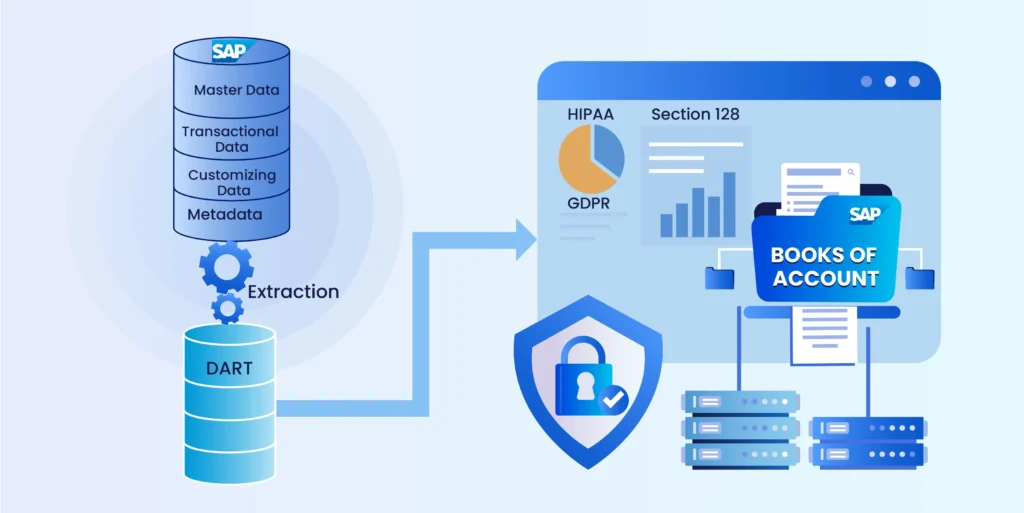
SAP DART plays a crucial role where audit readiness and regulatory compliance are paramount. Purposefully, DART helps enterprises that are using SAP systems to extract and retain critical transactional and financial data in compliance with evolving audit and legal requirements.
What is SAP DART? – An Overview
From finance and logistics to customer and employee data, SAP systems are used to manage a wide range of business operations. As a result, SAP systems generate vast amounts of data, which can be broadly categorized into five key types.
- Master Data (core business entities) – Customers, Vendors, Materials, Employees, Chart of Accounts
- Transactional Data (daily business operations and processes) – Sales Orders, Purchase Orders, Financial Postings, Goods Movements
- Configuration or Customizing Data (system setup rules, parameters & workflows) – Tax rules, Company codes, Pricing conditions, Approval flows
- Organizational Data (structure & hierarchy of business) – Plants, Storage Locations, Sales Organizations, Business Areas
- Metadata (data elements for interpretation & integration) – Field definitions, Table structures, Data relationships


SAP DART Implementation for Section 128 Compliance
This document is about how SAP DART implementation meets Section 128 compliance by archiving financial data in an audit-ready format.
Much of this data must be retained for years to meet strict audit and compliance regulatory requirements. To support enterprises in meeting these requirements, SAP offers SAP DART (Data Retention Tool). DART is designed to extract and store key business data subsets from SAP, specifically for audit and compliance purposes. By selecting data from production systems, DART saves it in a flat-file format (.DART files), which is then provided to auditors or external systems.
Key features of DART include:
- Support for tax and legal reporting
- Compliance with Section 128 & other statutory body requirements
- Customized and standard segment-based data extraction
- Exporting to third-party audit tools
- Intact, read-only storage formats
How SAP DART Helps with Section 128 Compliance?
What does Section 128 require from enterprises? Under Section 128 of the Companies Act, 2013, Rule 3, an enterprise registered in India is required to maintain its books of account properly for at least an eight-year period. These records should be accessible at all times within India for audits and regulatory reviews. A global enterprise must comply with this regulation, regardless of where it hosts its IT infrastructure and centralized systems.
What are the obstacles encountered by SAP users in complyingwith Section 128 requirements?Have to overcome two major challenges –
- Data Volume – retaining eight or more years of records (transactional & financial) increases infrastructure load and cost
- Audit Accessibility – data should be available for quick access to the regulators during audits and regulatory reviews
How DART delivers its value in solving these challenges –
- By extracting structured tax and financial data into self-contained files
- By retaining data in a read-only, tamper-proof format that meets legal standards
- By providing query and reporting tools that simplify record retrieval during audit and regulatory inspections
How to Align DART with Audit Requirements?
A successful DART implementation strategy should have a strong understanding of audit and regulatory contexts.
What parameters define this understanding and strategy?
- Nature and Frequency of Audits – whether annual statutory audits, surprise inspections, or tax reviews
- Jurisdiction-specific Regulations – depending on the jurisdiction, the regulations can be, for example, Section 128 in India, Sarbanes-Oxley in the U.S., GDPR in the EU, or PDPL in Saudi Arabia
- Industry-specific Regulations – depending on the industry, the regulations can be, for example, Basel for finance, HIPAA for healthcare, or GDPR and Sarbanes-Oxley for any industry
- Data Volume Optimization – balancing compliance without compromising performance, and storage optimization
Which DART Strategy You Can Choose?
According to the requirement, you can choose from three recommended approaches: Proactive, Informed Proactive, and Reactive
| Approach | About | How it Works | Advantages | Best Suited for Enterprises |
|---|---|---|---|---|
| Proactive (Standard Segments) |
|
|
|
|
| Informed Proactive (Expanded Segments) |
|
|
|
|
| Reactive |
|
|
|
|
Among the three methods, the best practice adopted by many enterprises is the Informed Proactive approach. By balancing both proactive and reactive strategies, this method achieves both readiness and resource optimization.
What Technical Setup and Configuration Are Required for DART Implementation?
Installing SAP DART is simple. The real value comes from how it’s configured. Let’s take a look at the SAP DART configuration steps:
Deciding what data to extract
DART comes with a standard set of data fields built for tax and financial audits. But every business has unique data needs like industry-specific fields, custom reporting structures, or company-specific financial categories that the standard setup won’t capture.
DART configuration allows these additional fields to be included in the extract, so auditors get a complete, relevant picture rather than a generic one.
Configuring DART Efficient
DART processes large volumes of financial data, and without proper tuning, extraction jobs can slow down or fail entirely, particularly for enterprises with years of accumulated transactions. Configuring DART involves breaking large extractions into manageable batches, allocating sufficient system memory, and ensuring the process doesn’t compete with live business operations.
Verifying the extract is accurate
A DART file only matters if the data is accurate and complete. During configuration, built-in checks validate the extracted data against the source system, so any gaps or errors are caught early, before an audit.
Connecting to archived data
Live SAP systems don’t hold data forever. Older records are typically moved to archive storage to keep the production system lean. DART configuration ensures it can reach both the live system and the archive, so the final extract covers the full retention period without gaps.
When configured correctly, DART moves beyond simple extraction and becomes a dependable, audit-ready compliance engine.
What SAP Teams Struggle with DART Implementation
DART implementation often appears straightforward, but in reality, teams face a consistent set of challenges that impact accuracy, compliance, and audit readiness:
- Configuration errors – Even small missteps in setup can lead to broken or incomplete extracts, often going unnoticed until later stages.
- Localization complexity – Country-specific formats (like FEC or SAF-T) require precise alignment of settings and dependencies, making global implementations harder to manage.
- Validation gaps – Extracted data may appear perfect initially, but inconsistencies often surface during audits, creating last-minute pressure.
- Storage confusion – Once DART files are generated, teams struggle with where and how to store them securely for long-term access and compliance.
- Operational gaps – Manual file handling, limited search capabilities, and disconnected access make audit processes inefficient and time-consuming.
- Compliance gap – DART focuses on data extraction only and does not provide the full framework needed for retention, integrity, and audit readiness.
DART works best when integrated with long-term data archiving strategies, such as Archon for storing non-structured data.
What Makes Archon an Expert in SAP DART Implementation?
SAP DART implementation is never just running a technology. More of staying on the right side of strict compliance mandates. With its unique expertise and experience in regulatory and compliance-driven data strategies, Archon makes a real difference. From finance to manufacturing to healthcare, having spent years, Archon’s team has been helping large-scale enterprises navigate the complex world of regulatory and compliance-driven data strategies.
With its combined expertise in technology and regulatory insights, SAP DART implementation with Archon builds a compliance framework that enterprises can trust. Ensuring its DART implementation can meet Section 128 compliance requirements while preserving performance by archiving legacy SAP data from active production systems.
For any global enterprise having its registered office in India, Section 128 of the Companies Act, Rule 3 requires that the books of account and other financial data have to be
- Maintained for a minimum of eight-year period
- Accessible at the registered office in India
- Available at any time for audit and regulatory inspection
Archon achieves this requirement by,
- Building and implementing DART extraction strategies aligned with audit and compliance needs, as required
- Retaining data in secure, compliant formats that meet legal admissibility standards
- Integrating with Archon Data Store for long-term storage of DART files, aligning with Section 128 compliance regulations

Further Reading: 8 Best SAP Data Archiving Solutions & Software in 2026
Are You Ready to Adopt Archon for DART Implementation & Section 128 Compliance?
Implementing SAP DART is a compliance enabler, instead of looking at it just as a technical exercise. Because it requires a fusion of an audit-ready strategy, technical configuration, and robust storage practices. SAP DART implementation, when combined with Archon Data Store (ADS), enables enterprises to gain not only compliance assurance but also scalability, accessibility, security, and a cost-effective solution.
Whether meeting global compliance standards or India’s Section 128 regulatory mandate, a well-configured DART implementation strategy ensures that records are compliance-enabled, accessible, and audit-ready. Partnering with Archon can streamline this complex journey of SAP DART implementation.
Talk to our experts to simplify your SAP DART implementation journey.
Frequently Asked Questions
-SAP doesn’t just store data, it manages business logic.
-And that logic doesn’t always translate cleanly outside the system.


