


Key Points:
- JD Edwards decommissioning becomes inevitable as rising data volumes, slow reporting, and high maintenance costs start impacting business agility and IT budgets.
- Retiring legacy JDE systems without a structured archiving plan risks data loss, compliance gaps, and loss of access to critical financial, payroll, and audit records.
- A clear data retention and archiving strategy ensures historical JD Edwards data remains secure, compliant, and easily accessible even after system shutdown.
- Organizations pursue JD Edwards decommissioning to reduce infrastructure costs, strengthen security, improve operational efficiency, and align with modern cloud or ERP platforms.
- A successful decommissioning process depends on careful planning, including data classification, dependency mapping, retention timelines, and thorough testing to maintain data integrity.
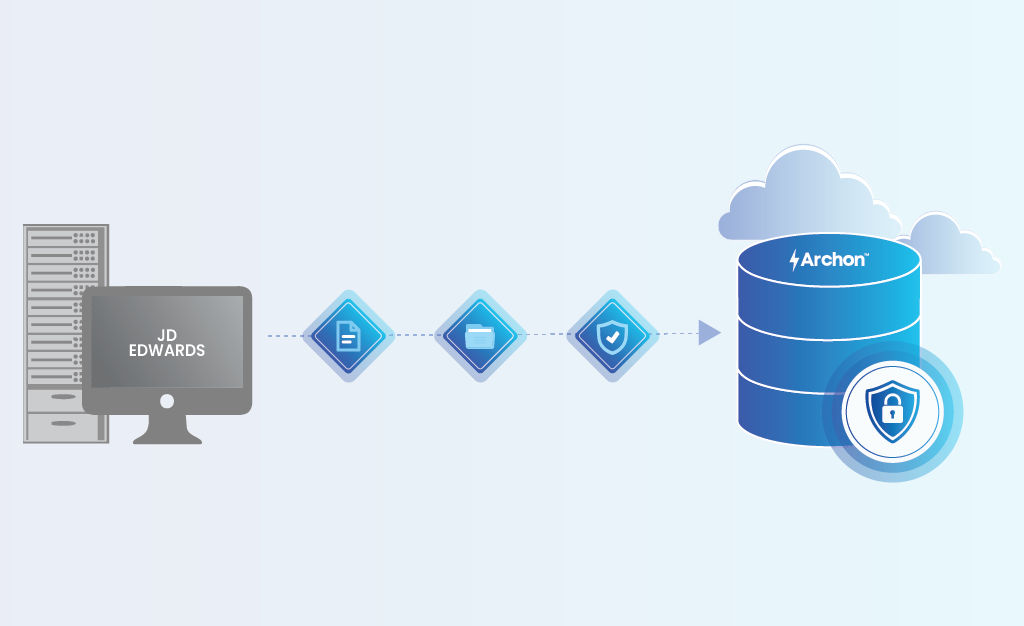
- Archon streamlines JD Edwards decommissioning through automated data extraction and secure, compliant archiving, while providing a centralized platform that ensures audit readiness, data integrity, and long-term accessibility of legacy records.
Have you heard the stories of organizations that held on to their legacy JDE systems for too long? What once powered business growth eventually became an expensive burden.
JD Edwards system – has likely been a trusted engine for years, powering payroll, finance, and supply chain operations with precision. But lately, things have started to change.
Your data keeps growing. Reports take longer to run. Maintenance and licensing costs are higher than ever. Compliance checks have become stressful because key records are buried deep inside outdated databases.
The thought of moving away from JD Edwards is appealing. Still, one question remains: what happens to all the data it holds, the financial transactions, payroll histories, and audit trails that still matter to your business?
It’s a question many organizations overlook until it’s too late. When decommissioning JD Edwards, this becomes a critical decision point.
Without a proper archiving plan, you risk data loss, compliance gaps, and losing access to vital information, issues that can disrupt your business long after decommissioning.
That’s why defining a clear archiving and data-retention strategy is essential before taking the next step. You can preserve your JDE legacy, maintain compliance, and continue to extract value from historical data with the right approach.
Why Are Organizations Retiring JD Edwards?
Business needs have evolved beyond what can be accommodated by JD Edwards, so organizations are switching out of it. As companies expand and operate in a more digital, connected world, they need platforms that offer speed, scalability, flexibility, and real-time visibility.
Reasons for JDE System Retirement and Decommissioning
As business and technology landscapes evolve, there comes a point when maintaining JD Edwards simply outweighs the benefits it provides. Here are the most common reasons organizations decide it’s time to decommission:
| Reason | Key challenges in legacy JD Edwards | Benefits of Decommissioning or Archiving |
|---|---|---|
| Reduced cost | Running JD Edwards is expensive. Licenses, infrastructure upkeep, and dependence on rare JDE expertise add up quickly. | Reduces heavy maintenance and licensing costs. Helps organizations save significant yearly expenses. |
| Enhanced security | Older JDE systems lack modern security factors such as multi-factor authentication, encryption, and regular patching. This leaves data exposed to cyber risks. | Strengthens data protection by migrating information to a modern, compliant, and secure archival environment. |
| Operational efficiency | Legacy JDE environments slow down reporting. They create data silos and limit integration with newer cloud applications. | Boosts agility and productivity by centralizing legacy data in fast, lightweight, and easily searchable archives. |
| Compliance requirements | Outdated systems fail to meet evolving standards like GDPR, SOX, and DPDPA. These require strict retention and traceability. | Ensures regulatory compliance with controlled access, audit-ready data, and automated retention enforcement. |
| Business transformation | As organizations move toward cloud-first strategies or modern ERPs like Oracle Cloud, SAP S4HANA, or Workday. JDE becomes redundant. | Supports smooth system retirement while keeping critical business data securely available for future reference. |
Want to see Archon in action?
Key Considerations Before You Decommission JD Edwards
Before decommissioning JD Edwards, establish a clear roadmap to keep your data, teams, and systems aligned.
Identify Critical Data: Determine which JDE records hold business or regulatory value, such as financial transactions, payroll histories, or audit logs, and decide what to migrate, archive, or retire.
Define Retention Timelines: Set retention periods for each data type (e.g., financial, HR, or operational) based on compliance needs like DPDPA, SOX, or GDPR to optimize storage and avoid data loss.
Map Dependencies: Trace data relationships across modules (finance, HR, supply chain) to preserve integrity and context during extraction and archiving.
Align Stakeholders: Involve IT, finance, and compliance early to ensure governance, validate data accuracy, and maintain a smooth, compliant transition.
Also Read: IBM Content Manager OnDemand (CMOD): Migration, Archiving and End-of-Life Planning Guide
The JD Edwards Decommissioning Process
Decommissioning JD Edwards is more than shutting down a legacy system; it’s a strategic process that ensures your historical data remains secure, compliant, and accessible long after retirement. A structured approach minimizes risk, costs, and safeguards business continuity.

1. Planning & Assessment
- Begin by identifying the JD Edwards environments and modules in use (Finance, HR, Payroll, Manufacturing, etc.).
- Conduct a detailed assessment of system architecture, data volumes, and integrations.
- Examine compliance obligations under SOX, GDPR, or DPDPA, and document potential security, cost, and operational impacts.
2. Dependency Mapping
- List all connected databases, reports, interfaces, and downstream applications that rely on JD Edwards data.
- Ensure continuity during decommissioning to prevent workflow disruptions.
- Document relationships between modules (e.g., GL to AP, Payroll to HR) to maintain business context post-migration.
3. Data Classification & Retention
- Categorize data based on sensitivity, business importance, and compliance requirements.
- Define what needs to be migrated, archived, or safely purged.
- Set clear retention timelines for each data type, like financial data (7–10 years), payroll (per labor law), and vendor records (as per contractual needs).
4. Data Extraction & Archiving
- Once classification is complete, extract the data securely while maintaining its integrity and context.
- To automate data extraction from JDE tables, preserve metadata, and transform it for long-term archival.
- Apply enterprise-grade security measures like encryption, access control, and full audit trails during migration.
5. Testing & Validation
- Conduct end-to-end testing to ensure data accuracy, accessibility, and compliance.
- Validate extracted datasets against JDE source records using reconciliation reports and checksum verification.
- Test query performance and audit-readiness from the new archival environment.
6. User Communication & Change Management
- Inform business users and auditors about the decommissioning timeline and new data access methods.
- Provide training or documentation on how to retrieve archived data on the secure interface.
- Clear communication ensures smooth adoption and eliminates confusion of post-shutdown.
7. System Shutdown
- Terminate all user access, disconnect integrations, and archive final logs with full traceability.
- Decommission associated servers, databases, and storage systems securely.
- Ensure that sensitive information on hardware is sanitized or destroyed according to policy.
8. Documentation & Governance
- Document each decommissioning step, from data extraction to validation, along with applied retention rules.
- Maintain compliance evidence for audits, including system access logs, chain-of-custody reports, and policy references.
- Define ongoing governance measures to handle audit requests or legal issues.

Oracle JD Edwards Decommissioning
A Complete Guide to Archive, Migrate & Retire JDE Without Compliance Risk
Industry Impact: How Key Business Functions Benefit from JDE Archiving
When you think about retiring JD Edwards, each business function faces its own challenge. Archiving ensures that no department loses the data it depends on, keeping your operations compliant, connected, and future-ready.
| Industry Requirement | Key challenges | Archiving Solutions |
|---|---|---|
| Manufacturing (Retaining valuable production and inventory insights from legacy JDE systems) | Production logs and inventory history are trapped in legacy JDE tables. This makes audits and product traceability difficult. | Archiving preserves operational data for quality audits, warranty tracking, and supply chain visibility without depending on legacy servers. |
| Finance (Keeping financial history accessible for audits and compliance) | Decades of GL, AR, and AP data must be retained for audits, reconciliations, and tax compliance. This creates a heavy load on legacy systems. | A structured archive keeps financial records searchable, export-ready, and compliant without maintaining outdated environments. |
| Supply chain (Maintaining visibility into past orders, shipments, and vendor performance) | Historical order data, shipment records, and vendor information are buried in inactive systems. This limits forecasting and analysis. | Archiving centralizes historical supply chain data. It improves long-term visibility and enables analytics while freeing modern ERP performance. |
| HR and Payroll (Securely storing sensitive employee and payroll records) | Managing sensitive employee and payroll data securely for years is difficult in legacy JDE systems. This risks non-compliance with SOX, GDPR, and labor laws. | Secure, role-based archiving with defined retention policies ensures compliance and fast access for audits or employee requests. |
A Unified Platform to Manage and Retire JD Edwards with Archon Data Store (ADS)
Retiring JD Edwards does not have to be complicated or risky. With the right platform, you can decommission your JD Edwards legacy system, migrate essential data, and archive historical records in a single, seamless process.
What if one trusted platform could handle every challenge of JD Edwards decommissioning, from data extraction to long-term compliance with complete security and ease? ArchonTM makes it possible.
Archon delivers the ultimate solution for modern JD Edwards data management through its proven solutions like Archon Analyzer™, Archon ETL™, and Archon Data Store™ (ADS).
Simplifying JD Edwards Data Transition with Archon ETL
Once you decide to retire from your JD Edwards system, the next challenge is moving your critical data safely without losing integrity or context. With years of financial, HR, payroll, and operational records stored in complex tables, you cannot simply extract and dump the data.
Archon ETL is designed to extract data from your legacy JD Edwards system at scale while preserving relationships, metadata, and business rules. Whether the data is active or historical, structured or semi-structured, Archon ETL ensures it is transformed and loaded accurately into a secure archiving environment.
Here’s how it works:
- Archon ETL organizes your JD Edwards data, separating active transactions, historical records, and compliance-critical information.
- Data is safely pulled from legacy tables without changing their structure or integrity.
- Relationships and business rules are preserved while the data is prepared for long-term storage.
- The processed data is loaded into Archon Data Store™ with full audit trails, metadata, and compliance checks intact.
Archive and Safeguard Your JD Edwards Data with Archon Data Store (ADS)
As you move forward with JD Edwards for decommissioning, it’s important to archive data for audits, reporting, and compliance. Rather than using legacy servers or static backups, these records require a secure, compliant, and searchable repository.
Built for enterprise-scale legacy systems, Archon Data Store (ADS) serves as a centralized, immutable archive that preserves every record from JD Edwards with full lineage, traceability, and legal admissibility.
Key capabilities of ADS:
1. Immutable Archiving with Full Chain of Custody
- Write-once, read-many (WORM) architectures for tamper-proof data retention.
- Digital signatures and timestamping for every archived record.
- Comprehensive audit trails recording all access and modification attempts.
- Encryption in transit and at rest is aligned with enterprise-grade security standards.
2. Compliance-Centric Data Retention and Secure Access
- Policy-driven retention management by region, function, or regulation.
- Role-based access controls (RBAC) with full audit logging.
- Automated deletion or legal hold enforcement triggered by compliance rules.
3. Scalable Storage Tiers and Data Architecture
- Hot, warm, and cold storage tiers with configurable retention timelines.
- Data compression and deduplication for storage efficiency.
- Seamless scaling for growing data volumes across hybrid environments (on-prem + cloud).
- Integration with object storage solutions (Azure Blob, AWS S3, Google Cloud Storage).
4. Data Validation, Reconciliation, and Integrity Audits
- Automated record-level checksum validation between JDE source and archive target.
- Reconciliation dashboards showing migrated vs. archived record counts.
- Integrity verification reports with full transaction lineage.
- Scheduled validation routines for periodic integrity checks post-migration.
Ready to set up your archiving?
Future-Proof JD Edwards with Archon Data Store (ADS)
If not now, then when? Legacy systems like JD Edwards have served enterprises well for years/decades, but maintaining them now often means higher costs, security exposure, and performance bottlenecks.
It’s time to turn that challenge into an opportunity.
With Archon, you can transform your JD Edwards retirement into a strategic modernization initiative. From precise data extraction using Archon ETL™ to immutable, compliance-ready storage in Archon Data Store (ADS), it ensures every record, rule, and transaction is preserved with complete integrity and accessibility.
Take the Next Step!
Every organization’s data journey is unique, but one truth remains the same: legacy data still holds untapped business value. With Archon, your historical JD Edwards data can be used for reporting, analytics, and compliance, even long after decommissioning.
Start your modernization journey today. Decommission JD Edwards with confidence, secure your data future with Archon.


