


TL; DR, Content Summary:
For years, IBM Content Manager OnDemand (CMOD) has quietly powered banks, insurers, and utility providers in managing billions of documents and reports reliably. But as technology and compliance standards evolved, CMOD didn’t. Today, many organizations find themselves with expensive, hard-to-maintain systems that hide years of valuable data behind legacy barriers.
The solution? Archon Data Store is an integrated platform designed to simplify CMOD retirement. They turn outdated CMOD repositories into a modern, searchable, and compliant data ecosystem, which reduces costs, eliminating risk, and unlocking data that is trapped in legacy silos. If your CMOD still runs critical archives, this is your blueprint to retire it safely, retain every record securely, and transform old data into a future-ready business asset.
This guide walks through why CMOD decommissioning is no longer optional and how to do it safely. It explores the growing risks of legacy archives from rising TCO and audit failures to inaccessible business intelligence and outlines a structured roadmap for migration and modernization.
Imagine an insurance company with a strong regional presence. For decades, IBM Content Manager OnDemand (CMOD) quietly powered the organization’s operations, like processing claims, storing policy information, and managing monthly statements without a hitch. Employees could retrieve records within minutes, auditors were satisfied, and business ran smoothly. CMOD was reliable, secure, and, at the time, a competitive advantage.
But as the years went by, cracks began to show. Maintenance costs crept higher, and IT teams struggled to find professionals with deep CMOD expertise. Integrating this decades-old system with modern applications became complex, and extracting historical data for reporting or analytics felt like searching for a needle in a haystack.
IBM CMOD is literally locking away years or decades of critical business data every day you don’t plan for it. These archives can hold enormous operational, regulatory, and strategic value, but only if they’re accessible, compliant, and actionable.
Holding on to CMOD forever isn’t a strategy; it’s a slowdown. The longer you wait to modernize, the tougher it becomes to manage, access, and trust the data buried inside. Now it’s more about unlocking the value hidden in archives with a smarter, simpler approach.
Think of it as the bridge between your legacy CMOD system and the modern world. Instead of wrestling with complex migrations or worrying about compliance gaps, Archon makes the whole process easier.
It automatically discovers what’s inside your CMOD data, extracts the right data securely, and moves it into a modern, compliance. With Archon Analyzer, ETL, and Data Store, all that legacy CMOD data becomes easy to access, cost-efficient to manage, and powerful enough to drive real business decisions.

A strategic guide to retire aging systems without risk. Learn how to reduce technical debt, control costs, and maintain compliance while keeping historical data accessible.
Why Do Organizations Still Rely on IBM CMOD?
IBM CMOD was transferred to UNICOM in 2015, and most older versions are now in limited or extended support.
Despite its age, IBM Content Manager OnDemand (CMOD) continues to hold a firm in many enterprise IT ecosystems. For decades, it has quietly powered the back office of BFSI, utilities, and government agencies which manage millions of reports, statements, and transactional records with reliability.

For instance, take a large insurance company processing millions of claims and policy documents every day. CMOD served as the invisible backbone that captured mainframe print streams, converted them into reports, and made them instantly retrievable. What started as a simple printing and storage solution evolved into powerful COLD (Computer Output to Laser Disk) and ERM (Enterprise Report Management) systems that became central to day-to-day operations.
Each day, CMOD handles high-volume spool files, customer statements, and operational data with ease. It could store petabytes of content, index it efficiently, and retrieve specific records within seconds. That reliability is why so many organizations still depend on it today.
- BFSI continues to store over 20 years of credit cards and statement archives.
- Healthcare providers rely on it to maintain HIPAA-compliant patient histories.
- Utilities and energy companies depend on it for managing billing, usage, and operational reports.
For years, CMOD delivered exactly what it promised: durability, compliance, and predictability. But the world around it has evolved.
Many enterprises continue to rely on CMOD because it reliably serves their needs. However, modernizing proactively ensures that data remains accessible, secure, and fully compliant, making future upgrades and integrations far easier.
“According to Gartner, by 2027, nearly 60% of enterprises will face serious compliance or operational risks tied to outdated, on-premises archives.”
Industry Snapshots with Legacy CMOD Data
Banks, hospitals, and utility providers have all depended on IBM CMOD architecture to store millions of documents from customer statements and patient histories to billing and usage reports. It’s stable, familiar, and deeply embedded in business operations.
But time has a way of changing things. The same system that once kept everything organized is now creating more problems than it solves. Formats have aged, file sizes balloon, and compliance demands have become stricter. What used to run smoothly now feels sluggish and hard to maintain.
Here’s how these challenges manifest in key industries:
1. BFSI (Banking & Financial Services)
Financial institutions continue to rely on CMOD to store decades of customer statements, transaction records, and loan documents. But with ever-growing compliance mandates like PCI-DSS and SOX, these legacy data struggle to keep pace. Slow search speeds, fragmented data, and rising maintenance costs make audits and reporting cumbersome, consuming valuable time and resources that could be spent on innovation.
2. Healthcare
Healthcare systems have long used CMOD to store patient histories, treatment records, and billing data. Yet, as healthcare regulations such as HIPAA evolve, legacy archives make it difficult to prove compliance or retrieve specific patient information. The result is delayed access to vital records, increased administrative overhead, and compliance gaps that can lead to penalties or lost trust.
3. Utilities & Energy
Utility and energy providers manage vast amounts of operational data from billing statements to usage and maintenance logs, which often spread across multiple CMOD instances. These silos prevent a unified view of business operations and hinder efforts to modernize analytics and reporting. Without integration or centralized access, decision-making slows and there are missed opportunities for efficiency.
Legacy CMOD challenges can be overcome with modern solutions that boost compliance, efficiency, and cost savings. Here’s how to tackle them effectively.
Tackling CMOD Head-On: Solutions That Work
At first glance, keeping CMOD running may feel like a safer, cheaper option. However, doing nothing entails hidden costs that increase each year, from escalating costs and licensing expenses to compliance risks, operational inefficiencies, and reduced business agility.
1. Rising Total Cost of Ownership (TCO)
CMOD wasn’t built for today’s dynamic, cloud-driven world. Between software licenses and hardware upkeep, who still know how to manage it, costs are steadily rising. Many companies don’t even realize they’re spending 30–40% more each year just to keep CMOD running compared to modern cloud archives.
The Solution:
- Perform a complete cost audit, such as custom scripts and additional storage.
- Consolidate storage and eliminate redundant systems.
- Move archives to scalable, cloud-based storage to reduce capital and operational costs.
2. Compliance Risk & Audit Failures
CMOD was never intended for the modern-day intricate regulatory environment. From GDPR and HIPAA to data residency regulations, older repositories struggle to implement retention, purging, and legal holds correctly. This creates a door of opportunity for compliance gaps, audit results, and indeed multi-million-dollar fines.
The Solution:
- Implement an automated compliance framework.
- Set clear automated retention schedules and access rules.
- Monitor activity centrally with dashboards to ensure audit readiness.
3. Operational Inefficiency
Slow searches, limited integration, and complicated indexing make even basic report retrieval time-consuming. IT teams are overworked, and business teams wait for critical information.
The Solution:
- Classify data and metadata mapping for quick retrieval.
- Use connectors or APIs to enable interoperability with modern systems.
- Simplify access without disrupting ongoing operations.
4. Loss of Business Agility
The pace of change in IT is faster than ever, and CMOD can’t keep up. Each integration, upgrade, or compliance update becomes a multi-week project. This rigidity limits how fast organizations can respond to new regulations, customer demands, or digital transformation goals.
Solution:
- Modernize with API-driven, cloud-native design
- Automate policy enforcement and enable flexible, scalable operations.
- A structured CMOD exit strategy restores IT agility.
Fixing these challenges isn’t just about keeping an old system running a little longer; it’s about rethinking how your organization manages and uses its data for the future.
Instead of pouring more time and money into maintaining CMOD, many organizations are choosing a smarter approach: retiring outdated systems safely, moving important data to modern platforms, and transforming flexible, cloud-based archives.
Planning a Successful IBM CMOD Decommissioning
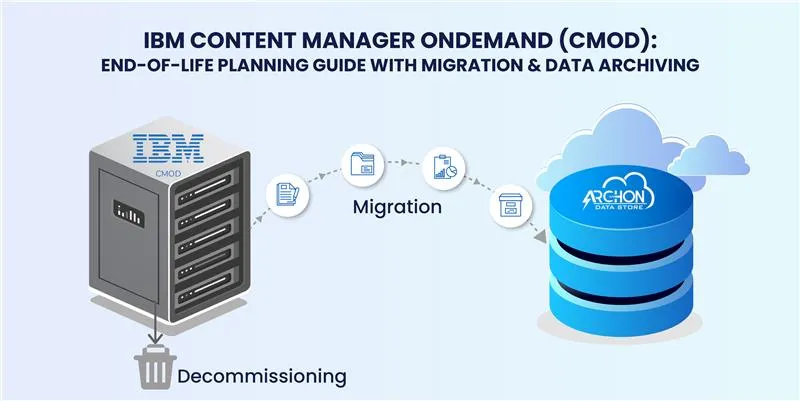
Before jumping into data migration or extraction, every successful CMOD retirement project starts with a solid plan. Here’s how a well-structured IBM cloud migration plan typically unfolds:
- Discovery: Begin by identifying all CMOD repositories, reporting objects, storage volumes, and interdependencies.
- Assessment: Assess each dataset’s value, retention needs, and compliance requirements.
- Migration: Run a controlled pilot to validate extraction logic, data mappings, and retrieval workflows.
- Decommissioning: After validation, it’s time to retire from redundant servers, and securely archive legacy data in a modern repository.
Planning is half the battle; executing it correctly is where Archon shines.
Modernize Legacy CMOD Systems with Archon
Archon brings together three seamlessly integrated components, such as Archon Analyzer for discovery and compliance assessment, Archon ETL for secure data migration, and Archon Data Store for long-term IBM archiving. Together, they create a continuous, compliant, and cost-optimized path from legacy CMOD systems to modern, analytics-ready archives.
Want to see Archon in action?
Archon Analyzer: See What’s Inside Your Archives
Before you move or retire from any data, you need clarity. Archon Analyzer scans your CMOD environment, providing a complete map of all reports, indexes, overlays, and metadata. It identifies content under retention or legal hold, flags compliance risks, and highlights outdated or unusual file formats, giving your team a clear picture of what matters most.
Archon Analyzer helps you avoid surprises and ensure all critical records are saved, migrated, or retired, ensuring that every record is preserved.
“Before Archon Analyzer, we had no idea how much of our CMOD data was under retention or legal hold. It was like opening Pandora’s box.” — IT Manager, BFSI
Archon ETL for Decommissioning and Migration
Decommissioning legacy systems starts with understanding the data you have. Once the CMOD environment is analyzed, Archon ETL (Extract, Transform, Load) streamlines the migration of petabytes of data from CMOD while preserving compliance, integrity, and accessibility.

1. Extracting Critical Data
Archon ETL performs controlled extraction from CMOD repositories regardless of file format, type, or archive data. Data migration systems handle structured (AFP, Line Data), semi-structured (PDF, XML), and unstructured (text, image, binary) content without losing any data.
2. Transforming & Mapping
Archon ETL converts legacy CMOD data structures into normalized, searchable formats optimized for modern databases and object storage. Analyzing and BI tools, governance frameworks, and analytics are supported by schema-driven mapping.
3. Defensible Deletion & Data Purge
Archon automatically applies retention policies based on regulatory and business rules. Obsolete or expired records are purged defensibly with tamper-proof logs, maintaining full compliance with GDPR, HIPAA, SOX, and legal hold requirements.
4. Schema Extraction & Auto-Indexing
CMOD schema definitions and index metadata from Load Objects (LODs) and Application Groups are dynamically extracted and restructured into query-optimized formats. This ensures archives are instantly discoverable for audit, reporting, and analytics without manual reindexing.
5. Role-Based Access Control (RBAC) & User Profiling
During migration and in the target environment, Archon enforces granular RBAC policies. User activity is logged at the session and object level, providing complete visibility into access patterns while maintaining a consistent security posture across both legacy and modernized systems.
Further Read: Application Decommissioning the Right Way: A Complete Guide for 2026
Archon Data Store (ADS): Modern Archiving Solutions
Once legacy IBM CMOD data is decommissioned and migrated, it needs a secure, efficient, and accessible home. Archon Data Store (ADS) provides a cloud-native repository specifically designed for large-scale CMOD’s, turning static legacy data into an actionable business resource.
ADS ensures that historical CMOD content remains compliant, searchable, and analytics-ready, while reducing operational overhead. It supports tiered storage, automated retention management, and advanced indexing, so organizations can quickly retrieve and analyze historical reports without relying on the old CMOD infrastructure.
1. Global Compliance-Enabled Archiving
ADS enforces retention and legal hold policies across global and regional regulations, including GDPR, HIPAA, PDPL, PDPA, PCI-DSS, SEC, FINRA, APPI, SAMA, MiFID II, DIFC, and local mandates like India’s Section 128. All archives are tamper-proof and audit-ready, ensuring your historical CMOD data remains defensible, compliant, and fully traceable.
2. Encryption and Security Controls
Security is integrated at every layer. ADS applies end-to-end encryption, Role-Based Access Control (RBAC), and automatic segregation of sensitive information, including PII and PHI. These measures prevent unauthorized access while maintaining full audit visibility for administrators and regulators.
3. Scalability and Storage Optimization
ADS is designed to grow with your data. It supports seamless scalability for expanding archives and uses tiered storage and compression to keep inactive data in low-cost tiers. This reduces storage expenses while maintaining performance and availability for frequently accessed content.
4. Cost Efficiency
By merging redundant CMOD repositories into one unified platform, Archon Data Store simplifies IT operations, reduces licensing costs, and eliminates vendor lock-in. This consolidation not only streamlines governance but also makes system administration significantly easier.
5. Fast, Compliant and Metadata Indexing
A metadata-driven index enables users to find even the oldest records quickly, while preserved schemas allow seamless reporting, trend analysis, and data-driven decisions. A complete audit trail is created for compliance, e-discovery, and internal reviews which make archived data a valuable business asset.
Move Legacy Data to Modern Storage Today
Customer Use Case: Leading Bank in Asia
Challenges:
A top bank in Asia was managing over 5 TB of legacy CMOD data from multiple core banking systems, including deposits, loans, credit cards, and ATMs. Data silos made reporting difficult, while maintaining CMOD was costly and resource intensive. The bank needed a way to consolidate data, retire from old systems, and ensure compliance.
Solutions:
- Extracted all CMOD report content and mapped it to corresponding metadata/index values.
- Migrated data into a modern archival system with validation for accuracy and integrity.
- Built a user-friendly search interface for business users to access historical content efficiently.
Outcome:
- Consolidated CMOD data into a centralized, searchable archive.
- Reduced redundant systems and maintenance costs.
- Enable fast access for analytics, compliance, and operational use.
Legacy vs. Modern: A Quick Snapshot
| Factor | Legacy CMOD | Archon Modernization |
|---|---|---|
| Retrieval Time | Minutes or hours | Sub seconds |
| Maintenance Costs | 100% baseline | 40 or 60% reduction |
| Compliance Risk | High | Automated retention and audit logging |
| Storage Cost | Fixed infrastructure | Tiered, pay as you grow |
| Access | Technical users only | Self-service, analytics-ready |
Take Control of Your CMOD Legacy with Archon Data Store
IBM CMOD has been a reliable cornerstone for enterprise archives for decades, and it presents growing challenges in recent times. Organizations cannot realize the value of their history because of inaccessible historical data, which is expensive, complex, and risky to maintain. Ignoring these issues only leads to rising costs, audit risks, and operational inefficiencies.
The time to act is now. Archon changes the equation. Take a structured approach to decommission, migrate, and archive your legacy CMOD systems with Archon, and transform your static archives into a powerful business resource.
Ready for future proof of your CMOD data? Contact us.


