

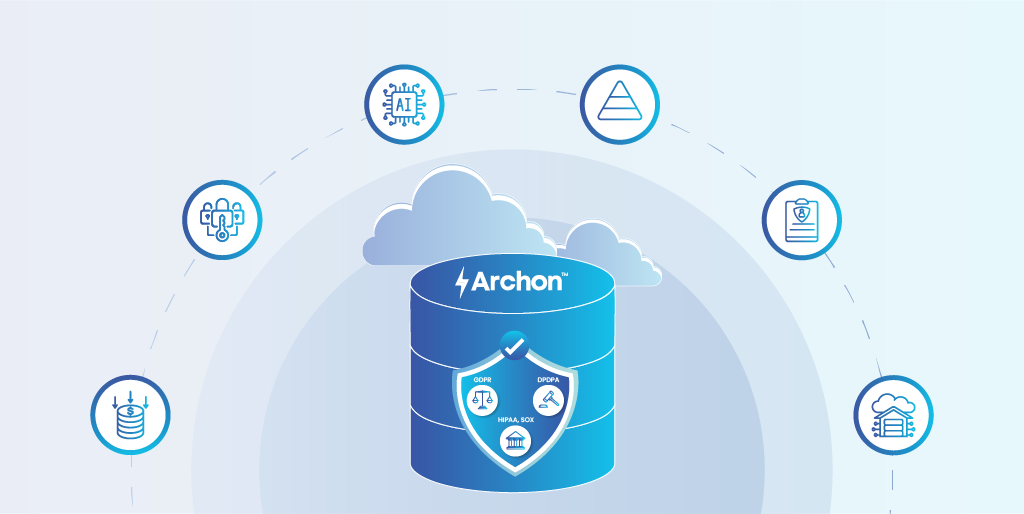

Key points:
- Enterprise data archiving best practices establish scalable, governed frameworks that manage inactive data beyond simple storage relocation.
- File-based architectures combined with multi-cloud and on-prem flexibility ensure predictable growth, infrastructure independence, and long-term migration freedom.
- Compression and automated tiering optimize cumulative storage economics while preserving retrieval performance and audit responsiveness.
- Structural preservation, immutability, encryption, legal holds, and policy-driven retention enforce evidentiary integrity and secure lifecycle governance.
- Open storage formats and AI-driven metadata enrichment protect data portability while enabling contextual discovery across structured and unstructured archives.
- A compliance-grade archiving platform like Archon operationalizes scalable, secure, and defensible enterprise archival management.
Data archiving is the structured process of moving inactive data out of production systems while preserving it for compliance, audit, and long-term business reference.
Over time, as your ERP, CRM, financial, and cloud systems accumulate historical records, production databases expand beyond optimal thresholds, infrastructure costs rise, upgrades become more complex, and legacy applications remain active solely to provide historical access.
At the same time, regulatory frameworks impose defined retention periods, immutability requirements, audit-trail standards, and defensible-deletion obligations.
The challenge you face is not simply data growth; it is the absence of structured control over historical information.
A disciplined archival framework enables you to separate inactive data from operational systems while preserving structural integrity, controlled access, and enforceable retention logic. When you implement archiving strategically, you improve production performance, strengthen regulatory assurance, control infrastructure expansion, and enable secure retirement of legacy systems.
Let’s break it down.
Data Archiving Best Practices for Enterprises
The following best practices outline how enterprises achieve these outcomes through structured archival governance.
1. Design the Archive for Scale Using File-Based or Lakehouse Architecture
Enterprise archives grow continuously as regulatory and operational history accumulates. Your archival architecture must therefore sustain long-term expansion without performance degradation or structural redesign.
A file-based, object-based, or lakehouse architecture supports horizontal scalability and read-intensive access patterns. Traditional relational databases, which are optimized for transactional throughput and frequent updates, are structurally misaligned with large-scale historical retention.
A scalable archive requires logical partitioning, robust metadata indexing, storage capacity forecasting, and defined retrieval performance benchmarks. You should align capacity planning with regulatory retention horizons rather than short-term projections.
When you build scalability into the architectural foundation, your archive remains stable and predictable as volumes increase.
2. Support Multi-Cloud and On-Prem Deployment
Enterprise infrastructure evolves due to regulatory mandates, mergers & acquisitions, geographic expansion, and cost realignment. Archival platforms must operate consistently across public cloud, private cloud, hybrid, and on-prem environments without modifying data formats, metadata structures, or retention policies.
Your archival platform must allow you to define and enforce storage location policies based on data category and governing jurisdiction. These controls should operate without requiring changes to indexing frameworks, metadata structures, or underlying storage architecture.
Workload portability is essential because enterprise infrastructure strategies evolve. Your archive should support migration across cloud and on-prem environments without requiring data re-archival, metadata reconstruction, or index rebuilding.
When infrastructure independence is engineered into the archival design, governance remains stable even as deployment models change.
3. Control Storage Economics withDataCompression
Archived data volumes increase steadily over time. Your storage strategy must manage long-term costs without compromising retrieval performance or regulatory responsiveness.
An effective archival solution implements compression and deduplication at the storage layer to reduce physical footprint while maintaining accurate indexing and search behavior. During evaluation, you should validate compression ratios, query latency, and compatibility with retention controls using representative enterprise datasets.
Compression policies must preserve audit traceability and retention enforcement. When storage optimization is engineered correctly, the archive remains cost-efficient while sustaining governance integrity.
4. Preserve Original Data Formats to Maintain Immutability and Trust
Archived records often serve as evidence during audits, litigation, and regulatory review. If structural integrity is altered during archiving, authenticity can be challenged and evidentiary defensibility weakened.
An enterprise-grade archival system must retain original schema definitions, relational hierarchies, timestamps, ownership attributes, and native document formats. Data should be stored in a manner that prevents post-archival modification while maintaining complete structural fidelity.
You should validate that archived datasets are fully reconstructable without reliance on the source application. This includes the ability to reproduce records exactly as they existed in production, with intact relationships and metadata context.
When structural authenticity and immutability are engineered into the archive, you can confidently decommission legacy systems while preserving a verifiable, defensible system of record.
5. Avoid Proprietary Storage Formats to Prevent Vendor Lock-In
Archived records frequently outlive both the applications that generated them and the vendors that supported them. If data is stored in proprietary formats, you become reliant on specific tools to read or extract that information.
An enterprise-grade archival platform ensures archived records remain accessible and portable, without long-term dependency on a specific vendor’s technology. Export mechanisms should support complete dataset extraction, including metadata and relational context, without proprietary conversion layers.
When evaluating an archival platform, verify that you can fully export and migrate archived data without loss of structure or usability. Without built-in portability, modernization efforts, vendor transitions, and long-term governance stability become significantly more complex.
6. Implement Automated Tiered Storage (Hot, Warm, Cold)
Archived data varies in access frequency. Uniform storage policies increase unnecessary cost exposure.
An enterprise-grade archival platform dynamically assigns storage tiers based on defined access patterns and inactivity thresholds. Frequently accessed datasets remain in high-performance storage, while aging records transition to lower-cost tiers without altering metadata, retention status, or access controls.
Tier movement should be governed by policy rules rather than manual intervention. Automated lifecycle transitions preserve retrieval consistency, protect audit responsiveness, and ensure storage economics scale in proportion to actual usage.
When tiering is engineered as part of the archival architecture, cost optimization becomes systematic rather than reactive.
7. Enrich Archived Data with AI-Driven Metadata and Contextual Discovery
Enterprise archives increasingly contain significant volumes of unstructured content, including documents, communications, and multimedia files. Without structured metadata, discoverability declines and audit response times increase gradually.
An intelligent archival platform integrates metadata enrichment directly into archival workflows. AI-driven techniques can automatically detect sensitive information, extract contextual attributes, classify content, and enable semantic search across extensive datasets. At the same time, enriched metadata must capture provenance details so you can demonstrate authenticity, lineage, and regulatory defensibility.
When you govern metadata intelligently, your archive evolves beyond static storage. It becomes a searchable, contextual knowledge layer that supports investigations, compliance validation, and informed decision-making.
8. Secure Archived Data with Encryption and Lifecycle Governance Controls
Archived environments frequently contain financial records, healthcare information, and personally identifiable data. Security must be integrated into the architecture.
A secure archival platform encrypts at rest and in transit protects data against unauthorized interception. Role-based access controls enforce least-privilege principles, ensuring users access only the information relevant to their function. Legal hold capabilities suspend deletion when required, and automated retention policies ensure records are removed only after defined eligibility criteria are met.
Deletion events should be fully auditable, with traceable logs documenting lifecycle enforcement. Archived environments must meet or exceed production security standards to prevent blind spots.
9. Centralize Archiving Outside Application-Specific Modules
Application-level archive features primarily reduce database load and rarely provide enterprise-wide governance consistency.
A centralized archival platform operates independently of source applications and provides uniform governance controls across multiple systems. This independence enables consistent policy enforcement, integrated search capabilities, and structured legacy system retirement without loss of historical access.
When you centralize archiving outside application ecosystems, you eliminate silos and strengthen governance oversight across the enterprise. It also reduces dependency on individual application upgrade cycles.
10. Map Retention Policies to Explicit Regulatory Mandates
Data archival and retention schedules must align explicitly with governing frameworks.
Archival logic should be formally mapped to regulations such as GDPR, DPDPA, SAMA requirements, DIFC mandates, SOX, and HIPAA. Each record class should correspond to a documented retention matrix specifying duration, jurisdiction, and deletion eligibility.
These rules must be configured directly within the archival platform rather than managed manually. Continuous monitoring is required to prevent both over-retention, which increases legal exposure, and premature deletion, which creates compliance risk.
Retention becomes defensible only when enforcement is system-driven and traceable.
Archon Data Store: A Certified, Compliance-Aligned Archival Platform
Enterprise archiving require a platform that translates governance requirements into enforceable architectural controls. Compliance, security, retention enforcement, and evidentiary integrity must be embedded into the framework, not managed manually or layered on top of storage infrastructure.
Archon Data Store is a next-generation, certified, purpose-built archival solution that is specially designed for enterprise archival.
- Policy-driven retention enforcement aligned with regulatory mandates
- Advanced metadata indexing and AI-assisted discovery
- Intelligent storage tiering (hot/warm/cold) for cost optimization
- End-to-end encryption with role-based access controls
- Immutable storage with structural preservation and audit traceability
- Infrastructure independence across cloud, hybrid, and on-prem environment
- Centralized governance outside source applications
- Seamless support for secure legacy system retirement
By embedding governance, security, scalability, and portability directly into its architecture, Archon Data Store enables enterprises to modernize confidently while maintaining regulatory assurance and operational control.
Explore how Archon Data Store can support your enterprise archival strategy. Contact us!


