


Key Points:
- ACDOCA is the central financial line-item table in SAP S/4HANA, unifying FI, CO, Asset Accounting, and profitability data into a single structure.
- The Universal Journal eliminates much of the reconciliation complexity found in SAP ECC by consolidating financial and controlling data into one source.
- ACDOCA enables real-time reporting, embedded analytics, and faster financial close processes through HANA’s in-memory architecture.
- Because ACDOCA stores richer dimensional data across multiple ledgers and currencies, it grows significantly faster than traditional ECC finance tables.
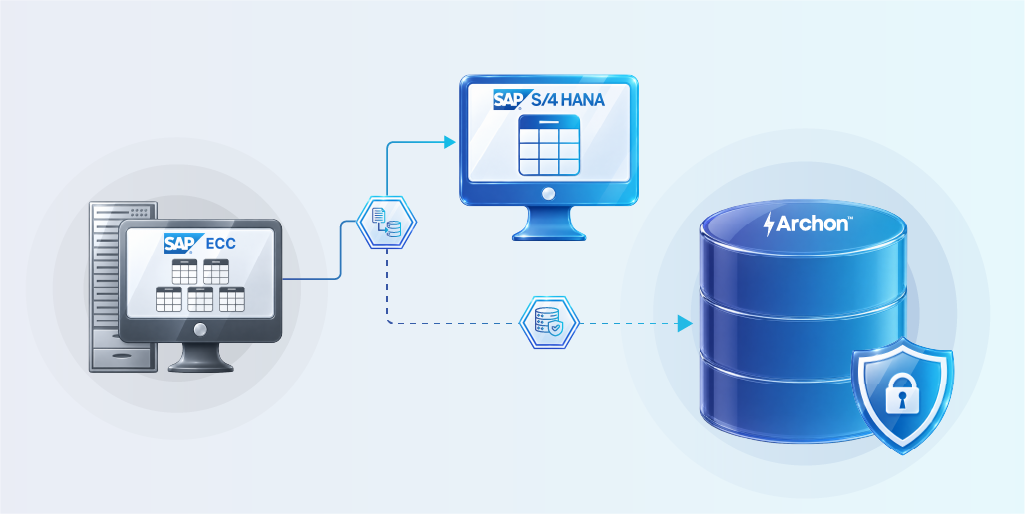
- Archon helps enterprises manage ACDOCA growth through SAP data archiving, retention governance, and long-term financial data lifecycle management.
SAP S/4HANA’s Universal Journal promised to simplify financial reporting by consolidating decades of fragmented ledger structures into a single source of truth. For most finance and IT teams, that promise delivered: real-time reporting, faster month-end close, and the end of reconciliation nightmares between FI, CO, and profitability modules.
But the Universal Journal also introduced a new operational reality that catches many organizations off guard. The ACDOCA table, which stores every financial line item in S/4HANA, grows faster and larger than the legacy tables it replaced.
Understanding how the ACDOCA table in SAP works, why it scales differently from ECC structures, and how to manage it effectively is no longer optional. It has become critical to maintaining performance, controlling data growth, and keeping S/4HANA environments sustainable over time.
Why SAP Replaced the Traditional ECC Finance Data Model
SAP ECC’s financial architecture was built incrementally over decades. New functionality got layered on top of existing structures rather than redesigned from the ground up.
The result was a distributed data model where a single business transaction could create entries across multiple tables: BKPF for document headers, BSEG for line items, specialized ledgers for cost accounting, and shadow tables for parallel valuations.
Finance teams had to reconcile data across these silos constantly. Reporting queries stitched together information from different sources. Real-time reporting was structurally impossible because data lived in different tables with different update cycles.
This created three core problems:
1. Multi-table reconciliation became procedural overhead
Maintaining consistency across ledgers demanded constant reconciliation work and introduced risk of discrepancies between FI and CO totals.
2. Reporting complexity limited analytical flexibility
Building custom reports required understanding complex table relationships and joins, which slowed development and created dependencies on technical resources.
3. The architecture couldn’t scale with modern enterprise requirements
Supporting parallel accounting standards, multiple currencies, and segmented profitability analysis meant bolting on additional tables and custom code.
S/4HANA’s redesign centered on eliminating this distributed structure entirely. The Universal Journal collapses what were previously dozens of separate tables into a single, unified structure. Every financial posting writes to the same source, whether it originates in FI, CO, or MM.
This wasn’t just database consolidation. It represented a fundamental shift in how SAP structures financial truth. Where ECC forced you to trust that reconciliation processes kept ledgers aligned, S/4HANA simplifies reconciliation by storing financial and controlling postings within a unified journal structure.
The shift to HANA’s in-memory architecture made this consolidation technically feasible. Column-store databases excel at aggregating large datasets quickly, which meant SAP could eliminate the pre-aggregated summary tables that ECC relied on for performance. Instead of maintaining separate totals tables, S/4HANA calculates aggregations on demand from the raw line item data in ACDOCA.
This trade-off works brilliantly for reporting but changes how organizations need to think about data volume management.
What Is the ACDOCA Table in SAP S/4HANA?

ACDOCA is the Universal Journal table that stores every financial line item in S/4HANA. Think of it as the complete, timestamped ledger of your enterprise’s financial activity, capturing not just the accounting entries but the full dimensional context of each transaction: cost center, profit center, segment, trading partner, functional and group currency amounts, and any custom characteristics your organization tracks.
Unlike ECC’s BSEG, which stored line items separately from their controlling or profitability context, ACDOCA embeds all dimensions in a single wide row.
When you post an invoice that touches both financial accounting and cost accounting, S/4HANA writes one set of line items to ACDOCA containing both the GL account assignment and the CO object assignment. This eliminates the joins and cross-table lookups that slowed ECC reporting.
The table structure reflects this consolidation. ACDOCA contains over 200 standard fields covering financial amounts in multiple currencies, quantity fields, assignment fields, valuation views, partner information, and extensions for industry-specific attributes.
Each line item carries a unique identifier combining the accounting document number, ledger, and line item number, plus temporal fields that enable point-in-time reconstruction of financial position.
What makes ACDOCA particularly powerful is its support for parallel ledgers and multiple accounting principles within the same table.
A single transaction can generate entries for IFRS, local GAAP, tax reporting, and management accounting simultaneously, all stored as separate line items differentiated by the ledger dimension. This native multi-ledger capability eliminates the need for the separate reconciliation ledger that ECC required.
However, this consolidation comes with a data volume implication. Because ACDOCA stores full dimensional detail for every transaction variant, it accumulates records faster than the aggregate of ECC’s BKPF and BSEG tables.
A company posting to three ledgers with segment reporting will write at minimum three times the line items for each business transaction compared to basic ECC posting. Add in additional valuations, group currencies, or parallel cost center assignments, and the multiplication factor increases.
It’s also worth noting that ACDOCA uses a different primary key structure than BSEG. Where BSEG used MANDT + BUKRS + BELNR + GJAHR + BUZEI, ACDOCA adds RLDNR (ledger) as a key field to support S/4HANA’s multi-ledger architecture. This means the same document number can exist multiple times in ACDOCA across different ledger views.
How the Universal Journal Simplifies SAP Finance
The Universal Journal simplifies reporting, reconciliation, and financial analysis by bringing multiple finance components into a single structure.
Unified Financial and Management Reporting
The Universal Journal delivers on the promise of single-version-of-truth reporting. Finance teams can run P&L statements, balance sheets, cash flow analysis, and profitability reports directly from ACDOCA without waiting for overnight batch jobs to reconcile ledgers. The same dataset that feeds statutory reporting also drives management accounting and segment reporting, eliminating the question of which report to trust.
Faster Month-End Close and Reconciliation
Month-end close cycles compress significantly because there’s nothing to reconcile. Where ECC finance teams spent days verifying that FI totals matched CO totals matched profitability segment totals, S/4HANA users verify only that the right postings occurred. The data consistency is architectural, not procedural. Error correction focuses on business logic rather than technical synchronization.
Real-Time Reporting and Analytics
Real-time reporting becomes standard practice rather than aspiration. Executives can drill from summary dashboards into transactional detail without hitting separate systems or waiting for data warehouse updates. The elimination of aggregation tables means reports always reflect the current state of ACDOCA. Users running SAP Fiori analytical apps query the same Universal Journal that closes the books.
Multi-Ledger Support for Complex Organizations
For organizations with complex legal structures or multiple accounting standards, the multi-ledger capability eliminates substantial custom development. Instead of building parallel shadow ledgers or maintaining separate instances, companies configure ledger variants within S/4HANA and let the system manage the multiplicity. Transfer pricing adjustments, group eliminations, and local statutory requirements all post to their respective ledgers in ACDOCA.
Flexible Dimensional Analysis
The architecture also enables analysis patterns that were impractical in ECC. Because every line item carries full dimensional attribution, you can slice financial data by any combination of characteristics without pre-aggregation. Ad-hoc profitability analysis by product-region-customer segment doesn’t require running special profitability modules. It’s a standard ACDOCA query with the right filters.
BKPF vs BSEG vs ACDOCA: Understanding the New Financial Data Structure
In ECC, the document header table BKPF stored one row per accounting document containing posting date, document type, reference information, and control fields. BSEG held the line items, with each row representing one line of the document: typically one GL account, one customer, or one vendor line.
The relationship was one-to-many, with one BKPF row to many BSEG rows. Reporting queries joined these tables along with controlling tables like COEP for cost postings.
S/4HANA retains BKPF in a compatibility mode. It still exists but serves mainly as a view layer for legacy transactions and custom code that expects the old structure. The actual financial line items write to ACDOCA, which plays the role BSEG did but with far richer attribution.
Where BSEG might store 50 to 60 fields per line item, ACDOCA stores over 200, encompassing everything from traditional accounting fields to full controlling object assignments to profitability segment details.
The critical architectural difference is that ACDOCA doesn’t just replace BSEG. It absorbs data that previously lived in CO tables, profitability tables, and special ledger tables. A single ACDOCA line item might contain what ECC stored across BSEG, COEP, and CE4xxxx tables. This consolidation eliminates joins but demands more storage per line item.
The line item multiplier effect becomes visible here:
- An ECC invoice might generate one BKPF row and five BSEG rows
- The same transaction in S/4HANA can generate fifteen or twenty ACDOCA rows if multiple ledgers, segments, and valuation views are active
- Each ledger variant creates a separate set of line items; each parallel valuation creates additional rows
- The total ACDOCA row count after migration often exceeds the combined BKPF and BSEG counts from ECC, even for the same transaction volume
For companies transitioning from ECC, this structural shift affects both migration strategy and ongoing operations. Legacy custom code that directly queries BSEG needs refactoring to read from ACDOCA or the compatibility views SAP provides. Reporting logic built around BKPF-BSEG joins translates to simpler ACDOCA queries but requires understanding the new field mappings.
| Aspect | SAP ECC | SAP S/4HANA |
|---|---|---|
| Document Header | BKPF (one row per document) | BKPF (compatibility view only) |
| Line Items | BSEG (50-60 fields per line) | ACDOCA (200+ fields per line) |
| Controlling Data | Separate CO tables (COEP, etc.) | Embedded in ACDOCA |
| Profitability Data | Separate CE tables (CE4xxxx) | Embedded in ACDOCA |
| Typical Line Items per Transaction | 1 BKPF + 5 BSEG rows | 15-20 ACDOCA rows (with multiple ledgers/segments) |
| Reporting Query Pattern | Multi-table joins (BKPF + BSEG + COEP + CE) | Single-table filter on ACDOCA |
| Data Consistency | Reconciliation-dependent | Architectural (single source) |
This structural transformation means migration planning must account for not just data conversion but the fundamental difference in how S/4HANA writes and stores financial transactions.
Key Fields and Architecture of the ACDOCA Table
The ACDOCA table in SAP organizes its field structure into functional groups that reflect the Universal Journal’s consolidation purpose. Understanding the core field categories helps clarify how the table supports both transactional posting and analytical reporting.

Document Identifier Fields
Document identifiers form the primary key: company code, fiscal year, accounting document number (BELNR), ledger (RLDNR), and line item number. These fields uniquely identify each line item and support document-level operations like reversal or parking.
Amount and Currency Fields
Amount and currency fields store values in multiple perspectives simultaneously. A typical line item includes transaction currency amount, local currency amount, group currency amount, and potentially additional parallel currency amounts. For quantity-based postings, the table captures both value and quantity with corresponding unit fields. This multi-currency native capability eliminates the need for separate currency translation tables.
Dimensional Assignment Fields
Dimensional assignment fields embed the controlling and profitability context directly in each line:
- Cost center, profit center, functional area, and segment appear as standard columns
- You can filter ACDOCA by cost center without joining to a separate CO table
- Profitability characteristics like customer group, product hierarchy, or sales organization sit directly on each line item
- This means ad-hoc analysis by any combination of dimensions becomes a filter operation rather than a multi-table join
Account Assignment Fields
Account assignment fields provide the traditional FI context: GL account, customer, vendor, asset, material. These fields link ACDOCA to master data but also support direct queries.
Finding all postings to a specific GL account is a simple filter operation. The account type field distinguishes between different posting categories, enabling queries that target only customer line items or only GL line items.
Temporal and Control Fields
Temporal and control fields enable audit and system management functions. Posting date, document date, entry date, and time fields support both transaction sequencing and regulatory reporting requirements.
The fiscal period and year fields facilitate period-close operations. Status fields indicate whether a line item is parked, cleared, or posted.
The table’s physical implementation as a column-store structure in HANA affects performance characteristics. Column-oriented storage compresses repetitive values efficiently: thousands of line items posting to the same cost center store that cost center value once with a reference structure.
This improves reporting performance but also makes long-term data management and partitioning important as ACDOCA scales.
How ACDOCA Transforms Financial Reporting and Data Management in S/4HANA
The following areas show where ACDOCA makes the biggest difference in S/4HANA Finance.
Single-table financial reporting
The shift from multi-table queries to single-table analysis fundamentally changes how finance teams interact with their data. In ECC, building a segment P&L required joining BSEG to profitability tables, filtering by segment characteristics, and aggregating across multiple ledgers.
In S/4HANA, the same report becomes a filtered aggregation query against ACDOCA: select the ledger, apply the segment filter, and sum by GL account. The simplification significantly improves reporting speed while eliminating reconciliation risk.
Faster custom reporting and analytics
Custom reporting development accelerates because analysts can prototype queries directly in HANA Studio or SAP Analytics Cloud without needing to understand complex table relationships.
A business user who understands segment definitions and account structures can build meaningful analysis without deep technical knowledge of SAP table architecture. This reduces IT reporting backlogs and shortens the cycle from question to answer.
Real-time financial close and reconciliation
Period-end closing processes benefit from the Universal Journal’s real-time consistency. Accruals, deferrals, and closing entries post to ACDOCA and become immediately visible across all ledger views.
Traditional batch reconciliation jobs that compared FI, CO, and special ledgers become unnecessary. Finance teams spend less time validating data synchronization and more time verifying transaction accuracy.
Improved auditability and transaction traceability
Audit trails strengthen because every line item in ACDOCA traces back to a source document while carrying full dimensional context. External auditors can drill directly from financial statement line items into supporting transaction details without navigating multiple systems or requesting custom extracts.
The completeness of dimensional data also enables highly specific audit queries across customer types, regions, products, or reporting periods.
Data growth and long-term performance management
The consolidation of all financial postings into ACDOCA introduces new data volume considerations. Because the Universal Journal accumulates records faster than the legacy tables it replaced and supports all financial operations centrally, organizations must actively manage table growth and storage performance.
Companies processing millions of annual line items in ECC can quickly scale to tens or hundreds of millions of records in ACDOCA, especially when advanced functions like margin analysis or material ledger are enabled.
Managing ACDOCA Growth, Performance, and Archiving in S/4HANA Environments
ACDOCA’s growth rate surprises most organizations during their first year on S/4HANA. The table accumulates line items from every financial posting across all ledgers, and unlike ECC where some data aged into archive tables automatically, S/4HANA keeps all line items in ACDOCA by default.
A mid-sized enterprise running three ledgers can easily generate 50 million new line items annually. Over a typical seven-year retention period, that approaches 350 million rows before considering mergers, acquisitions, or business growth.
This volume directly affects system performance. While HANA’s in-memory architecture handles large datasets well, queries still slow as ACDOCA grows into the hundreds of millions of rows.
Month-end close jobs, which query multiple fiscal years of data for comparison reporting, begin showing latency. Real-time dashboards that aggregate across full transaction history take longer to refresh. The HANA database size grows, driving up memory costs and backup windows.
SAP’s native archiving approach:
- The FIN_ACDOC archiving object moves closed fiscal period data to offline archive files
- Residence time controls when line items become eligible for archiving
- SAP recommends keeping at least two to three years of closed fiscal period data online to support comparative reporting and audit requirements
- Line items from older closed periods can move to archive files, but organizations must balance storage savings against retrieval complexity
- Archiving requires that all preceding fiscal years for that ledger are already archived, meaning you cannot selectively archive specific periods while leaving gaps
The challenge is that archiving the ACDOCA table in SAP removes transaction detail from the live system entirely. Because ACDOCA is the single source of truth, archived data becomes less accessible.
Unlike ECC where archiving old BSEG data while keeping summary tables maintained reporting capability, archiving ACDOCA means losing the ability to query that data in real time.
Archiving ACDOCA also requires archiving related objects: BKPF headers, asset documents, material documents. This interdependency means you can’t simply archive financial line items in isolation.
You’re archiving complete business transactions across modules. The prerequisite checks SAP builds into the archiving process enforce this integrity but add complexity to archive program execution.
Beyond archiving, organizations implement strategies for partitioning and compression. HANA supports table partitioning by fiscal year or other criteria, which improves query performance by limiting the data scanned.
Monitoring ACDOCA’s growth trajectory and implementing partitioning before the table grows unwieldy prevents the need for disruptive reorganization later.
The larger question is how to balance keeping sufficient data online for analysis against controlling the costs and performance impacts of unlimited growth:
- Finance teams need access to multi-year trends for planning and variance analysis
- Audit and compliance functions require the ability to retrieve and analyze historical transactions on demand
- Business users expect consistent performance whether they’re querying current period data or three years of history
Managing these competing requirements demands a data lifecycle approach that goes beyond periodic archiving.
How Archon Data Store Helps Enterprises Sustainably Manage ACDOCA Data Growth
Organizations moving to S/4HANA often discover that the Universal Journal’s performance promise depends on actively managing its size. Leaving ACDOCA to grow unchecked eventually degrades the responsiveness that attracted them to the platform.
Native SAP archiving addresses this but introduces retrieval friction: archived data moves to offline files that require separate access procedures and can’t participate in real-time queries.
Archon Data Store provides an alternative approach that maintains immediate access to archived financial data while removing volume pressure from the live S/4HANA system.
Rather than moving old line items to opaque archive files, Archon migrates ACDOCA data to a Lakehouse-based repository where it remains fully queryable and integrates seamlessly with reporting tools.
The architecture preserves the Universal Journal’s analytical advantages for historical data. Line items moved to Archon retain their full dimensional attribution: all 200+ fields from ACDOCA transfer intact. Users running trend reports spanning five years query a unified dataset that combines live S/4HANA data with archived Archon data transparently.
There’s no conceptual difference between analyzing last month’s transactions and analyzing transactions from three years ago. Both respond to the same query patterns.
Key capabilities for ACDOCA lifecycle management:
- Retention orchestration lets finance and IT teams define policies that automatically move ACDOCA line items based on age, document type, or business criteria
- Immutability and legal hold meet regulatory requirements while improving access speed compared to traditional SAP archive files
- Cross-application search means archived ACDOCA data remains discoverable alongside other archived enterprise data: vendor invoices, customer correspondence, procurement documents, HR records
For audit and compliance scenarios, Archon’s structure delivers faster access than retrieving from traditional SAP archive files. Auditors requesting transaction samples from closed fiscal years receive results faster because the data resides in an indexed, queryable structure rather than flat archive files requiring sequential reads.
From a system performance perspective, keeping ACDOCA lean improves both transactional posting speed and reporting response times.
Month-end close jobs run faster when they’re processing two years of online data instead of five. Dashboard aggregations respond quicker. HANA memory costs stabilize because the database isn’t constantly expanding.
These performance gains compound over time as the organization grows transaction volume without proportionally growing the live system footprint.
Final Thoughts
The Universal Journal represents one of SAP’s most significant finance architecture shifts in decades. By consolidating financial and controlling data into ACDOCA, S/4HANA enables real-time reporting, simplified reconciliation, and greater analytical flexibility than ECC environments could realistically support.
But the same architecture that makes the ACDOCA table in SAP powerful also changes how organizations need to think about long-term SAP data management.
As transaction volumes grow across multiple ledgers, currencies, and valuation views, maintaining performance becomes closely tied to how effectively financial data is governed, retained, and archived over time.
The key is balance. Organizations need enough historical data online to support reporting, planning, and compliance requirements without allowing ACDOCA to grow into an uncontrolled performance burden. That requires a lifecycle strategy that combines retention governance, scalable archiving, and accessible historical reporting.
If you’re managing ACDOCA growth in a live S/4HANA environment or planning your migration strategy, evaluate a sustainable lifecycle strategy with Archon.
Getting this balance right means your S/4HANA environment continues delivering the speed, visibility, and operational efficiency that justified the migration investment in the first place.


