


Key Points
- SAP ADK is designed for archiving, not decommissioning. It helps reduce database growth and improve SAP performance by moving inactive data into archive files while keeping it accessible through SAP.
- Many SAP ECC retirement projects stall because historical data remains dependent on the SAP environment. Audit, compliance, and reporting requirements often force organizations to keep ECC running in read-only mode.
- Archived data access is the biggest differentiator. SAP ADK archives data within the SAP ecosystem, whereas decommissioning projects require access to historical data without relying on SAP infrastructure or licenses.
- Compliance requirements extend well beyond migration. Organizations must retain financial, HR, tax, and operational records for years while ensuring accessibility, retention management, legal hold, and audit readiness.
- SAP ADK excels at database optimization within active SAP environments. Its native archiving objects support major SAP modules and maintain data relationships, making it a strong choice for ongoing ECC operations.
- Modern decommissioning initiatives often involve multiple legacy applications. Retiring SAP ECC alongside platforms such as Oracle EBS, PeopleSoft, and JD Edwards requires a broader strategy than SAP-only archiving tools can provide.
- Archon enables compliant data retention while supporting complete SAP ECC retirement. By preserving historical data independently of the source system, Archon allows organizations to decommission SAP infrastructure, eliminate ongoing maintenance costs, and maintain secure access to archived information for audits, compliance, and business reporting.
SAP ADK will not decommission your ECC system. Read it again!
Most SAP ECC decommissioning projects do not fail because of migration challenges. They fail because historical data remains trapped inside the legacy environment.
The S/4HANA migration goes live. Users move to the new platform. The project appears complete. Yet years later, the ECC system is still running in read-only mode because finance, compliance, legal, or audit teams still need access to historical records.
At the center of many of these discussions are two archiving approaches: SAP ADK and Archon.
Although both preserve SAP data, they were designed for very different outcomes.
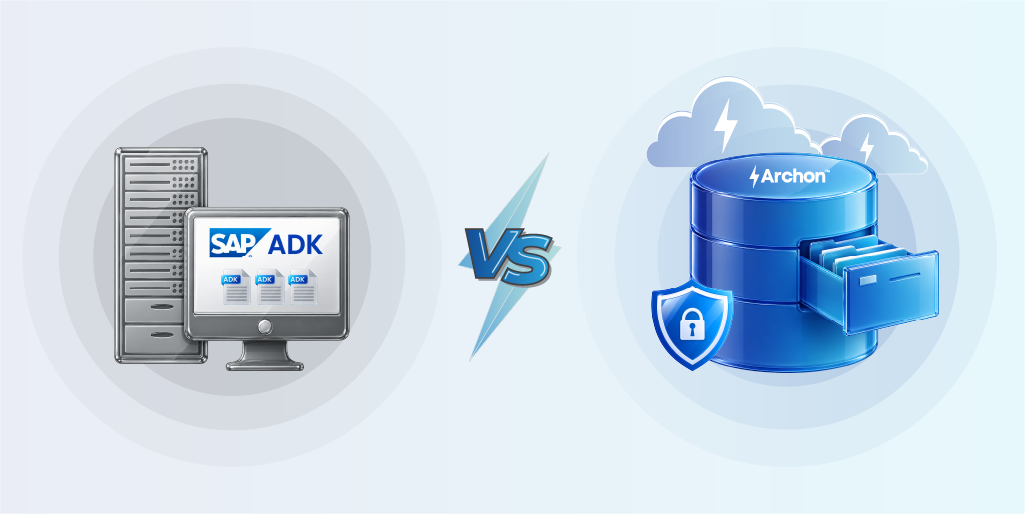
SAP ADK was built to archive data within a running SAP environment. Archon Data Store was built to preserve data after the source system retired.
Understanding that distinction is often the difference between reducing database size and actually shutting SAP ECC down.
This comparison works through SAP ADK and Archon Data Store dimension by dimension, across the capabilities that determine whether an ECC instance ever actually gets switched off.
What is SAP ADK?
SAP ADK (Archive Development Kit) is a framework within the SAP environment that provides the technical infrastructure: archiving objects, ABAP programs, monitor transactions (SARA), and file management routines, through which SAP applications move data from active database tables into archive files (.adf format) stored on a connected file system or certified content repository.
SAP ADK archiving process involves:
- Identifying eligible data
- Writing data from database tables to archive files
- Deleting archived data from the active database
- Retrieving archived data through SAP transactions when needed
The predefined archiving objects understand the relationships between SAP tables and ensure data is archived in the correct sequence.
Why SAP ECC Decommissioning Projects Stall
Most organizations encounter one or more common problems.
The Ghost System Problem
SAP ECC remains operational solely to service occasional audit requests, historical reporting, or regulatory inquiries. The system delivers little business value yet continues generating infrastructure, licensing, and support costs.
The Compliance Illusion
Many organizations assume that data remaining inside a live ECC environment is automatically compliant. In reality, audit-ready archives require retention controls, legal hold capabilities, and long-term accessibility independent of the source system.
The Footprint Problem
Projects reach the final stage of decommissioning only to discover that archived data still depends on SAP for retrieval, preventing complete system retirement.
The consequence is that ECC decommissioning projects stall, not for technical reasons, but because the wrong tool was chosen at the wrong stage.

SAP ADK: Built for Archiving Within SAP
SAP ADK (Archive Development Kit) moves older records from active database tables into archive files, helping organizations reduce database growth and improve SAP performance.
SAP ILM (Information Lifecycle Management) extends ADK by adding:
- Retention management
- Legal hold capabilities
- Compliance controls
- Integration with certified archive repositories
For organizations that intend to continue operating SAP ECC, ADK remains a proven and effective archiving solution. The limitation is architectural.
Archived data remains dependent on SAP retrieval mechanisms such as the Archive Information System. Access to archived information continues to rely on the SAP environment.
SAP ADK’s SAP-Native Strength
ADK’s technical depth inside SAP is genuine. Pre-built archiving objects cover the major SAP modules; FI (financial documents, payment advice, asset accounting), CO (cost objects, controlling documents), MM (purchase orders, inventory management), SD (sales documents, billing), and HR (payroll results, time management).
These archiving objects handle the referential integrity requirements of SAP’s data model, ensuring dependent records are archived together in the correct sequence.
- SARA transaction: Central monitor for scheduling, executing, and analyzing archiving runs by archiving object
- TAANA (Table Analysis and Archiving): Identifies archiving potential by table, guiding which objects to prioritize
- DB02: Database space analysis for monitoring archiving impact on database size
- Custom archiving objects: ADK supports custom Z-table archiving via ABAP development, but each custom object requires its own archiving program, typically months of development per complex object
- GOS / SOFFCONT1: Generic Object Services attachments are archived via ArchiveLink (OAC0 configuration) to a certified content repository, not directly by ADK
Archon Architecture – Built to Safely Turn the Source System Off
Archon is built for SAP system decommissioning. Archon Data Store approaches SAP archiving from a different perspective.
Instead of preserving data inside the SAP ecosystem, Archon extracts and stores information independently of the source application.
Data can be extracted through:
- BAPI
- RFC
- ABAP connectors
- Direct database extraction
Once archived, the data can be searched, reported on, and accessed without SAP infrastructure or SAP licensing.
The platform supports SAP ECC alongside more than 200 enterprise applications, including:
- Oracle E-Business Suite
- PeopleSoft
- JD Edwards
- Legacy HR systems
- Enterprise content management platforms
This allows organizations to retire multiple legacy systems using a single archive platform.

SAP ECC Archiving Playbook
A Practical Guide for Archiving SAP ECC Data Before S/4HANA Migration Without Increasing Cost or Compliance Risk
Compliance Architecture: SAP ADK vs Archon
Regulatory compliance post-decommission is not an afterthought. For most enterprises retiring SAP ECC, the archived data estate carries retention obligations spanning 7–10 years (IRS, HMRC, GoBD), up to 30 years for certain ERISA and pension records, and indefinite holds for active litigation. The archive platform must enforce these obligations without requiring the source system to remain operational.
SAP ADK / ILM Compliance Capabilities
- Rules-based retention in ILM Customizing: records are locked from destruction until the retention period expires, enforced within the SAP instance
- Legal hold in SAP ILM: destruction blocking for litigation-identified records, managed via ILM Object Administration
- Audit logging within SAP: change documents and ILM action logs provide a degree of audit trail within the SAP system
SAP ADK / ILM Compliance Gaps
- No native WORM: ADK archive files are not write-protected by the ADK layer itself. WORM compliance (SEC 17a-4, FINRA 4370) requires a certified third-party object store: adding cost, complexity, and a second vendor dependency
- No cryptographic immutability: ADK does not hash records at ingestion. There is no native mechanism to prove that an archived record has not been modified since archiving, a requirement in evidentiary contexts
- Retention enforcement tied to live instance: ILM retention rules and legal holds exist as configuration in the SAP system. If the SAP instance is decommissioned, those rules are gone unless re-implemented in a separate platform
- GDPR limitations: SAP ADK has no native pseudonymization capability. Right-to-erasure workflows for archived personal data require custom ABAP development or third-party tooling
Archon Compliance Architecture
- Cryptographic hashing at record level: SHA-256 hash computed at ingestion, stored alongside each record. Any post-ingestion modification produces a hash mismatch, detectable immediately
- Trusted timestamps: Each archiving event is time-stamped against a trusted authority, creating a legally defensible record of when data was archived
- WORM enforcement: Native write-once-read-many storage at the archive layer, meeting SEC Rule 17a-4, FINRA 4370, and CFTC requirements without third-party dependency
- Jurisdiction-aware retention: Retention schedules configured for IRS (7 years), FLSA (3 years for wage records), ERISA (6 years for plan records), GDPR (purpose-limited), HMRC (6 years), and India DPDP Act, enforced at the archive layer independently of any source system
- Legal hold across all retired systems: A single hold instruction in Archon locks the relevant records across every decommissioned application; SAP ECC, Oracle EBS, PeopleSoft, and others, in one action
- GDPR and PII: Native pseudonymization at ingestion, role-based access controls, data masking for sensitive fields, and right-to-erasure workflows that operate on archived records without requiring the source system
The compliance gap between ADK and Archon is not marginal. ADK’s compliance capabilities are real but system-dependent; they disappear when the SAP instance does.
Archon’s compliance architecture is self-contained: immutability, WORM, retention, legal hold, and audit trail exist independently of the source system.
Decommissioning Capability: SAP ADK vs Archon
Decommissioning means retiring the source system entirely: no running instance, no active license, no infrastructure footprint. Every other archiving benefit is secondary to this outcome if the business case for decommissioning was the original mandate.
What SAP ADK Delivers
- Data archiving within SAP – moves records from active tables to archive files, reducing database size and improving system performance
- ILM-managed retention policies configured within SAP Customizing – records are locked from deletion until the retention rule permits disposition
- Legal hold in SAP ILM – prevents destruction of records subject to litigation or regulatory hold, within the SAP estate
- Archive Information System – allows retrieval of archived records within the SAP GUI, using pre-defined archive information structures
- DART compliance for tax regimes: GoBD (Germany), GDPdU, and equivalent structured-data audit requirements are natively supported
What SAP ADK Cannot Deliver
- System retirement: ADK archives data in SAP-proprietary format. Retrieval depends on the SAP instance. Decommissioning the SAP instance makes archived data inaccessible via standard interfaces.
- Post-decommission DART reproduction: Tax authorities can request reproduction of DART extracts years after the original filing period. Without a running SAP instance, ADK has no mechanism to reproduce these on demand.
- Non-SAP retirement: ADK has no connectors for Oracle EBS, PeopleSoft, JD Edwards, or any non-SAP platform. Multi-system carve-outs require a different tool for every non-SAP application.
- License independence: SAP’s license agreements require active maintenance contracts to access ILM features. Post-decommission access to ADK-managed archives is not included in standard license termination clauses.

What Archon Delivers
- Complete system retirement: ECC license and infrastructure retired after extraction; no ongoing SAP dependency
- Multi-system retirement: Decommissions SAP ECC, Oracle EBS, PeopleSoft, JD Edwards, and legacy non-ERP platforms in a single archiving program
- Standalone retrieval interface: Archived data accessible via Archon’s web interface, no SAP GUI, no SAP license, no SAP infrastructure
- Cross-application search: A single query interface spans all retired systems simultaneously: FI transactions from ECC, payroll records from PeopleSoft, purchase orders from JD Edwards, as if they were in one system.
Archon: SAP Depth Plus System-Exit Capability
Archon operates at the extraction layer rather than the archiving-object layer. This distinction matters: Archon does not depend on SAP-defined archiving objects and their ABAP programs, it extracts directly from tables, via BAPI, then applies its own transformation and mapping logic.
- ABAP connector: Direct extraction via ABAP programs for complex data models, custom Z-tables, and industry-specific modules (IS-U, IS-H, IS-Retail), without requiring ADK archiving objects to exist
- BAPI / RFC: Standard SAP interfaces used where available, reducing dependency on database-level access
- GOS / SOFFCONT1: Native extraction of GOS attachments, linked documents, and SOFFCONT1 objects, preserved with their parent transaction context in the archive
- Custom Z-tables: Handled via Archon’s ABAP extraction connector and custom mapping layer, no ADK archiving object development required
- 1,000+ transformations: Data normalization, format conversion, pseudonymization, currency translation, and reference-data enrichment applied at ingestion
How much is your legacy SAP system costing you every year?
Discover the savings potential of retiring ECC while keeping historical data accessible and compliant.
Decommissioning Scenario Fit: SAP ADK vs Archon
The right choice depends on the business objective. If the goal is database optimization, SAP ADK remains the native solution.
If the goal is complete system retirement, organizations typically require a platform designed for decommissioning.
| Decommissioning Scenario | Archon | SAP ADK | Why It Matters |
|---|---|---|---|
| S/4HANA migration — clean cutover, ECC retired | ✔Archon | ✘ADK | ADK keeps ECC alive as the retrieval system. Archon lets you close it. |
| Multi-system carve-out (SAP + Oracle + PeopleSoft) | ✔Archon | ✘ADK | ADK is SAP-only. Archon handles cross-application retirement in one platform. |
| Regulatory audit with chain-of-custody requirement | ✔Archon | ⚠ADK | ADK audit trail depends on SAP change logs and content repository. Archon’s immutable chain of custody is native and independent. |
| Litigation hold across decommissioned systems | ✔Archon | ✘ADK | ADK legal hold is SAP-bound. Archon enforces holds across all retired applications. |
| GDPR right-to-erasure in archived HR payroll data | ✔Archon | ✘ADK | ADK has no native pseudonymization or erasure workflow for archived records. Archon handles PII masking and controlled erasure at the archive layer. |
| Database size reduction on a live ECC instance | Partial | ✔ADK | ADK is the right tool here — Archon is optimized for retirement, not in-system housekeeping. |
The Total Cost of Choosing the Wrong Tool
The business case for an archiving tool is rarely made on the basis of the tool alone. It is made on the basis of what happens after the tool is deployed; specifically, whether the SAP licence can be surrendered.
An ECC instance maintained in read-only mode carries costs that are rarely assembled in a single line item: SAP maintenance fees (typically 18–22% of license value per annum under standard support contracts), infrastructure (compute, storage, backup, DR), basis administration, security patching, and periodic audit support. For mid-market to enterprise ECC estates, this number is routinely in the $500,000–$2,000,000 per year range.
SAP ADK deployed as the primary archiving tool does not eliminate these costs. It reduces them by shrinking the active database and potentially enabling a smaller infrastructure footprint, but the license and support costs remain until the system is switched off. ADK-only strategies delay decommissioning because they produce an archive that can only be accessed via SAP, which means the system cannot be switched off.
Archon’s total cost model includes the archiving platform license, implementation (connector configuration, mapping, extraction, validation), and ongoing storage costs for the archive. Against that, the business case is the full elimination of ECC maintenance costs, typically recovered within 12–24 months of decommissioning.
Ready to Turn Off your ECC?
Archon is a stronger alternative to SAP ADK if your organization is seeking compliant data archiving and complete SAP legacy system decommissioning.
If your ECC instance is still running because historical data has nowhere compliant to go, that is the problem Archon was built to solve.
Get a customized assessment of your SAP landscape, data retention obligations, and retirement readiness. Request an assessment.


