


Key Points
- Large enterprises often manage hundreds to thousands of applications, many of which become redundant, underutilized, or misaligned with evolving business priorities over time.
- Nearly half of enterprises are preparing for ERP modernization, with many planning to replace legacy ERP systems or invest in SaaS-based platforms within the next 36 months.
- Application Portfolio Rationalization (APR) helps enterprises reduce operational complexity, lower technical debt, improve security posture, and align application investments with business strategy.
- A successful APR program evaluates every application across four key dimensions: business value, technical health, total cost of ownership (TCO), and risk profile.
- The biggest APR risks often emerge during decommissioning, especially when enterprises overlook data retention obligations, integration dependencies, and governance requirements tied to legacy applications.
- Archon Data Store helps enterprises retire legacy applications securely by archiving historical data in a governed, queryable repository while enforcing retention and compliance policies automatically.
Enterprise IT portfolios have a weight problem. Large enterprises often manage hundreds to thousands of applications, many of which become redundant, underutilized, or misaligned with current business priorities over time.
According to IDC’s 2023 SaaSPath Survey, nearly half of the enterprises are preparing for ERP transformation, with 46% planning to replace their existing ERP systems and 44% expecting to invest in SaaS-based ERP platforms within the next 36 months.
The cost is not just financial: it is operational drag, security risk, and technical debt that slows every transformation initiative on the CIO’s agenda.
Application portfolio rationalization (APR) is the structured process of assessing every application in an enterprise technology portfolio and assigning one of four dispositions: retire, retain, replatform, or replace.
This guide gives enterprise architects a practical framework for conducting APR, a decision matrix for the hardest disposition calls, and a clear view of the data governance challenges that most rationalization programs ignore until it is too late.
What Is Application Portfolio Rationalization?
Application portfolio rationalization is the systematic evaluation and optimization of every software application an enterprise operates, with the goal of reducing redundancy, cutting cost, improving security posture, and aligning the application landscape to current business strategy.
APR is not the same as an application inventory audit. An inventory counts what you have. Rationalization decides what to do with it. The process produces a prioritized disposition plan that becomes the roadmap for decommissioning, modernization, and replacement projects over the next 12 to 36 months.
The discipline emerged from enterprise architecture practice in the early 2000s but has gained urgency in the current environment for three reasons.
- First, cloud migration projects have exposed how many applications were never meant to run beyond their original deployment context.
- Second, regulatory frameworks; SOX, GDPR, HIPAA, SEC Rule 17a-4, have created data retention obligations that outlast the applications that created the data.
- Third, AI initiatives require clean, governed, queryable data that fragmented legacy portfolios cannot provide.
What Does an Application Portfolio Rationalization Assessment Cover?
A rigorous APR assessment evaluates each application across four dimensions. The combination of scores across these dimensions determines the appropriate disposition.

Business Value
Business value measures how directly the application supports revenue generation, customer experience, or operational efficiency. High-value applications are business-critical; low-value applications are candidates for retirement or replacement. Value scoring should come from business owners, not IT alone.
Technical Health
Technical health evaluates code quality, architectural currency, vendor support status, integration complexity, and security vulnerability surface. An application can be business-critical but technically unsustainable, those are your highest-priority modernization candidates.
Total Cost of Ownership
TCO captures licensing, hosting, maintenance labor, integration overhead, and compliance cost. 60% of enterprises undercount application TCO by excluding integration and compliance labor costs, which distorts rationalization decisions.
Risk Profile
Risk profile covers data sensitivity, regulatory exposure, vendor dependency, and business continuity impact. Applications handling regulated data, financial records, personal data, protected health information, carry retention obligations that survive decommissioning and must be planned for explicitly.
How to Decide: Decommission, Modernize, or Replace?
The core output of any APR process is a disposition decision for each application. The industry-standard model uses four categories, often called the “4Rs.” Each category carries a distinct set of actions and, critically, distinct data governance requirements.
| Disposition | When to Choose | Key Actions | Data Consideration |
|---|---|---|---|
| Retire (Decommission) | Low business value, high cost, vendor end-of-life | Archive data, shut down system, terminate licenses | Archive all historical data with retention policy and query access |
| Retain (Keep as-is) | High value, acceptable TCO, no better alternative | Document, monitor, plan future review cycle | Ensure data governance and security controls are current |
| Replatform (Modernize) | High value, poor technical health, rehosting viable | Lift to cloud, containerize, or refactor core logic | Migrate historical data; archive records from prior system versions |
| Replace (Re-engineer) | Strategic gap, legacy cannot meet future requirements | Evaluate vendors, implement new system, decommission old | Full data migration or archival of legacy records before cutover |
| Rehost (Lift and shift) | Acceptable app, cost-driven cloud move | Move to cloud infrastructure with minimal code change | Data stays in application; cloud security controls required |
| Repurchase (SaaS swap) | Commodity function better served by SaaS | Move to Salesforce, Workday, ServiceNow, etc. | Export and archive legacy data before SaaS cutover |
The disposition decision should be made by a cross-functional team: IT architecture, finance, compliance, and the relevant business unit owner. IT alone should never make retire decisions for applications that handle regulated or sensitive data.

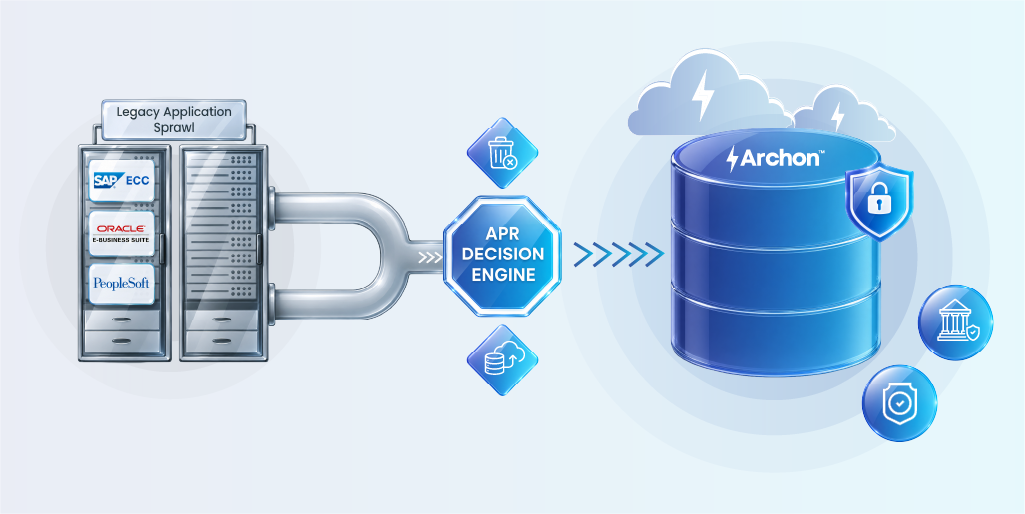
See how you can use the APR Decision Engine to categorize your application sprawl in real-time. Schedule your live demo today.
The 5-Step Application Portfolio Rationalization Process
Most successful APR programs follow a structured five-step process. Enterprises that skip steps, particularly step two (data classification) and step five (data governance), are the ones that face compliance exposure after decommissioning.
- Inventory and baseline: Catalog every application, its owner, its data types, its integrations, and its annual cost. Use discovery tools and CMDB data as a starting point but validate with business owners. Aim for completeness before accuracy.
- Classify by data type and regulatory obligation: Before scoring applications on business value, identify what data each system holds and what retention or compliance obligations apply. This step determines which applications cannot simply be “turned off”, they must be archived before retirement.
- Score each application across the four dimensions: Apply business value, technical health, TCO, and risk scoring in a consistent rubric. Score ranges of 1–5 across each dimension produce a composite score that guides initial disposition recommendations.
- Assign dispositions and sequence the roadmap: Translate scores into 4R dispositions. Sequence the roadmap by combining urgency (vendor end-of-life dates, compliance deadlines) with dependency mapping. Systems with many downstream integrations must be rationalized after the systems they feed.
- Execute data governance as a parallel workstream: Data governance – what happens to historical records, must run alongside every decommissioning project, not after it. Establish the archive strategy, the retention schedule, and the access model before the first application is retired.

A strategic guide to retire aging systems without risk. Learn how to reduce technical debt, control costs, and maintain compliance while keeping historical data accessible.
Common Mistakes in Application Portfolio Rationalization Programs
Most APR programs stall or underdeliver for predictable reasons. Understanding these failure patterns before you start is the most efficient form of risk management.
Treating APR as a One-Time Project
Application portfolios grow continuously. APR is a governance capability, not a project with an end date. Enterprises that run APR as a one-time exercise find their portfolio has regrown to the same level of redundancy within 24 months.
How to avoid it: Embed APR into the annual IT planning cycle as a standing governance process. Assign a named owner, maintain a living application inventory, and schedule a formal reassessment every 12 months — aligned to the budget planning calendar rather than triggered only when a major transformation forces the conversation.
Ignoring Data Governance Until After Decommissioning Begins
The most expensive mistake in APR is discovering, mid-project, that the application being retired holds 10 years of records subject to a 7-year regulatory retention obligation. Data retention requirements, under SOX, HIPAA, GDPR, or SEC Rule 17a-4, survive the application that created the data. Retiring a system does not extinguish the obligation.
How to avoid it: Map every application’s data types and retention obligations in step two of the assessment, before any disposition is finalized. Make the data governance question a hard gate: what archive strategy applies to this system’s records, and who owns executing it? No retirement date is set until that plan is approved and funded.
Related Read: 10 Data Retention Best Practices for Large Enterprises
Letting IT Own the Business Value Score
IT teams consistently overestimate the business value of applications they built or maintain. Business unit owners consistently overestimate the value of applications they are comfortable with. Both biases inflate scores and keep low-value applications on the retain list indefinitely.
How to avoid it: Use a structured scoring rubric with defined criteria and validate every business value score against objective usage data: active user counts, login frequency, integration traffic volume. An application that nobody actively uses has no business value, regardless of the owning team’s attachment to it. Require sign-off from both IT and the relevant business unit lead before any score is treated as final.
Underestimating Integration Complexity
Applications rarely exist in isolation. Decommissioning an application that feeds multiple downstream systems without first mapping those dependencies creates cascading failures across every system downstream, including systems that were never flagged as retirement candidates.
How to avoid it: Build an integration dependency map for every application before sequencing the roadmap: which systems does it send data to, receive data from, and share authentication with? Retire systems in reverse dependency order, consumers before producers, and require sign-off from each downstream system owner before any upstream retirement date is confirmed.
Aligning Application Portfolio Rationalization with ERP Migrations
The highest-return APR programs align with major platform migrations: SAP ECC to S/4HANA, Oracle EBS to Oracle Fusion Cloud, or PeopleSoft to Workday. These migrations are natural forcing functions. Every application in the portfolio must be evaluated against the new platform, can it integrate, does it duplicate functionality now delivered natively, or should it be retired before the migration cutover?
Enterprises often achieve greater cost reduction when APR initiatives are aligned with ERP modernization programs because redundant applications and integrations can be retired before migration.
The reason is straightforward: the migration creates a deadline that drives disposition decisions, and retiring redundant applications before migration reduces the data volume and integration complexity the new platform must absorb.
The critical dependency is data. When you retire an application during an ERP migration, you have two options: migrate its historical records into the new ERP or archive them in a governed repository that remains queryable post-migration.
Migrating historical data into a new ERP is expensive and often unnecessary; most historical records are accessed rarely, if ever, by operational users. Archiving them separately reduces migration scope, lowers cutover risk, and keeps historical data accessible for audits and eDiscovery without bloating the new system.
Ready to rationalize your application portfolio without compliance exposure? Archon Data Store ensures every decommissioned system leaves its data governed, queryable, and audit-ready.
Application Portfolio Rationalization Decision Matrix
Use this matrix to translate assessment scores into recommended dispositions for common application profiles encountered in large enterprise portfolios.
| Application Profile | Business Value | Technical Health | Annual TCO | Recommended Disposition |
|---|---|---|---|---|
| Legacy ERP module (SAP ECC, Oracle EBS) | High | Low (EOL 2027) | High | Retire: archive data, migrate to S/4HANA or Oracle Cloud |
| Homegrown reporting tool | Low | Low | Medium | Retire: replace with BI platform (PowerBI, Tableau) |
| Core HRIS (PeopleSoft, ADP) | High | Medium | High | Replace: migrate to Workday; archive payroll/HR history |
| CRM (Salesforce, legacy Siebel) | High | High (Salesforce) / Low (Siebel) | Varies | Retain (Salesforce) or Replace (Siebel); archive Siebel history |
| File management / document store | Medium | Low | Medium | Replatform: migrate to SharePoint or cloud object storage |
| Point solution (single department) | Low–Medium | Varies | Low | Retire or Repurchase SaaS equivalent; archive output records |
| Compliance / regulatory reporting app | High | Low | High | Replace or modernize: data retention obligations persist regardless |
How Archon Supports Application Portfolio Rationalization
Ever wondered what happens to your data when the application is decommissioned? This is the question most APR programs answer too late. When an application is retired, its data does not simply disappear, the retention obligations attached to that data remain in force, often for 7 to 10 years depending on the regulatory framework.
Enterprises have three options for handling data from decommissioned applications.
- The first is migration: moving historical records into the replacement system. This is expensive and increases the new system’s footprint unnecessarily.
- The second is deletion: destroying records at the point of retirement. This is non-compliant for any data subject to a retention obligation and creates defensibility risk.
- The third is archiving: moving historical records into a governed archive that preserves them in queryable form for the full retention period, then disposes them automatically when the obligation expires.
Archon Data Store is purpose-built for this third path. It ingests structured and unstructured data from retiring applications via Archon ETL, preserves it in an indexed, queryable archive, and enforces retention policies automatically.
When Medtronic decommissioned a portfolio of legacy clinical systems, Archon provided the data persistence layer that preserved patient and regulatory records without requiring those records to migrate into the new system. Access remained available for audit and eDiscovery queries throughout the retention period.
Archon Analyzer adds pre-archival data analysis, allowing teams to classify, deduplicate, and apply retention policies to data before it enters the archive, reducing storage costs and compliance risk simultaneously.
Prepare Your Application Portfolio for Cloud and AI Initiatives. Start Rationalization


