

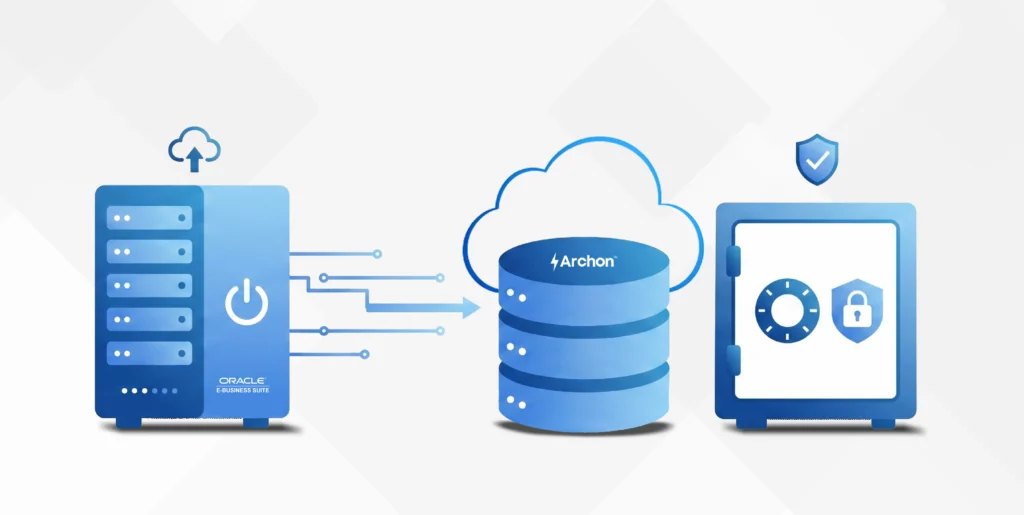

Key Points
- Oracle EBS decommissioning requires more than system shutdown; enterprises must preserve historical financial, HR, and operational records for 7–30 years to meet audit and compliance obligations.
- Oracle EBS 12.2 Premier Support ends in December 2030 (extended support – 2037), pushing organizations to plan migrations to Oracle Fusion Cloud, SAP S/4HANA, and other modern ERP platforms.
- Oracle EBS environments contain thousands of interconnected relational tables across GL, AP, AR, HR, Payroll, Procurement, and Manufacturing modules, making data extraction and validation highly complex.
- Regulations including SOX, HIPAA, SEC 17a-4, ERISA, and IRS retention rules require archived Oracle EBS records to remain accessible, immutable, and audit-ready long after the live ERP system is retired.
- Keeping Oracle EBS running only for historical access creates major licensing, infrastructure, security, and maintenance costs, often turning the legacy ERP into an expensive “read-only” environment.
- Archon Data Store helps enterprises archive Oracle EBS data with preserved business context, audit-ready access, legal hold support, and compliant long-term historical retention after decommissioning.
Oracle E-Business Suite sits at the center of financial and operational records for thousands of enterprises. When it comes time to migrate to Oracle Fusion Cloud, SAP S/4HANA, or another platform, those records do not simply disappear. They carry retention obligations; some running 7, 10, or even 30 years, along with audit, regulatory, and litigation risk.
For a CIO or CFO approving a decommissioning project, the central question is not only how to turn off Oracle EBS. The harder question is how to preserve structured access to 10 to 25 years of transactional history without maintaining a live system that continues to consume licensing and infrastructure costs.
This guide covers what Oracle EBS decommissioning involves, which data retention obligations apply, how to execute a compliant archive, and how to maintain verifiable historical access after the system goes dark.
What Is Oracle EBS Decommissioning?
Oracle EBS decommissioning is the process of retiring Oracle E-Business Suite, an enterprise resource planning platform, by migrating active workloads to a new system and preserving historical data in a compliant, accessible archive.
The goal is to eliminate Oracle EBS licensing, infrastructure, and support costs while meeting all regulatory retention and access requirements.
Oracle EBS is not a single application. It is a suite of integrated modules covering General Ledger, Accounts Payable, Accounts Receivable, Purchasing, Inventory, Human Resources, Payroll, and Manufacturing.
Each module generates structured relational data tied to business transactions, employee records, and financial postings. When decommissioning begins, all of these data domains require individual retention assessment.
Why Organizations Are Moving Off Oracle EBS
The primary driver is Oracle’s own support timeline. Oracle E-Business Suite 12.2 Premier Support runs through December 2030, with Extended Support available through 2037. Many enterprises are beginning migration projects now to avoid a compressed timeline as deadlines approach.
Beyond support lifecycle, the migration arguments include cloud economics, platform consolidation, and integration with modern analytics and AI tooling that Oracle Fusion Cloud or SAP S/4HANA provide natively.
However, the historical data accumulated in Oracle EBS over a decade or more cannot migrate wholesale to the new system. Transactional history from closed accounting periods, terminated employees, and expired contracts is not operationally active, but it remains legally and regulatorily relevant.
This distinction between active data that migrates and historical data that must be archived is the central architectural decision in every Oracle EBS decommissioning project.
Oracle EBS Data Retention Requirements: SOX, HIPAA, and SEC Rules
Oracle EBS holds data subject to multiple overlapping retention frameworks. The applicable requirements depend on industry, geography, and the type of data stored within each EBS module.
Financial Records: SOX and SEC
The Sarbanes-Oxley Act, Section 802, requires that audit-related financial records be retained for 7 years. This covers all records produced for or reviewed by external auditors, including journal entries, account reconciliations, trial balances, and supporting documentation stored in Oracle EBS General Ledger, Accounts Payable, and Accounts Receivable modules.
IRS rules require 6-year retention when gross income is understated by more than 25%, and 7-year retention for bad debt and worthless securities records. For most enterprises, this effectively means retaining all Oracle EBS financial module data for 7 years from the transaction date.
SEC Rule 17a-4 applies to broker-dealers and requires certain records to be retained in non-rewriteable, non-erasable format for periods ranging from 3 to 6 years depending on record type. For financial services firms running Oracle EBS, this means archive immutability is not optional.
HR and Payroll Data Requirements
Employee records in Oracle HCM and EBS HR modules carry their own retention schedules. The Equal Employment Opportunity Commission (EEOC) requires retention of personnel records for 1 year following termination under Title VII.
The Department of Labor requires payroll records to be kept for 3 years under the Fair Labor Standards Act (FLSA), and records related to employee benefit plans must be retained for 6 years under ERISA.
For organizations that self-insure or administer benefits through Oracle EBS, the benefit plan records may carry the full ERISA 6-year window. In litigation-prone industries, retaining full payroll history for 7-10 years provides practical protection against wage claims.
Healthcare and Life Sciences
Healthcare enterprises using Oracle EBS for billing and financial reporting face an additional layer: HIPAA. The HIPAA Privacy Rule (45 CFR 164.530(j)) requires covered entities to retain documentation of policies and procedures for 6 years from the date of creation or the date it was last in effect, whichever is later. Medical billing records, claims data, and remittance data flowing through Oracle EBS are directly in scope.
Life sciences companies using Oracle EBS alongside manufacturing and quality systems must also assess whether EBS records are subject to FDA 21 CFR Part 11 electronic records requirements, which adds audit trail and system validation obligations to the archive.
Need help mapping your Oracle EBS data to retention requirements? Request a Demo
The Cost of Keeping Legacy Oracle EBS Running
One of the largest hidden costs in an Oracle EBS migration is maintaining the legacy system after active workloads move to a new ERP. Oracle support and maintenance costs typically run at 22% of license value annually, with costs increasing over time even when Oracle EBS is retained only for historical access.
This creates a costly “read-only ERP” environment that still requires:
- Oracle EBS and database licensing
- Infrastructure and storage
- Backup and disaster recovery
- Security patching and monitoring
- DBA and ERP administration support
For large enterprises, these ongoing costs can range from hundreds of thousands to several million dollars annually, even when the system is rarely used.
The operational burden also grows over time. Aging Oracle EBS environments increase security, compliance, and maintenance risk, while audits and eDiscovery requests often require manual effort to retrieve historical records.
This is why many enterprises archive historical Oracle EBS data into a compliant platform before decommissioning. A structured archive preserves long-term access to financial, HR, and procurement records while eliminating the cost of maintaining a live Oracle EBS environment purely for historical reporting.
Oracle EBS Decommissioning Best Practices
Successful Oracle EBS decommissioning requires more than shutting down infrastructure or migrating active workloads. Enterprises must preserve historical records, maintain compliance visibility, and ensure long-term access to business-critical data after the legacy ERP system is retired.
The following best practices help reduce operational risk while supporting audit, legal, and regulatory obligations throughout the decommissioning lifecycle.

1. Inventory and Classify Oracle EBS Data
Begin by identifying every Oracle EBS module, schema, and data domain in scope for decommissioning. Financial records, HR files, procurement transactions, payroll history, inventory records, and supplier data each carry different business and regulatory requirements. Classifying data early helps determine what should migrate, what should archive, and what may eventually be deleted under retention policy.
2. Define Retention Rules Before Extraction
Retention requirements should be mapped before any data extraction begins. Oracle EBS environments often contain records governed by SOX, HIPAA, ERISA, SEC 17a-4, IRS, and regional privacy regulations.
Each dataset should have a documented retention schedule, legal basis, ownership model, and deletion policy. Organizations that archive data without retention governance frequently create compliance exposure through over-retention or accidental destruction.
3. Archive Historical Data in a Structured Format
Historical Oracle EBS data should be archived in a searchable, business-readable format that preserves referential integrity across modules. Flat-file exports or raw table dumps often lose application context, making audit retrieval difficult years later.
A structured archive should preserve business objects such as invoices, journal entries, payroll records, purchase orders, and employee histories while supporting secure search and reporting capabilities.
4. MaintainAudit-Ready Historical Access
After Oracle EBS is retired, finance, HR, legal, and compliance teams still require access to historical records. Best-practice archives provide role-based access controls, immutable audit trails, legal hold management and eDiscovery-ready exports. Users should be able to retrieve historical transactions without restoring backup tapes or reactivating the legacy ERP environment.
5. Validatethe Archive Before Final Decommissioning
Final Oracle EBS shutdown should occur only after archive validation is complete. Organizations should perform reconciliation testing, checksum validation, report comparison, and business-user acceptance testing to confirm archived records match the source system.
Validation failures discovered after shutdown can create expensive recovery projects and long-term compliance risk. Successful decommissioning occurs only when historical access, retention controls, and audit readiness have been fully verified.

Oracle EBS Decommissioning Guide
A Compliance-First Playbook for Exiting Oracle E-Business Suite Without Losing Data or Failing Audit
How to Archive Oracle EBS Data: A 5-Step Process
A structured data archiving process is the difference between a clean decommissioning project and one that stalls due to data integrity, audit readiness, or access failure.
The following sequence has proven effective across Oracle EBS decommissioning projects of varying scale.
- Inventory and Classify Oracle EBS Data: Begin by mapping every active EBS module and identifying which data domains each contains. GL, AP, AR, PO, INV, HR, and Payroll each carry different retention requirements. Export a schema inventory and classify records by data type, business domain, and applicable retention rule.
- Map Retention Policies to Data Domains: With the inventory complete, apply retention schedules to each data class. Document the legal basis for each retention period and note whether any records are subject to a litigation hold that overrides standard schedules. This policy map becomes the authoritative reference for the archive.
- Extract and Transform EBS Data into the Archive Format: Oracle EBS data is stored across relational tables that use non-obvious naming conventions. Extraction must preserve referential integrity, a journal entry without its associated ledger, period, or currency record is useless. Use an ETL process specifically designed for Oracle EBS schemas rather than generic database export tools.
- Validate the Archive Against Source Records: Before decommissioning the live system, run reconciliation queries comparing the archive record counts, checksums, and key values against Oracle EBS. Validate a statistically representative sample of business transactions, end to end. Document this validation as part of the decommissioning record.
- Decommission Oracle EBS and Test Historical Access: Once the archive is validated and signed off, proceed with decommissioning. Immediately run a set of defined access tests: retrieve a specific journal entry by date and account, produce a payroll history for a named employee, export an AP aging report for a closed period. If any test fails, the archive is not ready and decommissioning should pause.
The validation step is consistently under-resourced in Oracle EBS decommissioning projects. Organizations that skip end-to-end reconciliation before switch-off frequently discover data gaps only when an auditor or legal team requests records months later.
Oracle EBS Data Archiving Approaches Compared
Organizations approaching Oracle EBS decommissioning typically evaluate three archiving strategies. Each carries significantly different cost, risk, and access profiles.
| Approach | Description | Licensing Cost | Query Capability | Audit Readiness | Recommended For |
|---|---|---|---|---|---|
| Keep EBS Running | Maintain live Oracle EBS instance purely for historical access | Full ongoing Oracle license + infrastructure | Full native UI access | High — system is live | Rarely; very expensive |
| Custom Database Archive | Extract EBS data to a new relational database (SQL Server, PostgreSQL) | Database license + DBA maintenance | Custom SQL queries only | Medium — depends on implementation | Small data volumes, short retention windows |
| Flat-File/Tape Export | Export to CSV or backup tapes, stored in cold storage | Near zero storage cost | None without restore | Low — records not queryable | Archival-only, no access needed |
| Purpose-Built Decommissioning Archive | Structured EBS-aware archive preserving relationships, business views, and audit trails | Per-TB or subscription model | Business UI + structured queries | High — audit trail, legal hold, eDiscovery ready | Large enterprises, long retention windows |
| Cloud Data Lake | Extract EBS data to S3 or ADLS in open formats (Parquet, Iceberg) | Low storage cost; query cost varies | SQL via Athena/Synapse | Medium — requires custom audit layer | Technically mature organizations with lakehouse capability |
| ERP Vendor Archive Tool | Use Oracle-provided archiving tools (e.g., Oracle Information Lifecycle Management) | Bundled or add-on cost | Oracle-native queries | High — vendor-supported | Enterprises staying on Oracle stack |
Maintaining Historical Access After Oracle EBS Decommissioning
Historical access is not nice to have; it is a regulatory obligation. The standard imposed by most frameworks: SOX, HIPAA, SEC 17a-4, is not simply that records exist, but that they can be produced in a timely manner.
An archive that requires 2 weeks of database restore work to answer a single audit question does not meet the spirit of these requirements.
Audit-Ready Access
Audit-ready access means that an authorized user: an internal auditor, external auditor, or compliance officer, can query Oracle EBS historical records directly through a controlled interface, without involving the IT team for every request. The archive must support period-based GL queries, transaction drill-down, and export of structured reports in standard formats.
Access controls must mirror or exceed those maintained in the live Oracle EBS instance. Role-based access, authentication logging, and immutable audit trails of who accessed which records, and when are required components of a compliant archive.
Legal Hold and eDiscovery
When litigation is filed or anticipated, a legal hold prevents destruction of potentially relevant records. An Oracle EBS archive must support the ability to place a legal hold on specific record sets by date range, entity, employee, or transaction type, and guarantee those records are not subject to scheduled deletion until the hold is lifted.
eDiscovery requests require the ability to export structured, human-readable records in standard formats such as CSV, PDF, or EDRM XML. Archives that store data only in proprietary binary formats create significant discovery cost and risk.
Stop paying to keep Oracle EBS alive for historical reporting. Archive the data, preserve access, and decommission with confidence. Contact us
Three Common Mistakes in Oracle EBS Decommissioning Projects
Oracle decommissioning projects often fail because organizations focus only on migration timelines and infrastructure shutdown. Historical data access, compliance validation, and archive readiness are frequently treated as secondary tasks until problems emerge during audits or legal requests.
The following mistakes are among the most common causes of cost overruns, delayed decommissioning, and long-term compliance risk.
1. Treating decommissioning as an IT project, not a compliance project.
Oracle EBS decommissioning touches legal, finance, HR, and compliance as much as it touches IT. Organizations that manage it as a pure infrastructure migration often complete the technical work and then discover that finance cannot access closed-period reports, or that HR cannot produce a payroll history for a worker’s compensation claim. Compliance and business stakeholders must be involved from the scoping phase.
2. Underestimating the complexity of Oracle EBS schemas.
Oracle EBS uses thousands of relational tables with indirect naming conventions and multiple layers of virtual tables and views. A naive export of raw database tables produces data that is not interpretable without the Oracle EBS application context. Effective decommissioning archives must preserve business-layer context, the mapping of raw data to meaningful records such as invoices, journal entries, and employee records.
3. Setting decommissioning dates before the archive isvalidated.
Project timelines often drive technology decisions in the wrong direction. When a contract expiry or licensing renewal creates a hard deadline to decommission Oracle EBS, organizations sometimes turn off the system before the archive is fully validated. The result is a gap in the historical record that cannot be reconstructed without re-engaging the archived system, which may no longer be available. Validate first; decommission second.
Archon Data Store for Oracle EBS Decommissioning
Archon Data Store is an enterprise data archiving and application decommissioning platform built to handle the complexity of Oracle EBS schemas and multi-decade retention requirements.
Rather than treating EBS data as undifferentiated relational records, Archon preserves the business context of Oracle EBS transactions, so an archived AP invoice is still queryable as an AP invoice, not as a set of raw rows in a staging table.
Archon ETL handles the extraction and transformation of Oracle EBS data, maintaining referential integrity across modules and mapping raw table data to business-readable record types.
Archon Analyzer provides a query and reporting interface that allows finance, audit, and compliance teams to access historical records without IT involvement.
For legal hold and eDiscovery, Archon Data Store provides hold management, structured export in compliance-standard formats, and immutable audit trails of all access events.
Organizations that have used Archon for Oracle EBS decommissioning, including enterprises in manufacturing, healthcare, and financial services, have been able to turn off live EBS instances while maintaining full audit-ready access to 15 or more years of historical data.
Ready to plan your Oracle EBS decommissioning?


