

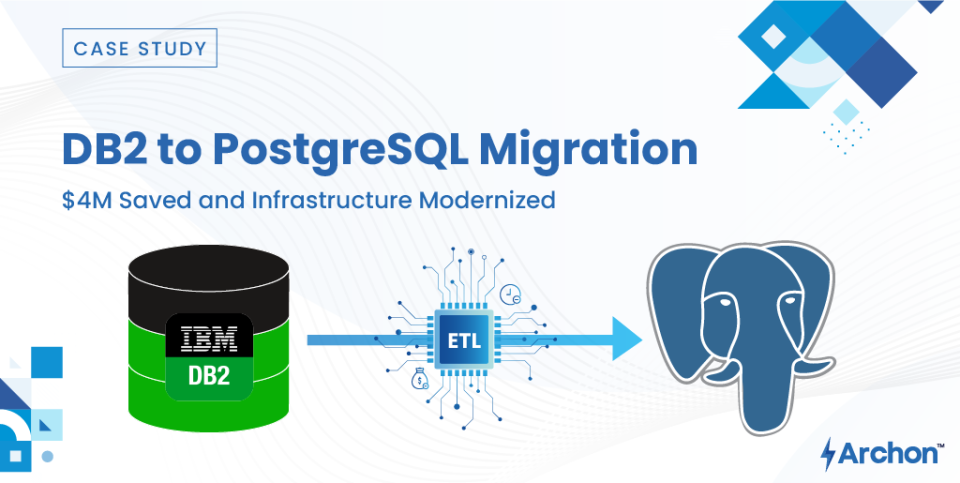
IBM Db2 is an efficient database system which has been serving various enterprises for many years. However, without proper modernization, any company may face performance issues, limited adaptability, and greater operating costs.
A global Human Resources company had their core data infrastructure running on IBM Db2. Managing payroll, benefits, and workforce data for enterprise clients across multiple jurisdictions became an expensive constraint.
Hardware leases, software licensing, hypervisor storage costs, and vendor maintenance subscriptions were compounding year on year with no corresponding gain in capability or agility.
Having modernization and cost reduction firmly on their agenda, migrating to an open, flexible platform like PostgreSQL became their strategic priority. The company selected EDB Postgres Advanced Server as its target, combining open-source freedom with enterprise-grade capabilities.
Business Requirements
Before planning the migration, the organization came to the table with a clearly defined set of requirements and an equally specific set of concerns.
- Non-Negotiable Deadlines: The migration had strict deadlines imposed by internal stakeholders and external vendor dependencies. The company evaluated multiple migration partners and found that Archon was the only vendor with the capacity and methodology to meet the required timelines without compromising on rigor.
- Client-Level Data Isolation: Despite moderate data volumes, the architecture was highly complex with each client’s data fully isolated. The migration process had to be performed through a phased approach with no bulk migration of data.
- Internal Resource Constraints: It was clear that the organization lacked the resources internally to facilitate such a complicated migration process. Data governance, project management, IT operations, and technical remediation all required external support.
Their key priorities were to modernize IT infrastructure and reduce the high costs associated with legacy systems like IBM Db2.
Challenges: Technical Compatibility Gaps
Migration of Db2 to Postgres did not involve a simple lift and shift approach since both these architectures have differences among themselves that needed to be remediated.
The company’s migration involved several specific technical challenges:
- Converting Materialized Query Tables (MQT) in Db2 to Materialized Views in Postgres.
- Type casting rules to preserve data integrity across schema differences.
- Adapting application code to fetch data from ref cursors, enabling stored procedure conversion.
- Identifying Postgres-equivalent utilities for Db2 housekeeping and parallel processing functions.
- Resolving a Control M character embedded in source DB2 files that was causing load failures at the target.
Addressing these complexities with precision was critical to delivering a seamless and reliable migration to PostgreSQL.
Plan → Migrate: The Archon Roadmap
Archon executed the IBM Db2 migration in two phases: assessment and execution.
Phase 1: Assessment with Archon Analyzer
Before any data moved, Archon Analyzer conducted a comprehensive technical assessment of the existing Db2 environment. The tool crawled metadata and data structures to build a detailed profile of the source database, producing:
- A full migration effort estimate, scoped at the individual object level
- Identification of all stored procedures and queries requiring conversion
- JOIN statement comparison and compatibility mapping between source and target schemas
- Relationship modelling across the full data architecture
- End-to-end data validation planning to establish acceptance criteria before migration begins
These insights gave our Archon team a head start, enabling a clear plan to identify and address source–target incompatibilities early.
Phase 2: Execution with Archon ETL and Smart ETL
Migration execution was handled through Archon ETL, configured with Smart ETL features designed to optimize resource consumption, reduce execution time, and handle the operational complexity of staged, client-isolated migrations.
Key capabilities deployed during execution:
- 200+ pre-built software connectors to manage source and target database interactions throughout the migration
- Automated migration services to handle repeatable tasks at scale and reduce manual intervention
- Chunked extraction using query mode to identify data anomalies, including the Control M character issue, before they caused load failures.
- Quote identifier insertion around problematic characters to ensure clean, fully validated data loads
- Workload management features to minimize execution time across sequenced, client-by-client migration stages
Throughout the process, Archon operated as an embedded partner rather than a remote vendor. Communication was structured, progress was transparent, and technical decisions were made collaboratively with the client’s internal teams at every stage.
This shift enabled them to move away from years of vendor lock-in with IBM Db2 and take greater control of cost, scalability, and future innovation.
“I’m extremely impressed with the partnership we have made with Platform 3. They treat us like we’re a very important client, and that has made our migrations successful.”
The database director noted that vendor lock-in through IBM Db2 and similar proprietary platforms had been actively detrimental to the business. Post-migration, the organization operates with full flexibility in cloud deployment and license management.
Business Impact: Cost Efficiency and Performance Shift
The Archon Data Store-led migration delivered measurable business impact:
If your legacy database eats your modernization budget, we need to talk
