


Key Points
- A missing or incomplete data chain of custody can trigger massive regulatory penalties, even when no data breach or loss has occurred.
- Data chain of custody creates a complete, chronological record of who created, accessed, transferred, archived, or deleted enterprise data throughout its lifecycle.
- Regulations including SOX, HIPAA, GDPR, SEC Rule 17a-4, and PCI DSS require organizations to maintain tamper-evident audit trails and defensible custody records.
- Chain of custody differs from data lineage: lineage tracks where data moved and transformed, while custody tracks who controlled the data and what actions were performed on it.
- The most common custody failures occur during legacy system decommissioning, fragmented audit logging, manual approval workflows, and third-party/vendor data transfers.
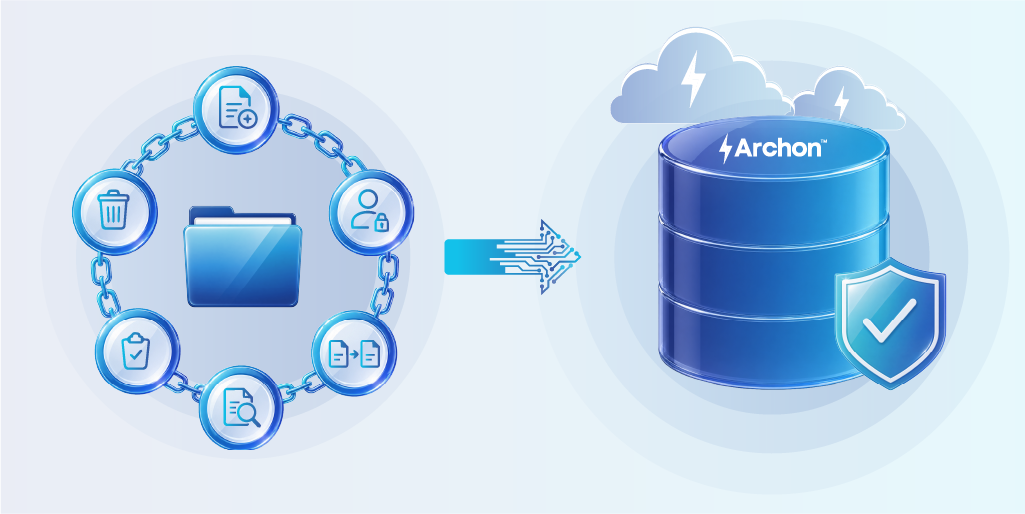
- Platforms like Archon help enterprises preserve audit trails, maintain WORM-compliant storage, and retain complete custody records across migrations and system decommissioning projects.
In 2024, a US financial services firm faced a $7.2 million SEC fine, not because data was lost, but because it could not prove who had access to it, when, and why. That is the cost of a missing data chain of custody.
For any enterprises subject to SOX, HIPAA, GDPR, or SEC regulations, the ability to demonstrate a complete, unbroken record of data handling is no longer optional.
Data chain of custody defines the documented history of every action taken on a dataset: who created it, who accessed it, who moved it, and who ultimately archived or deleted it.
In legal and regulatory contexts, an incomplete chain of custody can invalidate evidence, trigger enforcement action, or expose executives to criminal liability.
This guide explains what data chain of custody is, why it matters for enterprise compliance, and how to build a process that holds up to the most demanding audit or legal challenge.
What Is Data Chain of Custody?
Data chain of custody is the chronological, documented record of the custody, control, transfer, analysis, and disposal of data. It establishes that data has not been altered, tampered with, or improperly accessed at any point in its lifecycle — from creation to final disposition.
The concept originates in forensic evidence law, where an unbroken chain of custody is required for evidence to be admissible in court. In enterprise data management, the principle applies to every regulated dataset: if you cannot demonstrate an unbroken record of how data was handled, you cannot prove compliance.
Data Chain of Custody vs. Data Lineage
Data lineage tracks where data came from and how it was transformed — it answers the question: ‘Where has this data been?’ Data chain of custody answers a different question: ‘Who had control of this data, and what did they do with it?’ Both are required for full audit readiness, but they serve distinct compliance functions.

Why Data Chain of Custody Matters for Enterprise Compliance
Every major data regulation like SOX, HIPAA, GDPR, SEC Rule 17a-4, PCI DSS includes an implicit or explicit chain of custody requirement. Enterprises that cannot produce an audit-ready custody record face fines, litigation exposure, and reputational damage.
Legal Hold and eDiscovery
When litigation is threatened or initiated, organizations must place a legal hold on relevant data — freezing it from modification or deletion. Without a documented chain of custody, legal teams cannot certify the integrity of that data to opposing counsel or the court. The EDRM estimates that eDiscovery disputes cost enterprises an average of $1.4 million more when custody records are incomplete.
Regulatory Enforcement
Regulators increasingly treat the absence of a chain of custody as evidence of non-compliance in itself. Under GDPR Article 5(2), enterprises must be able to demonstrate accountability for personal data processing. If you cannot show a continuous custody record, you have failed the accountability principle, regardless of whether the data was actually misused.
Building a defensible chain of custody is not a compliance project, it is a risk management strategy that protects the organization at every level, from the data center to the boardroom.
Need to build an audit-ready chain of custody
Chain of Custody Requirements by Regulation
Different regulations impose different chain of custody obligations. The table below summarizes the core requirements across the eight regulations most commonly applicable to enterprise data programs.
| Regulation | Applies To | Retention | CoC Requirement | Penalty |
|---|---|---|---|---|
| SOX § 802 | Public companies | 7 years | Immutable audit log | Fines / 20yr prison |
| HIPAA | Healthcare (US) | 6 years | Access logs required | Up to $1.9M/violation |
| GDPR Art. 5 | EU personal data | Purpose limitation | Documented CoC chain | 4% global revenue |
| SEC 17a-4 | Broker-dealers | 6 years | WORM + audit trail | $1M+ per violation |
| PCI DSS 3.2 | Payment card data | 12 months | Access log retained | Loss of card processing |
| CCPA | CA consumers | On request | Data lineage required | $7,500 per violation |
| ISO 27001 | All certified orgs | Ongoing | Information asset log | Certification revoked |
| NIST 800-88 | US federal agencies | Per policy | Media sanitization log | Audit failure/breach |

How to Build a Data Chain of Custody Process
A robust chain of custody process covers six stages, each requiring specific documentation and controls. The following steps reflect the requirements of NIST SP 800-53, ISO 27001, and common regulatory guidance from SEC, HHS, and the ICO.
- Classify data at ingestion: Assign a sensitivity classification (public, internal, confidential, restricted) and a regulatory category (PHI, PII, financial record, cardholder data) at the point of creation or receipt. Classification determines which custody controls apply.
- Log all storage events: Record where data is written, in what format, under what encryption standard, and who authorized the write. Storage logs must include timestamps accurate to the second and must be tamper-evident — ideally written to a WORM-compliant system.
- Capture every access event: Every read, export, copy, or query must generate an audit log entry. Log the user identity, the data accessed, the purpose (where systems permit), and the outcome. Access logs are the most frequently requested record in regulatory audits.
- Document all transfers: Any movement of data between systems, teams, vendors, or geographies requires a transfer record. Include: originating system, destination system, transfer method, data volume, verification hash, and authorizing personnel.
- Enforce legal hold procedures: When litigation hold is invoked, freeze all custody events for affected datasets. Ensure hold status is logged, communicated to custodians, and tracked centrally. Holds must survive system migrations and decommissioning events.
- Record final disposition: Whether data is archived, deleted, or physically destroyed, generate a certificate of disposition. For secure erasure, reference the specific NIST SP 800-88 method used. Disposition records must be retained even after the underlying data is gone.
Common Chain of Custody Failures and How to Avoid Them
Most chain-of-custody failures are not caused by bad intent, they result from fragmented systems, manual processes, and decommissioning gaps. These are the four most common failure patterns.
Fragmented audit logs across systems
Enterprises that store audit logs in individual application silos cannot produce a unified custody record during an audit. When a dataset has passed through five systems over seven years, reconstructing its custody history from five separate log formats is extremely difficult and often impossible for legacy or decommissioned systems.
No custody record at decommissioning
Application decommissioning is the most common point of chain of custody failure. When a legacy system is shut down, its audit logs are frequently deleted along with application data. Any custody record stored only in that system is permanently lost. Enterprises must migrate custody logs to a long-term archive before any system is decommissioned.
Manual handoff processes
Email-based approval chains, shared spreadsheets, and informal verbal authorizations create gaps in the custody record. A custody event that is not documented within a system of record does not exist for compliance purposes, regardless of what actually happened.
Gaps at vendor boundaries
Data that moves to or from cloud vendors, outsourced processors, or SaaS platforms frequently loses its custody chain at the boundary. Data Processing Agreements under GDPR must include chain of custody provisions but most enterprises do not enforce these contractually or technically.
These common chains of custody failures can be avoided by centralizing audit logs, preserving custody records during system decommissioning, automating data handoff processes, and maintaining consistent tracking across vendors and cloud platforms.
How Archon Data Store Supports Chain of Custody Compliance
Archon Data Store is an archival lakehouse platform that provides a centralized archive that captures and preserves the complete custody record for enterprise data across its lifecycle. When enterprises migrate from or decommission legacy systems like SAP, Oracle, PeopleSoft, Siebel, Dynamics, Archon migrates not just the data, but the full audit history, ensuring the chain of custody remains unbroken through the transition.
Archon’s platform stores data in tamper-evident, WORM-compliant storage that satisfies SEC Rule 17a-4, SOX Section 802, and HIPAA requirements for audit trail integrity. Every access event, transfer, and disposition action is logged to the centralized archive, giving compliance and legal teams a single source of truth for any custody inquiry.
Case study: Medtronic used Archon to decommission a global legacy ERP system while preserving 12 years of regulatory data and its associated custody chain, enabling the enterprise to pass a subsequent FDA audit without disruption.
See how Archon preserves the chain of custody through decommissioning


