

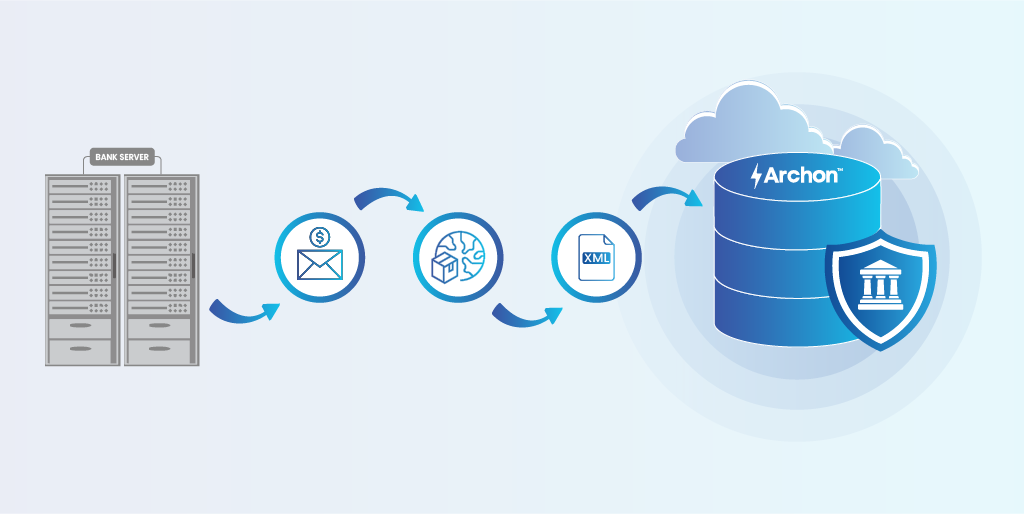

Key points:
- Financial messages are regulated records. SWIFT, FIX, ISO 20022, and interbank communications must be retained, searchable, and audit-ready.
- Compliance risk sits inside messaging systems. Retention gaps, fragmented storage, and weak audit trails expose finance institutions to penalties and reputational damage.
- Core systems are built for processing, not suitable for compliant storage. They prioritize transaction speed over regulatory-grade archival, discovery, and defensible deletion.
- Search and retrieval define audit success. Regulators expect rapid production of complete message histories with full metadata and traceability.
- With increasing data volumes, real-time payments, cross-border transactions, and ISO 20022 expansion drive exponential message growth.
- Structured archiving lowers cost and complexity. Offloading historical messaging data from legacy storage systems reduces infrastructure strain, storage overhead, and licensing expenses.
- Archon Data Store enables governed, policy-driven retention. With centralized control, configurable retention schedules, and immutable audit trails, ADS ensures regulatory alignment across jurisdictions.
- Archon Data Store transforms archives into strategic assets. Beyond compliance, Archon Data Store supports secure search, analytics access, system decommissioning, and long-term data lifecycle governance, positioning financial messaging archives as controlled, accessible, and future-ready enterprise assets.
Most banks believe that once a transaction is posted in the core banking system, the record is safely retained. Every entry in a financial record reflects an underlying transaction.
As a data leader, you define the standards for system modernization, regulatory assurance, and controlled decommissioning.
So eventually,
- Payment hubs are upgraded
- SWIFT gateways are replaced
- AML platforms get evolved
- Core systems remain
Yet quietly, regulatory exposure increases because transaction evidence is not visible.
Wondering how to store financial messages as compliant records rather than just data sitting in operational systems?
Data archiving preserves the transaction evidence of financial messages that are complete, tamper-proof, and remain accurate, traceable, and defensible over time.
This article walks through the regulatory requirements for financial archiving, core challenges while archiving, and an archiving approach to address them comprehensively.
What Financial Messaging Really Represents
Your institution processes thousands, sometimes millions of financial messages, every day, including:
- MT messages transmitted via SWIFT
- ISO 20022 XML payment instructions
- ACH batch files
- RTGS and real-time settlement messages
- Securities and trade finance communications
These are not generic system files. They are:
- Structured and time-stamped transactional instructions
- Legally binding interbank communications
- Contractual records defining obligation and authorization
- Settlement intent between financial institutions
These messages become the authoritative source of truth when issues like delayed cross-border payments, sanctions reviews, or fraud investigations arise.
Compliance Requirements for Financial Messaging Archiving
What happens during every transaction? The debit and credit entries are visible, balances are updated, and reconciliation reports match. From an operational perspective, everything appears complete and therefore safe.
When regulators, auditors, or correspondent banks ask for proof of a transaction, they are rarely satisfied with ledger entries.
But they want to,
- see the original instruction, as transmitted.
- see the compliance checks performed.
- understand the routing path, acknowledgements, delays, and any manual intervention.
For instance, a SWIFT MT103 or an ISO 20022 payment message is legal evidence and an audit trail record. It is regulatory proof. It is often the only defensible record that a payment was initiated, processed, screened, and settled correctly.
If that message is not preserved in its native form, you keep the numbers, but you lose the story behind the numbers.
And that is where governance gaps begin.
| System | Typical Stored Format |
|---|---|
| Payment Hub | XML, DB tables, sometimes flat files |
| Core Banking | Structured DB tables |
| SWIFT Gateway | FIN text format (MT), XML (MX) |
| AML System | Extracted DB fields, sometimes XML snapshot |
| Middleware | XML / JSON / Text (usually transient) |
Challenges Faced While Archiving Financial Messages
As financial messages accumulate, the operational, legal and technical complexities shoot up. Below are the most common challenges organizations face when archiving financial messages.
- Volume Explosion: High-frequency transactions generate massive message volumes daily, creating storage and performance strain.
- Complexity of Messaging Formats: Multiple standards (MT, MX, ISO 20022 XML, ACH, RTGS, etc.) require structured parsing and long-term readability.
- Various Regulatory Retention Demands: Different jurisdictions mandate varying retention periods and proof-of-integrity standards.
- Legal Admissibility: Archived messages must remain tamper-proof, time-stamped, and legally defensible in audits or court proceedings.
- Search & Retrieval Complexity: Search and retrieval become difficult when data is raw and unstructured. Investigations require precise, metadata-driven retrieval across years of historical data.
- System Decommissioning Risks: Retiring payment hubs or gateways without preserving full message context can create regulatory exposure.
- Cost & Infrastructure Burden: Storing structured financial messages in production systems increases licensing, storage, and maintenance costs.
- Cross-System Dependency: Messages often span multiple platforms (core banking, AML, payments), making unified archiving difficult.
- Security & Access Control: Archived messages contain sensitive financial and customer data requiring strict role-based access and encryption controls.
What Actually Needs to Be Archived
Financial messaging archiving is about preserving a complete, multi-layered evidence trail.
1. Original Financial Messages (Instruction Layer)
You must retain the native message format, including:
- SWIFT MT (FIN) messages
- SWIFT MX (ISO 20022 XML) messages
- ACH batch files
- Real-time payment payloads
These may exist as XML files, FIN text, CLOB/BLOB objects, encrypted archives, or cloud object storage artifacts, but the original structure must remain intact.
2. Structured Metadata (Search & Retrieval Layer)
Raw files are not sufficient. Key indexed metadata must include:
- Sender and receiver BIC codes
- Message type
- Timestamps
- Transaction reference
- Currency and amount
- Value date
Auditors request patterns and structured indexing for regulatory retrieval.
3. Processing & Journey Artifacts (Operational Layer)
Every financial message moves through validation, routing, and enrichment flows. You must retain:
- Validation and repair history
- Manual overrides and approvals
- Routing decisions
- Settlement timestamps
- Rejections and resubmissions
This forms the transaction journey.
4. Compliance & Control Evidence (Control Layer)
Compliance systems generate their own evidence, including:
- Sanctions match scores
- AML risk flags
- Analyst review notes
- Override justifications
- Case escalation history
- System and user audit logs
From an architectural standpoint, you are archiving instruction + journey + control evidence.

Preserving Transaction Context Beyond Core Banking
Core banking systems store:
- Ledger entries
- Debit and credit postings
- Balances
- Internal transaction references
They capture the financial impact, not the original instruction.
What Gets Lost If You Archive Only Core Tables?
- The full native SWIFT MT message structure (headers, trailers, network metadata)
- ISO 20022 XML payloads in original format
- Delivery confirmations and acknowledgements
- SWIFT gpi UETR identifiers for end-to-end tracking
- Correspondent routing history
- Repair and resubmission details
- Sanctions screening scores and analyst justifications
Core banking reflects what happened financially. It does not preserve how, why, or through which path it happened.
Under regulatory scrutiny, this distinction becomes critical.
If regulators ask for the original transmitted instruction, the ledger data cannot reconstruct it. If they ask why a flagged payment was released, accounting entries provide no compliance reasoning.
Archiving only core banking tables preserves the accounting result, not the transaction evidence. Therefore, the whole chain of custody needs to be archived.
Building a Financial Messaging Archiving Strategy
Financial messaging archiving is a strategic decision that determines whether your institution can confidently reconstruct a transaction, defend a compliance decision, and modernize systems without regulatory hesitation.
An effective strategy must connect transaction evidence, regulatory expectations, and architectural independence into one coherent framework.
Archiving Three Dimensions of Transaction Evidence
A complete archive preserves more than data it preserves narrative integrity. Every financial transaction carries three essential dimensions of evidence:
- Instruction Layer – What Was Sent: The original transmitted message in its native format (FIN, ISO 20022 XML, ACH payload, etc.), including headers, trailers, identifiers, and structured fields. This layer proves the exact instructions issued.
- Journey Layer – How It Moved: Validation results, repair history, routing decisions, timestamps, acknowledgements, and settlement confirmations. This layer demonstrates how the instructions traveled through systems and counterparties.
- Control Layer – Why It Was Allowed: Sanctions screening outcomes, AML scores, analyst reviews, override justifications, and approval logs. This layer proves that governance and regulatory controls were applied.
Regulators increasingly expect lifecycle reconstruction; if any one of these dimensions is missing, the transaction story becomes incomplete.
ISO 20022 and Rising Evidentiary Expectations
If you have migrated towards the ISO 20022 messaging standard, you fall under a different evidentiary expectation. These messages contain:
- Rich structured party data
- Detailed remittance information
- Regulatory reporting elements
- Purpose codes and extended identifiers
With richer data comes greater accountability; storage volumes increase, search complexity expands; retrieval must be precise and structured.
Archiving now requires preserving financial intelligence in a format that supports indexed access, compliance audits, and multi-year lifecycle analysis.
The Regulatory Retention Requirements
Retention requirements vary across jurisdictions and business lines. Payment messages may need to be retained for five to ten years, and trade finance communications often for a longer period. Securities-related messaging may carry extended retention obligations.
Regulatory frameworks such as MiFID II, Dodd–Frank Act, and Basel III expect complete transaction records, defensible audit trails, and demonstrable compliance controls. At the same time, data protection frameworks such as GDPR impose obligations around data minimization, controlled access, and defensible deletion.
The solution is to reduce retention without understanding regulatory impact. Perhaps that is policy-driven, structured, and governed archiving.
Archiving Implications for Modern Institutions
Financial messages are distributed across payment hubs, SWIFT gateways, AML platforms, middleware layers, and core systems. They may exist as XML files, database records, queue artifacts, or encrypted objects in storage.
A mature archiving strategy must therefore be:
- System-independent – Evidence remains accessible even after applications are upgraded or retired
- Lifecycle-aware – Capable of reconstructing the full transaction journey without relying on live systems
- Policy-driven – Retention aligned with jurisdictional and regulatory mandates
- Immutable – Leveraging WORM or tamper-proof storage mechanisms
- Indexed for retrieval – Searchable by message ID, UETR, BIC, amount, currency, and date
- Securely governed – Role-based access controls for auditors, compliance, and operations teams
The Strategic Impact of Structured Financial Messaging Archiving
If you lead data governance, enterprise architecture, or modernization, financial messaging archiving is a strategic enabler.
- Enables safe legacy system decommissioning
- Reduces storage pressure in transactional platforms
- Accelerates audit response times
- Strengthens regulatory defensibility
- Improves dispute management
- Unlocks structured analytics opportunities
Without structured archiving, financial institutions remain locked into legacy systems prone to data risks.

How Archon Supports Financial Messaging Archiving
Financial messaging archiving is most effective when it is treated as a compliance and governance capability, much above storage functionality. Archon is designed with this principle, helping banks manage financial messages as regulated records throughout their lifecycle.
1. Unified Archiving Across SWIFT, FIX, and ISO 20022
Banks rarely operate with a single messaging standard. Legacy SWIFT MT messages, ISO 20022 MX messages, FIX protocols, and proprietary formats often coexist for years, especially during modernization and migration programs.
Archon Data Store provides a unified archiving layer that captures and preserves messages across formats and source systems. By decoupling archiving from operational platforms, it ensures that historical messages remain accessible even as applications, gateways, or networks change. This unified approach reduces fragmentation and supports consistent governance across payments, capital markets, and reporting.
2. Policy-Driven Retention and Defensible Deletion
Archon Data Store enables policy-driven retention, allowing banks to define how long different types of financial messages must be kept based on regulation, jurisdiction, or business context. Once retention obligations expire, Archon supports defensible deletion, ensuring records are removed in a controlled, auditable manner rather than left to accumulate indefinitely.
This approach helps banks to balance compliance requirements with data minimization, reducing long-term risk and storage exposure.
3. Immutable preservation of original messages
Regulators expect archived messages to remain exactly as they were when created or received. This means preserving the full message payload, headers, timestamps, routing information, and metadata in a tamper-proof, worm format.
Archon Data Store ensures immutability – messages cannot be altered, overwritten, or selectively edited, maintaining their evidentiary value for regulatory reviews, dispute resolution, and forensic investigations
4. Fast, Audit-Ready Search and Retrieval
With its metadata-centric design, Archon Data Store allows compliance teams to quickly locate and retrieve specific messages across extensive archival volumes. Compliance teams can locate records by transaction reference, counterparty, date, or message type without relying on IT teams to restore backups or access legacy systems.
Eventually, Archon’s approach is shaped by the realities of regulated financial environments, where auditability, data integrity, and governance are non-negotiable.
End the Compliance Uncertainty of Financial Messaging
By focusing on immutability, centralized control, and regulator-aligned access, Archon supports banks in meeting evolving expectations across jurisdictions. Rather than tying compliance with individual systems, it provides a durable foundation for managing financial messaging data over the long term.
Connect with our compliance specialists to keep your financial messages audit-ready.


