


TL:DR
Compliance extends beyond simply meeting regulations; it has a direct impact on business continuity, trust, and growth. As data volumes and systems grow, compliance costs rise due to fragmented data, legacy applications, and manual processes, even without new regulations.
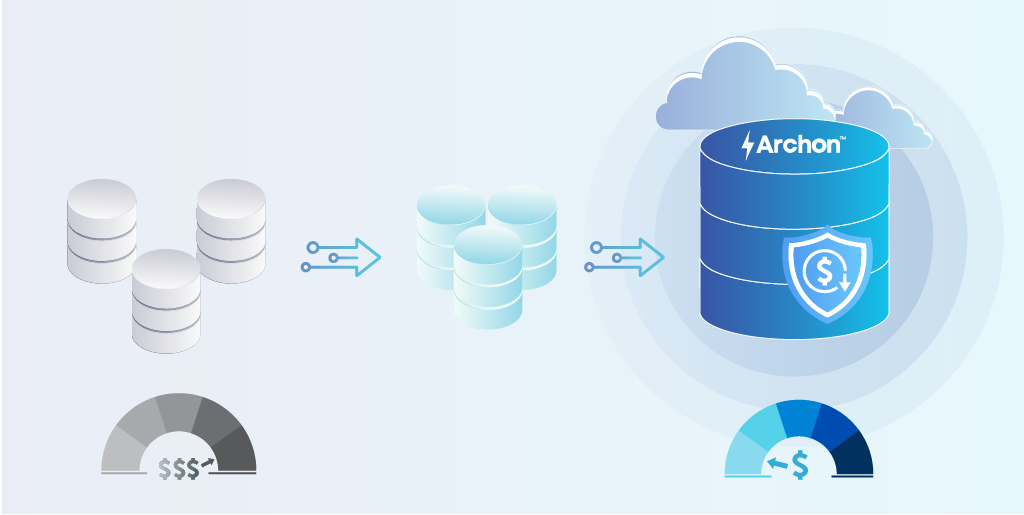
Centralized data archiving addresses this challenge by consolidating compliance-critical data into a governed, searchable, and secure repository. This reduces audit effort, enforces consistent retention, enables the retirement of legacy systems, and lowers long-term compliance costs.
Intelligent archival platforms like Archon combine policy-driven governance, tiered storage, automation, and secure-by-design architecture. Archon turns compliance from an escalating cost center into a scalable, mature capability.
Compliance is a baseline requirement to operate in modern, regulated markets. For enterprises across industries, compliances like HIPAA, GDPR, etc. determines whether a business can continue to function, expand into new regions, or participate in high-value ecosystems.
What if you haven’t focused on compliance? The consequences may go far beyond fines. They include operational restrictions, loss of licenses or certifications, and in some cases, complete loss of market access.
At its core, a compliance failure threatens business continuity and the organization’s finances.
Compliance has become a powerful signal of reliability and maturity, beyond regulatory enforcement. Customers, partners, regulators, and investors all read a strong compliance posture as evidence that an organization is well run.
It’s true, vice versa. A single lapse – whether a data breach, audit failure, or retention violation – can undo years of brand trust.
In regulated industries, compliance posture directly influences vendor and partner selection, strategic alliances, and even M&A due diligence. Poor compliance does not stay isolated; it shapes how an enterprise is perceived across its entire ecosystem.
Why Has Compliance Become More Complex and Expensive?
Modern compliance is fundamentally data-driven. Enterprises are required to retain records, protect sensitive information, retrieve data on demand, and prove data integrity often for years or decades.
As business systems multiply, so do the data sources that fall under regulatory scrutiny. ERP platforms, HR and payroll systems, CRM applications, industry-specific platforms, and custom legacy systems all generate compliance-relevant data.
But the challenge? Compliance effort scales faster than revenue. Cost increases are not driven solely by new regulations, but by fragmented data landscapes, legacy systems kept alive only for historical records, and heavily manual audit and reporting processes.
For most organizations, the challenge isn’t complying with regulations; it’s doing so efficiently at scale.
How Does Compliance Impact Daily Operations?
Compliance impacts day-to-day enterprise operations in tangible ways. Audit readiness must be maintained continuously, not rushed at year-end. Legal holds and investigations can disrupt business processes when data is difficult to locate.
Internal and external data access requests demand fast, accurate responses. Retention and deletion policies must be enforced consistently across systems to avoid over-retention or accidental data loss.
These activities increase audit preparation costs and drive up the cost of compliance audits, especially when data is scattered. When compliance data is difficult to access or poorly governed, operational friction increases, and so does cost.
Where Do Enterprises Struggle While Adhering to Compliance?
Most enterprises struggle to comply due to siloed data across various systems.
Compliance-relevant information is scattered across ERP systems, HR and payroll platforms, CRM applications, and a wide range of custom and legacy systems. Each additional system introduces incremental cost, risk, and operational dependency.
Each platform requires separate controls, separate audits, and separate validations. Over time, organizations maintain applications not for business value, but simply to preserve historical records. This fragmentation directly increases compliance risk, cost, and operational overhead.
Where Does The Compliance Cost Paradox Lie?
Compliance is mandatory. However, compliance spending continues to rise, even when no major new regulations are introduced, and the organization’s risk profile remains largely unchanged. The primary reason is the increased data volume. Enterprises are storing and managing more data than ever, across more systems than ever.
The paradox is clear: enterprises spend more on compliance while gaining less visibility and control. Regulatory audit readiness becomes harder to sustain, and compliance turns into a reactive, resource-intensive process rather than a governed one.
Why Distributed Data Environments Drive Compliance Costs?
When data is spread across systems, each system demands separate compliance efforts – separate audits, controls, and validations. Legacy applications are maintained purely for historical data access, incurring licensing, infrastructure, and support costs with limited compliance capabilities.
Manual processes dominate, relying on human searches, spreadsheet reconciliations, and ad-hoc reporting. These approaches not only inflate cost but also increase the likelihood of errors and audit findings.
The result is a compliance model that is fragile, expensive, and difficult to scale.
Is Centralized Data Archiving The Key to Compliance?
Centralized data archiving reframes compliance from a system-level problem to a governance-level strategy. At an enterprise level, centralized archiving is a governed, unified repository for regulated and historical data.
A centralized archive enables consistent retention enforcement, continuous audit readiness, and controlled, traceable access to sensitive records. By consolidating compliance-critical data, organizations simplify governance while reducing operational dependency on multiple production systems.
How Centralized Data Archiving Reduces Compliance Costs?
The cost benefits of centralized archiving are direct and measurable. A single source for audits and reporting reduces preparation time and minimizes reliance on IT teams and external consultants.
- Auditors can access required records faster, shortening audit cycles and lowering professional service costs.
- Centralized archiving also enables safe decommissioning of legacy systems. Applications retained solely for compliance can be retired without risk, ruling out ongoing licensing, infrastructure, and maintenance expenses.
- Automated retention and legal hold management further lowers compliance costs by enforcing policies consistently, preventing over-retention, and minimizing exposure to regulatory penalties.
- When investigations or disputes arise, centralized archives allow faster data retrieval, enabling rapid responses while reducing operational disruption and legal response costs.

How Archon Lowers Compliance Costs Through Centralized Archiving?
Archon has regulatory compliance as its core priority. A single archive – no fragmented systems, system-specific compliance efforts, and purpose-built for regulatory data.
Data Privacy and Data Minimization
Archon Data Store supports privacy and data minimization principles by centralizing and governing historical data, reducing unnecessary data sprawl across production and legacy systems while preserving compliant, auditable access.
By enforcing policy-driven retention, legal holds, and defensible deletion, Archon Data Store ensures that personal and sensitive data is retained only for as long as regulations require.
Storage tiering
Archon’s storage tiering reduces compliance-related infrastructure costs by automatically placing archived data on the most cost-effective storage tier based on access frequency and performance needs.
High-cost storage is reserved only for frequently accessed audit data, while rarely accessed historical records are moved to low-cost cold or archival tiers. This prevents unnecessary spending on premium storage and significantly lowers long-term storage, backup, and infrastructure expenses without affecting regulatory availability.
Policy-driven Data Tiering
Data tiering reduces compliance costs by classifying data according to its regulatory relevance, lifecycle stage, and risk profile, allowing enterprises to avoid applying uniform, high-cost governance controls to all data.
By enforcing differentiated retention, access, and legal hold policies, organizations prevent over-retention, reduce data volume, and limit compliance overhead. This leads to lower operational effort, reduced audit scope, and minimized long-term data management costs.
Data Compression and Compaction
Archon also leverages data compression and compaction to reduce data volume without sacrificing integrity. By shrinking storage footprints, organizations lower backup, infrastructure, and long-term retention costs while remaining audit-ready.
Metadata enabled for Faster Retrieval
Rich metadata indexing by Archon enables precise, policy-aware search across archived data, allowing compliance and legal teams to locate relevant records in minutes rather than days.
By eliminating manual searches across multiple systems and reducing dependence on IT teams, metadata-driven retrieval shortens audit and investigation timelines and lowers operational effort. This significantly reduces external consulting and legal response costs, while maintaining full traceability and regulatory confidence.
Secure-by-Design Archiving Architecture
Built on a secure-by-design architecture, Archon incorporates encryption, role-based access, immutable storage options, and centralized audit trails. By limiting data exposure and strengthening governance, organizations reduce data breach risk and associated compliance penalties.
From Cost Control to Compliance Maturity
The most mature organizations shift their perceptions. They don’t ask, “How much does compliance cost us?” Instead, they ask, “How efficiently do we manage compliance?”
Centralized data archiving is not a one-time cost-cutting measure; it is a long-term foundation for sustainable compliance.
Enterprises that control their data footprint are better positioned to control compliance costs, reduce operational burden, and approach audits with confidence rather than urgency.
One Archive. Fewer Audits. Lower Compliance Spend. Start Centralizing Your Data


