

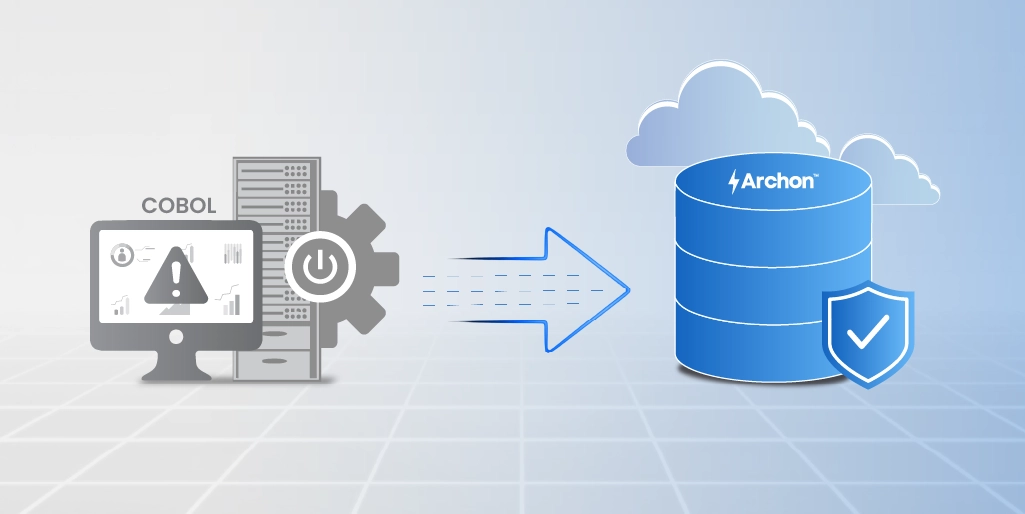

Key Points
- COBOL modernization is fundamentally a data challenge. Preserving decades of business records, rules, and context is often harder than migrating the applications themselves.
- Legacy COBOL systems continue to drive significant operational costs through mainframe infrastructure, software licensing, specialized skills, and ongoing maintenance.
- Data dependencies are frequently undocumented. Critical relationships often exist in COBOL programs, copybooks, and VSAM files rather than in formal schemas.
- Historical data must remain accessible after migration. Regulatory audits, legal requests, and business reporting often require access to records years after the source application is retired.
- Successful modernization follows a phased approach. Discovery, data inventory, incremental migration, validation, and controlled decommissioning reduce project risk.
- Data integrity is non-negotiable. Organizations must preserve copybooks, validate record-level accuracy, manage encoding conversions, and maintain business context throughout the migration process.
- Archon helps organizations retire COBOL systems with confidence by discovering legacy dependencies, extracting and preserving historical data, maintaining metadata and business context, and providing compliant access to records long after the mainframe has been decommissioned.
Are your COBOL blues tougher than Monday blues?
Your legacy COBOL environment may feel like an expensive machine running solely to preserve historical records. Performance slows, licensing costs climb, maintenance demands grow, and specialized skills become harder to find.
If modernization is on your agenda, reducing infrastructure and licensing costs is only part of the equation. The bigger question is whether decades of data and knowledge will remain accessible long after the legacy platform is gone.
A large US financial institution completed an eighteen-month COBOL migration project. The code was moved. The system was decommissioned. The migration was declared a success.
Three years later, regulators requested transaction records dating 4 years back. The mainframe was gone. The data, technically, still existed in flat file exports that nobody had catalogued, in backup tapes nobody had indexed, in formats that required the COBOL copybooks nobody had preserved.
It is the story that does not appear in COBOL migration case studies because the organizations that live it rarely publicize it. But it plays out, in variant forms, across financial services, healthcare, insurance, and government every year, precisely because the industry has spent twenty years treating COBOL modernization as a code problem when it has always been a data problem first.
Modernization of conversation is no longer a strategic option. It is a succession planning emergency with a data governance problem attached.
What is COBOL Migration?
COBOL migration is the process of moving applications written in COBOL from legacy mainframe or midrange environments to modern platforms, architectures, or programming frameworks while preserving business functionality.
Organizations typically pursue COBOL migration to reduce infrastructure costs, improve performance, address skills shortages, enable cloud adoption, and modernize critical business processes. The COBOL modernization initiative triggers COBOL migration to a different environment.
Why Organizations Are Modernizing COBOL Applications Now
According to the Communications of the ACM, roughly $3 trillion in daily commerce flows through COBOL systems. Around 95% of ATM transactions touch COBOL code. Around 80% of in-person banking transactions go through it. About 800 billion lines of COBOL code are still actively used around the world. The language is 66 years old. And the people who understand it most deeply are, increasingly, not available.
Recent salary benchmarks state COBOL developers in the U.S. typically earn between $80,000 and $140,000 annually. Maintaining a COBOL environment with three dedicated developers can therefore cost approximately $250,000 to $420,000 per year in salaries alone, and potentially $450,000 to $600,000+ annually when benefits, overhead, contractors, and specialized mainframe skills are included.
While mainframes continue to perform reliably, growing economic and operational pressures are driving organizations to modernize.
The Rise of COBOL Modernization
| Era | Time Period | COBOL Milestone | Business Impact |
|---|---|---|---|
| The Birth of Business Computing | 1959–1969 | COBOL is introduced by the CODASYL committee and rapidly adopted by governments, banks, and large enterprises. | Establishes a common business programming language across hardware vendors. |
| Mainframe Expansion | 1970–1989 | COBOL becomes the dominant language for transaction processing and batch operations. | Powers large-scale banking, insurance, payroll, and government systems worldwide. |
| Enterprise Standardization | 1990–1999 | Organizations standardize mission-critical applications on COBOL and IBM mainframes. | COBOL becomes deeply embedded in core business operations and data management. |
| Y2K and Legacy Reinforcement | 2000–2009 | Massive Y2K remediation efforts extend the lifespan of COBOL applications. | Organizations invest heavily in preserving and updating existing systems rather than replacing them. |
| Modernization Begins | 2010–2019 | Cloud computing, digital transformation, and API-driven architectures expose limitations of legacy environments. | Enterprises begin rehosting, refactoring, and replatforming COBOL applications. |
| Skills Gap Era | 2020–Present | Aging workforce, rising mainframe costs, and integration demands accelerate modernization initiatives. | Focus shifts from simply maintaining COBOL systems to preserving data, reducing risk, and enabling innovation. |
| AI and Data Accessibility Era | Future State | Historical COBOL data is integrated into cloud, analytics, and AI ecosystems. | Organizations modernize while retaining compliant access to decades of business records. |
The Business Risks of Keeping Legacy COBOL Systems
Every year a COBOL mainframe stays in place; the risk register quietly grows. Here is what is actually accumulating.
Runaway Operational Costs
Proprietary hardware and IBM’s monthly license charge model create a single-vendor ecosystem with little pricing power. Mainframes consume disproportionate power and require expensive, specialized data center cooling. Add annual support contracts, COBOL specialist salaries, and the integration middleware needed to connect the mainframe to any modern system, and the cost of standing still starts to look a great deal like the cost of moving, without any of the upside.
Regulatory Compliance That Gets Harder Every Year
Keeping legacy systems compliant with modern regulations like GDPR or CCPA requires costly additional tools and complex patching cycles. The mainframe was not built for consent management, data subject access requests, or the kind of field-level auditability that modern privacy regulations now demand.
Every new compliance requirement becomes an integration project. Every integration project adds cost, fragility, and another layer of undocumented dependency.
Institutional Knowledge Walking Out the Door
This is the risk that is invisible until it is catastrophic. The system knows things that no one has written down. Decades of regulatory change, business rule amendments, and edge-case handling live in the code and in the memory of the people who maintain it.
When those people retire without a knowledge transfer program in place, that institutional memory evaporates. The system keeps running, until it needs to change, or until it breaks, and no one left in the building can explain why it was built the way it was.
A Compliance Posture That Cannot Survive Scrutiny
Audit trails exist in legacy COBOL environments, but they are buried in formats that modern GRC tools cannot natively consume. Legal hold requests take weeks to fulfil. A regulator asks for transaction records from 2009, and the answer requires a mainframe session, a specialist contractor, and a printout. That is an audit risk.
As data governance expectations harden across financial services, healthcare, and government sectors, the gap between what regulators expect and what a COBOL environment can actually produce is widening every year.
A Talent Market That Has Already Tipped
47% of organizations cannot fill COBOL positions today. With salaries rising 25% each year and 92% of COBOL developers expected to retire by 2027, the talent gap is widening rapidly. The premium is already being paid. And unlike most skills shortages, this one has no resolution on the supply side. Universities stopped teaching COBOL more than two decades ago, and no new cohort of developers is coming.
Not sure where your COBOL estate stands? Archon’s pre-decommission data audit maps your historical data footprint, retention obligations, and compliance exposure before your migration program kicks off. [Request a data readiness assessment →]
Common COBOL Modernization Strategy – A Phased Roadmap
A successful COBOL migration strategy hinges on evaluating your legacy system’s architecture against business goals.
A structured, phased roadmap ensures continuity and reduces risk:

1. Discovery and Inventory
Before touching code, document the entire COBOL environment.
- Audit Codebase: Identify active programs, copybooks, JCL scripts, and database dependencies. Retire unused applications.
- Data Mapping: Define how legacy data (e.g., VSAM, sequential, Db2) maps to modern relational databases or cloud storage.
2. Choose Your Migration Path
Select the “R” strategy that aligns with your budget, timeline, and long-term modernization goals.
- Rehost: Move the existing COBOL code to a modern, cloud-based mainframe emulator (e.g., AWS Mainframe Modernization or Micro Focus). This is the fastest approach with minimal code changes.
- Refactor/Automate: Use automated tools (such as AI-assisted migration or specialized compilers) to convert COBOL directly into Java or C#.
- Rearchitect: Redesigns the application architecture to align with modern technologies, cloud-native platforms, or microservices frameworks.
- Decommission and Archive: Retires the legacy COBOL application while preserving historical data in a compliant, accessible archive.
3. Incremental Migration (The Strangler Pattern)
Avoid “big bang” cutovers whenever possible.
- API Wrapper: Place an API layer in front of the existing mainframe system.
- Module-by-Module: Incrementally migrate and test individual bounded capabilities, routing traffic from the old system to the new containerized services. The original system serves as a fallback until completely phased out.
4. Testing and Validation
Parallel execution and automated testing are critical to guarantee business logic remains intact.
- Regression Testing: Run the migrated application alongside the legacy application, comparing outputs identically.
- Data Consistency: Ensure data migrated to modern databases strictly matches the numerical precision and formatting of the old system.
The Data Challenges That COBOL Migration Guides Don’t Prepare You For
Technical migration guides address compiler versions, language constructs, and deployment targets. What they consistently underserve is the data transformation layer, the set of problems that are neither purely technical nor purely compliance-related but sit at the intersection of both.
VSAM Implicit Relationships
VSAM (Virtual Storage Access Method) files store data in key-value structures that predate the relational model. The critical point is one that surfaces repeatedly in practitioner communities, is that the relationships between VSAM datasets are not in the schema. They are in the COBOL programs that read VSAM. When those programs are migrated or decommissioned, the relational logic they encoded disappears unless it has been explicitly mapped and documented.
COMP-3 and Silent Data Corruption
COBOL’s COMP-3 (packed decimal) data type stores numeric values in a binary format optimized for mainframe arithmetic. When COMP-3 fields are migrated to floating-point types in Java or other modern languages without explicit type mapping, rounding errors are introduced. These errors pass functional testing because they are small, but in financial calculations, small is consequential.
EBCDIC-to-ASCII Encoding Failures
COBOL systems on IBM z/OS use EBCDIC character encoding, which is incompatible with the ASCII and Unicode character sets used by modern systems. Conversion failures, particularly in fields containing special characters, currency symbols, or packed data, can corrupt records in ways that are not immediately apparent. These are categories of the ‘silent failure’ that practitioners report discovering in production months after migration completion.
Copybooks as the Interpretive Layer
COBOL PICTURE clauses and copybook definitions are the metadata that makes COBOL records meaningful. The field labelled PIC S9(7)V99 COMP-3 is a signed, packed decimal number with an implied two decimal places, but that interpretation is only available if you have the copybook. Without it, the binary data is present but uninterpretable.
The practical implication: any archiving strategy for COBOL data that does not preserve copybook definitions alongside the records creates a compliance liability that is indistinguishable from not archiving the data at all.
Data migration complexity holding up your modernization timeline? Archon’s COBOL data archiving ingests VSAM, flat files, and DB2 with schema mapping intact
10 COBOL Migration Best Practices for Preserving Data Integrity and Compliance
The following best practices help ensure that critical business context, historical records, and regulatory requirements remain intact throughout the migration journey.
1. Build a Data Inventory Before Moving Any Code
Migration teams often focus on programs and overlook the data structures behind them. Inventory VSAM files, copybooks, data dictionaries, batch jobs, and downstream integrations before migration begins.
This establishes the foundation for identifying hidden relationships, dependencies, and business rules embedded in the legacy environment.
2. Reverse Engineer and Document VSAM Relationships
Analyze COBOL programs to uncover the implicit relationships between VSAM datasets. Create a logical data model that documents parent-child relationships, key dependencies, and business rules.
The relationship logic exists in application code, not in the VSAM schema. Without documenting it, critical business context can be lost during migration or decommissioning.
3. Preserve Copybooks as First-Class Metadata
Treat copybooks as critical metadata assets, not development artifacts. Archive and version-control copybooks alongside the data they describe.
Copybooks provide the interpretive layer required to understand field structures, packed decimals, and record layouts years after migration.
4. Define Explicit Data Type Mapping Rules
Establish conversion standards for COMP-3, COMP, binary, and zoned decimal fields before migration. Use fixed-precision decimal types rather than floating-point representations for financial data.
Explicit mappings prevent rounding discrepancies and silent data corruption that may not appear during testing but can affect financial accuracy in production.
5. ValidateData at the Record Level
Perform field-by-field reconciliation between source and target systems using representative production datasets. Include financial totals, balances, transaction counts, and exception scenarios.
Aggregate-level validation can miss small discrepancies that accumulate over millions of records.
6. Perform Controlled EBCDIC-to-Unicode Conversion
Standardize character encoding conversion processes and test records containing special characters, packed data, and regional symbols. Validate both data values and field lengths after conversion.
Encoding issues often remain hidden until records are accessed months after migration.
7. Archive Before You Decommission
Create a governed archive of historical data, metadata, copybooks, and business context before retiring the COBOL application.
Once the application is decommissioned, recreating record interpretations and business logic can become expensive, time-consuming, and sometimes impossible.
8. Preserve Business Context
Document business rules, batch processing logic, calculations, and exception handling embedded in COBOL programs. Store this information alongside archived data where possible.
Regulators, auditors, and business users typically need meaningful information, not raw records.
9. Establish Long-Term Data Accessibility
Ensure historical data can be searched, reported on, and retrieved without requiring the original mainframe, COBOL runtime, or specialized technical expertise.
The objective of modernization is not merely to move data, but to ensure it remains usable and compliant long after the legacy system has been retired.
10. Make Compliance Requirements Part of the Migration Plan
Define retention, legal hold, audit, and data access requirements at the beginning of the project rather than after migration completion.
Compliance gaps are significantly more expensive to address after the source system has already been decommissioned.
Successful COBOL migration is a data preservation initiative. Organizations that treat copybooks, VSAM relationships, data types, and historical records as strategic assets are far more likely to avoid the costly surprises that emerge years after the mainframe has been retired.

The Biggest COBOL Modernization Mistakes to Avoid
While the best practices discussed earlier focus on what organizations should do, the following mistakes highlight what repeatedly causes modernization efforts to stumble.
These pitfalls appear across migration case studies, analyst reports, and practitioner experiences, regardless of whether the chosen approach is rehosting, refactoring, rearchitecting, or complete decommissioning.
- Treating Data Migration as a Separate Project: Data migration is often left until late in the modernization effort, when budgets and timelines are already under pressure. Successful projects modernize applications and data together, not as separate workstreams.
- Overestimating Automation Capabilities: Modern tools can automate much of the COBOL conversion process, but the most complex business rules and edge cases still require human expertise. Automation accelerates migration; it does not eliminate the need for validation.
- Underfunding Testing and Validation. Many enterprises underestimate the effort required for testing and validation. While best practices often recommend allocating up to 40% of the modernization budget to UAT and validation, projects frequently reserve half that amount and face schedule pressure later. Because many mainframe applications lack formal test suites, teams must often recreate regression tests from historical production transactions—a process that can take several months and requires specialized mainframe expertise
- Failing To Capture Business Knowledge: Many critical business rules exist only in legacy code or in the minds of experienced employees. Capturing that knowledge before modernization begins reduces the risk of losing important functionality.
- Attempting a Big-Bang Migration: Migrating everything at once increases project risk and limits opportunities to identify issues early. A phased approach with parallel validation provides a safer path for mission-critical systems.
The Archon Approach: Archiving the Record and the Meaning
Archon was built for the architectural reality of enterprise decommissioning, including the specific requirements of COBOL and mainframe data.
Schema Context at Ingestion
One of the biggest risks in COBOL migration is losing the metadata that gives records meaning. Before archival begins, Archon Analyzer helps organizations inventory legacy assets, discover data structures, analyze dependencies, and identify relationships embedded across COBOL programs, VSAM files, and other mainframe sources.
During ingestion, Archon preserves COBOL PICTURE clause definitions, copybook field mappings, and source system metadata alongside the records themselves.
A compliance analyst retrieving a transaction record in 2032 does not need access to a retired COBOL developer to understand what the data represents. The schema context remains part of the archive.
Zero Mainframe Dependency from Cutover
Archon eliminates the need to maintain a zombie mainframe solely for historical data access. Through Archon ETL, organizations can extract, transform, and migrate data from legacy mainframe environments, including VSAM, DB2, IMS, flat files, and JCL batch outputs, into a governed archive before decommissioning occurs.
With more than 200 connectors, Archon ingests and validates historical data while the source system is still operational, enabling organizations to retire IBM z/OS infrastructure at cutover rather than years later. Legal hold, audit response, and enterprise search continue independently of the retired platform.
Evidentiary Trust, Not Just Storage
Historical data is only valuable if its authenticity can be proven. Every record ingested by Archon receives a trusted timestamp at the point of archival. The repository is protected through WORM (write-once, read-many) storage and append-only audit logs.
When regulators, auditors, or legal teams require proof that records have remained unchanged since archival, Archon provides verifiable evidence without requiring a separate chain-of-custody process.
The outcome is more than application retirement. By combining Archon Analyzer for discovery, Archon ETL for extraction and transformation, and Archon Data Store for compliant retention and access, organizations preserve both the records and the business context behind them.
Instead of leaving decades of operational history trapped inside obsolete formats, they create a trusted, searchable, and analytics-ready data asset that remains accessible long after the mainframe has been switched off.
The Last Mile of COBOL Modernization
COBOL modernization is often framed as a technology transformation, but the lasting challenge is preserving the data, business context, and compliance obligations that remain long after the legacy platform is retired.
Organizations that succeed are not necessarily the ones that migrate the fastest. They are the ones that recognize that historical data is an asset with a lifespan far beyond the application that created it.
By prioritizing data preservation, metadata management, validation, and long-term accessibility from the outset, they avoid costly surprises years after the migration is complete.


