


Key Points
- Unified archiving consolidates communications, structured data, and documents under one governed platform, replacing the siloed systems that create production gaps during audits and litigation.
- Regulators don’t ask for “your email archive” or “your Teams archive” separately — they name a custodian and a date range. Responding accurately requires every system to answer at once.
- Since 2021, the SEC has charged more than 100 firms and collected over $2 billion in civil penalties for communications recordkeeping failures — the consistent cause being fragmentation, not absence of tools.
- A genuine unified archiving platform applies one retention policy, one legal hold, and one search interface across every record type: email, collaboration tools, SMS, ERP data, and documents.
- The enterprise information archiving market is projected to reach $24.62 billion by 2033 (SNS Insider, 2025), driven by regulatory pressure and the growing volume of records generated across collaboration platforms.
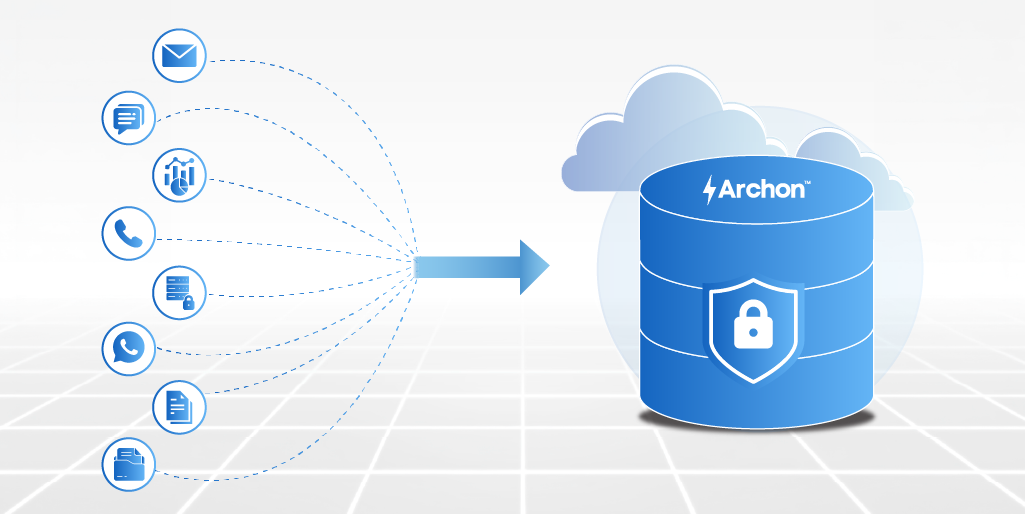
- Archon consolidates communications records, structured application data, and unstructured documents in one governed archive, so a regulatory response or legal hold spans the full enterprise record — not just the channel someone remembered to archive.
Why One Archive for Everything Is No Longer Optional
In August 2024, the SEC charged 26 investment advisers and broker-dealers and collected $393 million in penalties. The firms weren’t accused of losing data. They had data. What they couldn’t do was produce it accurately, completely, and on time because the records were spread across multiple systems that didn’t talk to each other.
This is the enforcement pattern that has repeated across more than 100 firms and three years: email archived in one system, messaging in another, transaction records in a third. When examiners arrive with a request naming a person and a time period, the response takes weeks and arrives in pieces. Pieces are not production. Partial production is what enforcement orders are built around.
The phrase “unified archiving” gets used in two narrow ways: an all-in-one email platform, or a multi-channel communications tool. Both answer part of the question. Neither answers the one an examiner actually asks.
This guide covers what unified archiving means for an enterprise managing records across communications, structured data, and business systems — what it requires technically, what it looks like in practice, and why the siloed approach fails at exactly the moment it’s needed most.

What Unified Archiving Actually Means
Unified archiving is the practice of holding every enterprise record — communications, structured business data, and documents under one governance policy, in one searchable store, governed by a single retention and legal hold framework.
Three distinct record categories create the problem:
Communications records
These records are what most people picture when they hear “archiving”: email, SMS, Microsoft Teams messages, Slack threads, WhatsApp conversations. These are governed by SEC Rule 17a-4, FINRA Rule 4511, MiFID II, HIPAA, and equivalent obligations across jurisdictions.
The compliance risk here is well-documented: the SEC’s off-channel enforcement sweep has produced over $2 billion in fines since 2021, almost entirely because firms archived some channels and not others.
Structured business data
This is what most communications-focused archiving tools don’t touch: ERP records, financial transaction data, SAP application data, clinical systems, HR platforms, and core banking records.
This data carries its own retention obligations — SOX requires financial records for 7 years; FDA 21 CFR Part 11 governs pharmaceutical data; core banking regulators require transaction history for periods that often exceed a decade. These records live in application databases, not email servers, and they require a different capture architecture.
Unstructured documents
Files, contracts, reports, SharePoint sites, legacy content from decommissioned systems — sit in a third category that rarely fits neatly into either communications compliance tools or structured data archiving platforms.
The reason unified archiving matters is what happens when a regulatory request or legal discovery spans all three. Regulators issue subpoenas for “all records relating to [client / deal / period].”
That means email threads, meeting logs, transaction confirmations, account statements, and supporting documents. Answering from five separate systems, under five separate retention schedules, with five separate export formats, is how partial production happens.
One archive. Not five.
The Real Cost of Running Multiple Archives
Most enterprises don’t choose fragmentation. They accumulate it.
An email archiving tool gets deployed to solve the 17a-4 problem. A Teams compliance connector gets added when remote work expands. An SMS capture solution goes in after the first FINRA exam flag. SAP archiving runs separately because the ERP team owns it. SharePoint governance sits in a third place because it came with the Microsoft 365 contract.
Five tools. Five contracts. Five retention schedules. None of them aware of the others.
The costs are visible in three places.
Audit response time
A regulatory examination request typically gives firms a short response window — 30 days for many standard requests, and as little as 48–72 hours for time-sensitive preservation orders.
Responding accurately from a fragmented archive requires locating the relevant custodians in each system, running separate searches, reconciling different date range formats, exporting in different file structures, and assembling a complete production package manually. What takes hours in a unified archive takes weeks in a siloed one.
Delayed production has itself become an enforcement issue: the SEC’s August 2024 action specifically cited firms that “failed to adequately implement and monitor execution” of their recordkeeping policies, even when those policies technically existed.
Legal hold gaps
A legal hold placed in the email archive doesn’t freeze the Teams conversation or the SMS thread for the same custodian. If holds aren’t placed simultaneously across every system, records expire under normal retention schedules while litigation is active. This is a spoliation.
Spoliation sanctions, adverse inference instructions, evidence exclusion, monetary penalties follow from it. The structural cause isn’t negligence; it’s the coordination burden of managing holds across systems that don’t communicate.
Invisible coverage gaps
A firm using five archiving tools rarely knows exactly what each one captures and what it doesn’t. Deleted message events in Teams, edited messages in Slack, iMessage on unmanaged devices, application data from a system decommissioned three years ago — each of these falls into a gap between tools. The firm doesn’t know the gap exists until an examiner asks for something inside it.
What a Unified Archiving Platform Covers
The scope of a unified archive tracks the scope of what regulators, courts, and auditors actually request. That scope has expanded substantially since 2015.
Communications
This remains the highest-enforcement category. Email, SMS, Microsoft Teams, Slack, WhatsApp, iMessage, and social media each carry distinct capture requirements, retention periods, and BYOD constraints.
The SEC’s enforcement pattern makes this coverage non-negotiable for financial services firms. But communications coverage is only one layer of the unified archiving picture and it’s the layer most vendors stop at.
Archon’s guide to digital communications archiving covers the channel-specific requirements and capture architecture in full.
Structured enterprise application data
This is the layer that communications-focused tools miss entirely. When a financial services firm decommissions a legacy trading platform, the transaction records don’t disappear — the retention obligation runs for up to 7 years after the system goes dark.
When a healthcare organization retires an EHR, patient records require continued access under HIPAA for 6 years from creation or last effective date. When a manufacturer winds down an SAP ECC environment, the financial data inside it stays under SOX retention requirements.
None of these records are emails. None of them sit in a messaging platform. They live in application databases, and they require a different capture architecture: direct database connectors, schema-aware extraction, and a governance layer that applies retention by record type rather than by system.
Legacy and decommissioned system data
This category falls through every gap. An organization running 40 enterprise applications and planning to retire 12 of them over the next three years has a unified archiving problem it may not have named yet.
Application decommissioning without a archiving strategy leaves active retention obligations in a system the business is paying to keep running — not for any operational purpose, but because switching it off means losing the records.
Unstructured documents and file stores
SharePoint sites, network drives, cloud file repositories — carry governance requirements under records management policies, sector-specific regulations, and litigation hold obligations.
SharePoint archiving and document-level retention are increasingly integrated with communications governance in the same regulatory inquiry.
| Record Category | Examples | Primary Obligations | Typical Retention |
|---|---|---|---|
| Communications | Email, Teams, SMS, Slack, WhatsApp | SEC 17a-4, FINRA 4511, MiFID II, HIPAA | 3–7 years |
| Structured application data | ERP/SAP records, trading data, core banking | SOX, FDA 21 CFR Part 11, Basel III | 7–10+ years |
| HR and payroll records | Compensation, benefits, workforce data | FLSA, EEOC, state labor laws | 3–7 years |
| Clinical records | EHR data, patient communications, lab results | HIPAA, state health records laws | 6+ years |
| Financial transaction records | Trade confirmations, account statements, invoices | SOX, SEC, FINRA | 6–7 years |
| Decommissioned system data | Legacy ERP, retired applications, PST archives | Inherits the obligation of the original system | Until obligation expires |
The last row is where most organizations get caught. Retiring a system doesn’t retire its records obligations.
The Four Capabilities That Define a Unified Archiving Platform
Not every platform that markets itself as “unified” is. The word gets applied to any tool that handles more than one file type. The capabilities that separate genuine unified archiving from a marketing label are precise.
1. One retention policy across every record type
Retention management at the channel level — a 3-year policy for email, a separate 6-year policy for SMS, a different configuration for Teams — is not unified governance. It’s siloed governance with a common login screen.
A genuine unified archiving platform applies retention by record type, jurisdiction, and regulation, not by system. When the same custodian’s email and SMS messages are both governed by FINRA Rule 4511 (6 years) and MiFID II (up to 7 years), the platform resolves the conflict to the longer clock automatically, on both record types, without manual reconciliation.
The data retention policy framework that governs the communications side must extend to the structured data side through the same policy engine; otherwise, you have two retention programs running in parallel, each with its own error surface.
2. One legal hold spanning every system
A legal hold that covers email but not Teams, for the same custodian over the same date range, is a partial hold. Partial holds produce partial preservation. Partial preservation, when the missing records are later requested in litigation or examination, is spoliation.
Placing a hold in a unified archive is one action: name the custodian, set the date range, confirm. The hold suspends normal retention and expiration across every record type in the archive simultaneously — communications, structured data, documents, and decommissioned system records.
In a siloed environment, the same action requires logging into five separate systems and confirming five separate holds. Under the timeline of active litigation or a regulatory examination, that coordination gap is where records get missed. eDiscovery and legal hold Management from a unified store shortens response time and closes the gap.
3. Cross-system search returning a unified timeline
A regulatory request names a person and a period. It doesn’t specify which of your archiving systems to search.
A unified archive returns every record for the named custodian and date range in one query, displayed as a unified timeline. The investigator or compliance officer sees the complete record of what that person said, what they did, and what the business systems recorded about their activity, in chronological order. This isn’t convenience.
This is the production capability that determines whether a firm can respond accurately to a subpoena in days rather than weeks.
Search across siloed systems requires running each one separately, reconciling different date range formats, and manually assembling a timeline from different export files. Cross-channel, cross-system search from one store converts a multi-week production exercise into a same-day response. The difference between those two timelines is often the difference between a clean examination and a civil penalty.
4. Immutable storage with a complete chain of custody
A tamper-evident record is not optional in regulatory or legal contexts; it’s the technical requirement that makes a stored copy a legal record. Cryptographic hashing at ingestion, a trusted timestamp, and WORM storage or the SEC’s 2022 audit-trail alternative convert a database entry into a record a court or regulator will accept.
The chain of custody requirement extends beyond the initial capture. Every access, every export, every hold action, and every policy change applied to a record must appear in an immutable audit log.
Immutable storage isn’t the same as secure storage. A record that can be accessed and read isn’t the same as a record that demonstrably has not been altered since the moment it was created. The data chain of custody that runs from capture through production is what makes the record defensible when it matters.
Unified Archiving and the Regulatory Compliance Picture
The regulatory argument for unified archiving doesn’t rest on one rule. It rests on the intersection of multiple rules governing the same enterprise.
A financial services firm operating in the US and EU is simultaneously subject to:
- SEC Rule 17a-4 (broker-dealers): electronic communications retained for 3 years, easily accessible for the first 2
- FINRA Rule 4511: 6 years for records where no other period is specified
- MiFID II Article 16(6): telephone and electronic communications retained for 5 years, up to 7 on regulatory request
- SOX Section 802: financial records retained for 7 years
- GDPR Article 17: right to erasure — in conflict with mandatory retention for records subject to other rules
None of these regulations names a specific archiving system. All of them apply to the same organization, to the same people, and to communications and records that often appear in the same underlying dataset.
The intersection is where siloed compliance programs break down. A FINRA Rule 4511 hold running in the email system and a SOX retention schedule running in the ERP system and a GDPR erasure request coming in through a separate workflow create three parallel processes that must not interfere with each other — but will, if they’re not governed by the same underlying policy engine.
This is not a theoretical risk. The SEC’s enforcement pattern shows firms that had policies, had tools, and still faced penalties because the policies didn’t extend across every channel, and the tools didn’t coordinate with each other. “Failed to adequately implement and monitor execution” is the language in those orders. The implementation failure, in most cases, is structural: compliance governed by system rather than by policy.
A unified archiving platform resolves multi-regulation conflicts at the policy level, before they become a production failure at the examination level. The longer of two conflicting retention periods applies.
The legal hold suspends both retention and expiration simultaneously. The GDPR erasure request runs against a flag that identifies records under active hold or mandatory retention — blocking the erasure until the obligation expires. One policy engine, applied to every record, updated when regulations change.
Compliance archiving as a practice covers the regulatory logic. Unified archiving covers the system architecture that makes that logic enforceable across the full enterprise record estate.
Common Implementation Challenges and What Actually Solves Them
Unified archiving is a sound concept that enterprises regularly fail at in practice. The failure modes are predictable.
Challenge 1: The existing archive has decades of legacy data.
Most enterprises building a unified archive aren’t starting from zero. They have PST files from 2007, legacy ERP archives from systems retired in 2015, email archives from a vendor they no longer use, and a SharePoint migration that never finished. Getting this data into a unified archive requires extraction, normalization, and re-ingestion — not just a connector pointing at the current system.
This is the problem legacy email archive migration and IBM CMOD migrations address in their respective contexts. The principle applies universally: the unified archive must be capable of ingesting legacy data from prior systems, not just capturing new records going forward. A unified archive that starts from today’s date still has a retention gap for the period before it.
Challenge 2: The structured data lives in systems IT doesn’t want to move.
Application databases are live operational systems. The ERP team doesn’t want an archiving vendor touching the SAP environment. The clinical systems team has change-control processes that make a new connector a six-month project. Core banking infrastructure has zero tolerance for downtime risk.
This is a legitimate concern. The architecture that works here separates read-only extraction from archival ingestion. An archiving platform that can read directly from application databases — without requiring agents, middleware, or operational changes to the source system — removes the IT objection. Enterprise data archiving covers the extraction architecture in detail; the principle is that the source system should be completely unaffected by the archiving process.
Challenge 3: Retention policies conflict across business units.
Finance wants 7 years for everything. Legal wants to retain indefinitely until litigation clears. The privacy team is trying to enforce data minimization under GDPR. HR has different retention schedules for different employee record types.
A unified archiving platform with a centralized policy engine resolves these conflicts at the metadata level. Records are tagged by type, jurisdiction, regulation, and custodian at ingestion. The longest applicable retention period wins. Active legal holds override expiration. GDPR erasure requests are queued and executed only when the last retention obligation clears. The policy engine enforces all of this without manual coordination between business units.
Data retention best practices covers the policy framework; the technical requirement is that the framework runs on the archive, not on a spreadsheet.
Challenge 4: The archive vendor becomes a single point of failure.
Storing every enterprise record in one platform raises a legitimate question: what happens when the vendor changes pricing, gets acquired, or exits the market? A 7-year retention obligation that started in year 1 of a 3-year contract has a gap.
This is where data format and portability matter more than any other technical specification. An archive stored in an open, vendor-neutral format like Apache Parquet is readable without the vendor. A migration to a new platform doesn’t require re-extraction from a proprietary format. The records are independently accessible from day one. Archon stores in open format for this reason: the retention obligation is the organization’s, not the vendor’s, and the records should be accessible accordingly.
How to Evaluate Unified Archiving Solutions
Vendor evaluations for this category tend to over-weight the demo and under-weight the contract. Ask these questions before committing.
On scope:
- Which record types does the platform capture natively — communications only, or structured data from enterprise applications as well?
- For each application type in your environment (SAP, Oracle EBS, Salesforce, core banking, clinical systems), what is the specific extraction method? API connector? Direct database read? Agent-based extraction? What change does this require on the source system?
- Are decommissioned system data and legacy archive migration included, or are those separate service engagements?
On governance:
- Does a single legal hold span all record types simultaneously from one action — or do holds need to be placed separately in each module?
- How does the platform resolve conflicting retention obligations across regulations and jurisdictions?
- How are GDPR / DPDPA erasure requests handled against records subject to other mandatory retention obligations?
On production:
- Can a single search query return communications and structured data records for the same custodian and date range — in a unified timeline?
- What export formats are supported for regulatory production: EDRM XML, PST, CSV, native format?
- What is the production time from a search query to a reviewable export, for a dataset covering 12 months and one custodian across three record types?
On chain of custody:
- Is every record cryptographically hashed at ingestion and timestamped?
- Is the audit trail — every access, export, hold action, and policy change — itself immutable?
- Where does the platform’s chain of custody documentation begin and end?
On exit:
- In what format are records stored? Is the format readable without the vendor’s own software?
- If the relationship ends before a retention obligation expires, what happens to the records?
- Is there a data migration fee? What does it depend on?
| Evaluation Dimension | What to Look For | Red Flag |
|---|---|---|
| Scope | Communications + structured data + legacy | “We support email, Teams, and SMS” |
| Governance | Policy engine runs across all record types | Separate retention configs per module |
| Legal hold | One action covers all records, all systems | “Place a hold in each channel separately” |
| Search | Cross-system, unified timeline | Module-by-module search with manual assembly |
| Chain of custody | Hash + timestamp + immutable audit log | “Tamper-resistant” without specifics |
| Data portability | Open format, readable without vendor | Proprietary format, migration fee on exit |
What a Unified Archive Looks Like When It Works
In 2023, a regional bank in Southeast Asia set out to decommission more than 100 legacy applications following a post-merger consolidation.
The applications spanned core banking, customer records, compliance files, and historical transaction data — accumulated across two organizations with different IT architectures, different retention schedules, and different compliance programs. The records couldn’t simply be deleted: regulatory obligations for the banking sector required continued access to historical records for periods ranging from 5 to 10 years, depending on record type and jurisdiction.
The challenge wasn’t storage. It was governance. With 100 applications pointing to records under different retention schedules, managed by different teams, and subject to different regulatory frameworks, the bank had no practical way to place a unified legal hold, respond to a regulatory records request, or run an audit covering the full record estate.
Archon consolidated more than 5 TB of records from those applications into a single- governed archive.
- Retention policies were applied by record type not by source system
- Legal holds could be placed across the full record estate from one action
- Search returned records from core banking, communications, and compliance files in a single query
The legacy applications were retired. The retention obligations continued to be met. The cost of maintaining 100 live systems solely for records access was eliminated.
That’s the unified archiving outcome at scale: one record estate, governed by one policy, responding to one inquiry, replacing infrastructure that existed only to satisfy obligations the unified archive now handles.


