


Key Points:
- Rule 34 reaches ESI in an organization’s “possession, custody, or control,” but whether third-party data falls within that scope depends on the organization’s legal or practical control over the data.
- When ESI sits with a nonparty, the applicable mechanism is Rule 45, which contains similar provisions addressing production format and accessibility but operates under a separate subpoena framework.
- Courts can require metadata or other characteristics of ESI when they are necessary to make the production reasonably usable, but Rule 34 does not impose a blanket requirement that every production be native or include all metadata.
- Every objection must state specifically what is being withheld, and negotiating a Rule 502(d) clawback order alongside the ESI protocol can provide advance protection against privilege waiver during high-volume production.
- Proportionality and cost-shifting arguments under Rule 26(b)(2)(B) depend on evidence of the actual burden and accessibility of the data, while Rule 37(e) addresses the consequences when discoverable ESI is lost after a preservation duty arises.
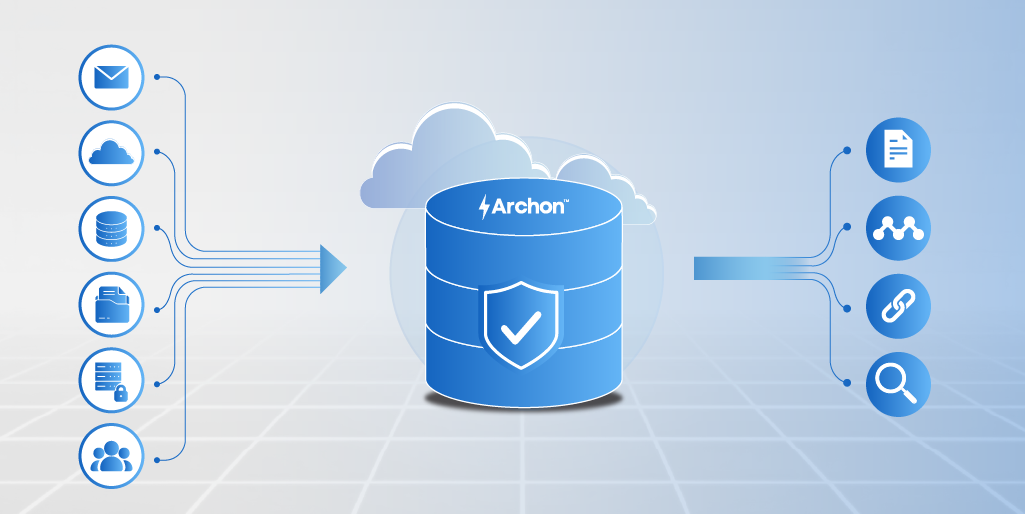
- Archon Data Store addresses these requirements structurally: cross-application search across 200+ systems, preservation of archived metadata and structural context, auditable legal hold capabilities, and visibility into archived data volumes.
FRCP Rule 34 is the rule that turns a discovery request into an enforceable obligation to produce documents and electronically stored information. It sounds procedural. It is actually a direct test of whether an organization’s data infrastructure can locate, preserve, and hand over records without the process itself becoming a second lawsuit.
That makes the archive part of the discovery equation: historical ESI must remain identifiable, accessible, and usable long after the systems that created it are retired.
What FRCP Rule 34 Covers: Scope, ESI, and Possession, Custody, or Control
Rule 34 allows any party to serve a request on any other party to produce and permit inspection, copying, testing, or sampling of items within the scope of Rule 26(b) that are in that party’s possession, custody, or control. The rule reaches three categories of material:
- Documents and electronically stored information, including writings, drawings, graphs, charts, photographs, sound recordings, images, and other data or data compilations, in any medium from which information can be obtained directly or after translation into a reasonably usable form
- Tangible things, which the requesting party may inspect, measure, test, or sample
- Designated land or other property, for inspection, surveying, or testing
Each request must describe the items sought with reasonable particularity and specify a reasonable time, place, and manner for the inspection. “Reasonable particularity” is not a formality.
Courts have compelled amended productions where a request or a production was organized so loosely that a requesting party could not tell which documents answered which request.
“Possession, custody, or control” is the phrase that catches organizations off guard. It does not require physical possession. Whether an organization has control over ESI held by a third party is fact-specific and can depend on factors such as contractual rights, the relationship between the parties, and the organization’s legal or practical ability to obtain the data.
This may include:
- Data held by a SaaS vendor or managed service provider where the organization has a contractual or legal right to obtain it
- Records sitting in a decommissioned or “sunset” application that is still technically accessible
- Data controlled by a subsidiary, affiliate, or contractor where the organization has sufficient authority over the data
- Backup archives and cold storage tiers, depending on their accessibility and the circumstances of the case
The important question is not simply where the data physically sits. It is whether the organization can establish that responsive ESI is within its possession, custody, or control and can explain how that determination was made.
Rule 34 vs. Rule 45: Requesting ESI from Nonparties and Vendors
Rule 34 applies to parties to the lawsuit. When ESI is sought directly from someone who is not a party, such as a cloud storage vendor, a former employee, or a business partner, the mechanism shifts to a Rule 45 subpoena. Rule 45 contains its own provisions governing ESI, including production format, accessibility, and protections for the subpoenaed nonparty.
The two rules address similar practical issues, but they are not interchangeable:
| Requirement | Rule 34 Parties | Rule 45 Nonparties |
|---|---|---|
| Form of production if unspecified | Ordinarily maintained or reasonably usable form | Ordinarily maintained or reasonably usable form |
| Duplicate-format obligation | Not required to produce the same ESI in more than one form | Same general protection applies |
| Inaccessible ESI | Governed by Rule 26(b)(2)(B) | Rule 45 incorporates the same inaccessibility concept |
| Who can object | Responding party | Subpoenaed nonparty |
| Where disputes are resolved | Court handling the litigation | Generally the court where compliance with the subpoena is required |
The practical difference that trips people up is jurisdiction. A nonparty subpoena dispute is generally handled by the court where compliance is required, not necessarily the court hearing the underlying case. That means a vendor served with a Rule 45 subpoena may be negotiating format and burden issues in an entirely different district than the litigation itself.
For organizations that receive Rule 45 subpoenas as a nonparty, usually as a vendor, prior employer, or business counterparty, the same reasonably accessible and reasonably usable form concepts matter, but the organization is responding under the subpoena framework rather than directly under Rule 34.
Form of Production: Native Files, Metadata, and the Reasonably Usable Standard
Under Rule 34(b)(2)(E), a request may specify the form or forms for producing ESI. If it does not, the responding party must produce ESI in the form in which it is ordinarily maintained, or in a reasonably usable form, and is not required to produce the same ESI in more than one form.
This provision generates discovery disputes because “reasonably usable” depends on the nature of the ESI, the request, the agreed production protocol, and the circumstances of the case.

Comparing Native, TIFF, and PDF Production
- Native files generally preserve the source file’s structure, metadata, formatting, and dynamic characteristics more completely than static image formats. They can be more difficult to redact for privilege and may require review platforms built to handle multiple file types.
- TIFF with a load file renders each page as a static image, which pairs well with Bates numbering and redaction workflows, but does not preserve interactive elements and may require accompanying extracted text and metadata for review.
- PDF is portable and easy to review, but whether it is sufficient depends on the nature of the underlying ESI and whether conversion has removed information necessary to understand or use the data.
Courts have ordered parties to redo or supplement productions where converting native ESI to PDF removed metadata or other information necessary to make the production usable.
Other decisions have recognized that Rule 34 does not automatically require native production simply because the requesting party prefers it, and have required native or TIFF production where the circumstances and nature of the data made that format appropriate.
The common thread is not that every ESI production must include metadata or be delivered in native format. It is that the production needs to preserve the characteristics necessary for the requesting party to use and understand the ESI. Depending on the data, that may include metadata, relationships between files, spreadsheet functionality, searchable text, or other attributes that can be lost during conversion.
Once a production format is negotiated or incorporated into an ESI protocol, it provides an important framework for subsequent production. But the parties and court may still address changes or additional production requirements when circumstances warrant.
Format disputes rarely originate as abstract legal disagreements. They often start when an export process cannot cleanly separate structured records from the system that generated them, which makes archive and retrieval architecture relevant to discovery strategy.
Objections, Specificity, and Privilege Protection in Rule 34 Responses
A party served with a Rule 34 request must generally respond in writing within 30 days of service, or within 30 days of the parties’ first Rule 26(f) conference if the request was served early under Rule 26(d)(2). For each item or category, the response must either state that inspection will be permitted, or state the grounds for objecting with specificity, including the reasons.
Critically, the response must also state whether any responsive materials are being withheld on the basis of that objection. A general objection followed by a partial, unexplained production does not satisfy the rule.
This creates a practical sequencing problem: legal teams have to know, within 30 days, exactly which systems and custodians hold responsive data, what falls inside each objection, and what remains to be produced regardless of the objection. Doing that credibly requires being able to search across systems before committing to a position in writing.
Using Rule 502(d) Clawback Orders to Manage Privilege Risk
Producing at volume raises a separate risk: inadvertently handing over privileged material during a Rule 34 response. Federal Rule of Evidence 502 addresses this directly.
- FRE 502(b) is the default protection. It applies to certain inadvertent disclosures where the disclosure was inadvertent, the holder took reasonable steps to prevent disclosure, and the holder promptly took reasonable steps to rectify the error.
- FRE 502(d) lets a court enter an order stating that disclosure of privileged or protected information in the litigation does not waive the protection in that proceeding or in any other federal or state proceeding.
A Rule 502(d) order can therefore provide stronger advance protection than relying solely on the default Rule 502(b) standard. Its effectiveness still depends on the language of the order and the circumstances of the disclosure.
Negotiating a 502(d) order at the same time an ESI protocol is negotiated, rather than after a production mistake has already happened, can reduce privilege risk during high-volume production.
Proportionality, Inaccessibility, and Cost-Shifting Under Rule 26
None of the above matters if the ESI genuinely cannot be produced without disproportionate cost. Rule 26(b)(1) limits discovery to matter that is relevant and proportional to the needs of the case, weighing the importance of the issues, the amount in controversy, the parties’ relative access to information and resources, and whether the burden or expense of the discovery outweighs its likely benefit.
Rule 26(b)(2)(B) goes further for ESI specifically: a party need not provide discovery from sources it identifies as not reasonably accessible because of undue burden or cost. If challenged, the responding party carries the burden of showing inaccessibility.
If that showing succeeds, the requesting party can still obtain the discovery by showing good cause, and the court may impose conditions addressing the burden or expense.
Courts assessing these disputes have historically considered factors discussed in eDiscovery case law and guidance, including:
- The specificity of the discovery request
- The likelihood of finding relevant information from an alternative source
- The availability of the information from other, more accessible sources
- The purposes for which the responding party maintains the inaccessible data
- The relative benefit to the parties of obtaining the information
- The total cost of production compared to the amount in controversy
- The relative ability and incentive of each party to control costs
The recurring failure point in these disputes is proof. Courts have rejected cost-shifting arguments where a responding party failed to substantiate the burden of retrieval beyond limited or informal searches.
In other cases, courts have shifted significant retrieval and processing costs after the producing party provided concrete evidence of what an extended historical data pull would cost.
The lesson is straightforward: a conclusory claim of burden is difficult to defend. A burden claim backed by sampling, volume counts, vendor estimates, and other evidence gives the court something concrete to evaluate.
This is where legacy infrastructure quietly becomes a litigation cost center. Proving inaccessibility, or challenging an opponent’s inaccessibility claim, both require being able to sample and estimate volume quickly.
When that requires reactivating a retired application or restoring backup media just to generate the estimate, an organization is paying to establish facts it ideally should already be able to demonstrate.
Preservation Failures and Rule 37(e) Exposure
Everything above assumes the ESI still exists. Rule 37(e) governs what happens when ESI that should have been preserved in anticipation of litigation is lost because a party failed to take reasonable steps to preserve it, and the information cannot be restored or replaced through additional discovery.
A safe harbor protects losses that result from the routine, good-faith operation of an electronic information system, provided that operation was not continued after a preservation duty had already attached.
Where those conditions for loss are met, the available remedies split into two tiers:
- If the court finds prejudice to another party from the loss, it may order measures no greater than necessary to cure that prejudice.
- If the court finds that the party acted with intent to deprive another party of the information’s use in the litigation, it may presume the information was unfavorable, instruct the jury that it may or must presume the information was unfavorable, or dismiss the action or enter a default judgment.
Courts can still issue curative measures for careless, unintentional loss where the requirements of Rule 37(e) are met. That distinction matters operationally: the question is not simply whether anyone acted maliciously. It is whether reasonable steps were taken once the duty to preserve attached and whether the lost information can be restored or replaced.
Proving that requires more than a memo sent to a distribution list. It requires evidence that the hold reached the relevant custodians and systems, that routine deletion was addressed where required, and that the preservation process remained effective for the relevant period.
Building a Defensible Rule 34 Response Workflow
Handling Rule 34 obligations consistently comes down to sequencing and evidence, not legal interpretation alone. A workable response process generally includes:
- Confirming the duty to preserve has attached and issuing a legal hold to every relevant custodian and system, not only the obvious email accounts
- Mapping which systems, including third-party, cloud, and legacy platforms, may hold responsive ESI, and confirming access before the 30-day response clock becomes the constraint
- Sampling volume early enough to support a proportionality or inaccessibility argument with actual numbers rather than estimates
- Negotiating the production form and, where possible, a Rule 502(d) clawback order at the same Rule 26(f) conference, before a single file is exported
- Documenting every objection at the item or category level, stating explicitly what is and is not being withheld
- Producing with the metadata and other characteristics necessary to make the ESI reasonably usable
- Maintaining appropriate documentation of collection, processing, and production activities so the organization can explain what happened to the data
- Distinguishing early whether a request targets the organization directly under Rule 34 or reaches a nonparty under Rule 45
Every one of these steps depends on the same underlying capability: knowing where data lives and being able to retrieve it without unnecessarily disturbing the system it came from.
Where Archon Data Store Fits Into Rule 34 Compliance
Archon Data Store is designed around exactly the dependency the workflow above keeps surfacing.
- Possession, custody, or control, made answerable. Archon connects to more than 200 enterprise systems, including SAP, Oracle, PeopleSoft, and Epic, ingesting structured, semi-structured, and unstructured data into one governed repository, so legal does not need to reactivate retired systems simply to locate and access archived records.
- Reasonably usable by design. Records retain associated metadata and structural context at the point of archival rather than being flattened into static images later, helping preserve the characteristics needed to understand and retrieve archived records when discovery requires them.
- Legal hold as an operational control, not a memo. Holds can be placed on specific records, custodians, or categories when a preservation duty attaches, with hold activity captured in an auditable log. The scope and operation of a legal hold should still be determined by the organization’s legal preservation requirements.
- Real numbers for proportionality and cost discussions. Cross-system search and tiered storage allow organizations to identify archived data and assess volumes and retrieval requirements, giving legal teams more concrete information when evaluating accessibility and discovery burden.
If your compliance team is still estimating what a discovery request will cost because nobody can say for certain what is sitting in a ten-year-old file share, that gap shows up first in a proportionality argument and eventually in a spoliation dispute. It is worth closing before opposing counsel finds it first.
Getting Ahead of the Next Rule 34 Request
The organizations that handle Rule 34 calmly are not the ones with the best outside counsel. They are the ones that already know, before the request arrives, which systems hold responsive data, what form they can produce it in, and what a defensible legal hold actually looks like on paper. That level of readiness starts with an archive that preserves historical records in a form that can be located, retrieved, and produced when required.
Producing PDFs without considering whether the conversion removed information necessary to understand the ESI is not a strategy. If your archive can’t answer “what do we have and can we prove we preserved it” when a discovery request arrives, that’s worth fixing before the next request lands, not during it.


