


Key Points:
- Business email often contains important business records, from customer communications and approvals to financial and operational decisions.
- Protecting those emails from threats is only part of the compliance challenge. Organizations also need to think about retention, preservation, access, and retrieval.
- The right retention period depends on the regulations, industry, jurisdiction, and type of record involved, so a single rule rarely works for everything.
- Compliance becomes harder when emails move outside the normal workflow, especially during employee departures, system migrations, forwarding, BYOD, or when records are spread across multiple platforms.
- A stronger approach brings classification, retention, preservation, legal holds, and retrieval together so records remain available and defensible when they are needed.
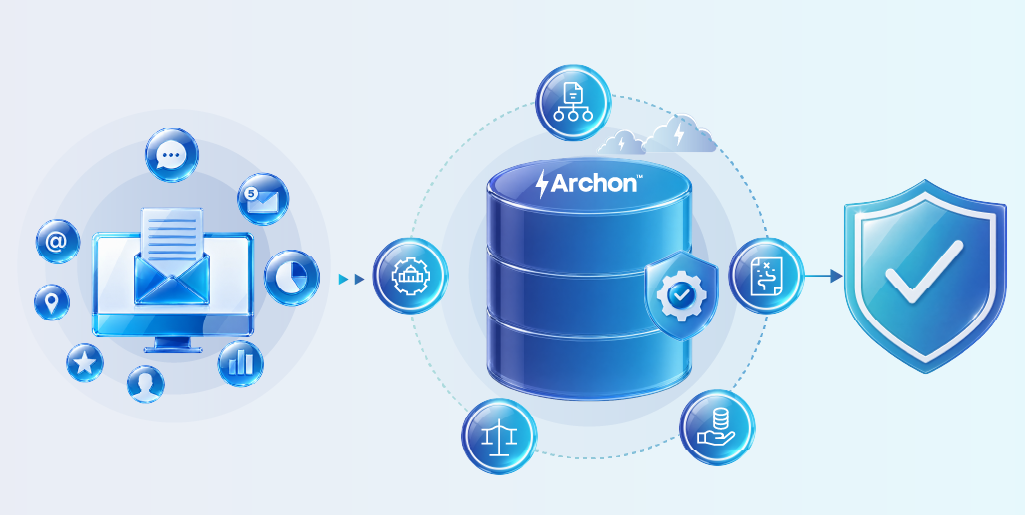
- Archon Data Store adds a dedicated archival layer to help preserve and retrieve historical business email as mailboxes, applications, and systems change.
Email is where the real business happens. Contracts get negotiated in threads, client instructions get confirmed over reply-all chains, and the details that regulators and auditors care most about, pricing decisions, health information, financial disclosures, sit quietly in inboxes long after anyone remembers they exist.
Which is exactly why email keeps showing up at the center of compliance failures, data breaches, and litigation disputes, not because it is less secure than other systems, but because almost nobody manages it as a governed business record.
Most organizations already run some form of email security. Spam filters, encryption in transit, maybe a data loss prevention tool. What they usually don’t have is a coherent answer to a simpler question: once an email has been sent or received, who is responsible for what happens to it next, and can they prove it?
That gap between “we protect email” and “we can demonstrate compliance for email” is where much of the actual risk sits, and it is rarely visible until an audit, a breach, or a litigation hold forces someone to go looking for it.
What Email Data Protection Compliance Actually Covers
Email data protection compliance is often treated as a security checklist: encrypt messages, block phishing, filter spam, done. That covers the transmission of an email. It does very little for what regulators, courts, and auditors actually ask about, which is the state of that email after it lands, and how long it stays that way.
Real compliance spans three distinct layers, and most programs only build the first one properly.
Security controls protect email while it moves and while it sits in an active mailbox. Encryption in transit, typically TLS, and encryption at rest, typically AES-256, sender authentication through SPF, DKIM, and DMARC, access controls, multi-factor authentication, and phishing or malware defenses all belong here. This is table stakes, and most IT teams have it reasonably well covered because vendors have spent two decades productizing it.
Data governance determines what happens to an email after it has served its immediate purpose. Which messages need to be retained, for how long, under whose authority, in what format, and what happens when that retention period ends.
This is where classification, retention schedules, legal holds, and defensible deletion live, and it is the layer most organizations treat as an afterthought, usually because it sits at the intersection of IT, legal, and compliance, and nobody owns the intersection.
Regulatory evidence is the ability to prove, on demand, that the first two layers actually worked. Not “we believe our retention policy was followed,” but an audit trail that shows when a record was captured, whether it has been altered since, who has accessed it, and under what authority.
Applicable privacy, healthcare, financial-services, and other regulatory frameworks can impose documentation, preservation, security, or recordkeeping obligations that make this evidence important during audits, examinations, investigations, and litigation.
A company can pass every security assessment and still face a compliance problem, because the audit is not asking only whether the email was encrypted. It may also ask whether the relevant record still exists, whether its integrity can be demonstrated, and whether the organization can explain how it was preserved and retrieved when needed.
Why Business Email Has Become a Compliance Liability
Email volume has outpaced the ability of most retention and governance frameworks to keep up with it, and the mismatch shows up in a handful of predictable, recurring ways.
The regulatory load on email keeps expanding rather than settling. GDPR, India’s Digital Personal Data Protection Act, HIPAA, the GLBA Safeguards Rule, PCI DSS where payment card data is involved, SEC and FINRA rules for financial communications, and a growing list of state-level and sector-specific mandates each define their own requirements around protected information, recordkeeping, security, retention, and auditability.
A financial services firm, a healthcare provider, and a manufacturer are not managing the same email compliance problem, even though all three would technically describe what they do as “email compliance.”
Email also sits at an unusual intersection: it is simultaneously an active communication tool and a long-term business record, and those two roles pull in opposite directions. IT teams optimize mailboxes for speed and storage cost, which pushes toward aggressive deletion and mailbox size caps.
Legal and compliance teams need specific records preserved for litigation, regulatory examination, or audit purposes. Without a system that reconciles those two goals explicitly, one of them loses by default, and it is rarely the deletion side that loses quietly.

The regulatory expectation itself has also shifted, from good intentions to demonstrable proof. It is no longer sufficient to have a written retention policy sitting in a compliance folder.
Auditors and regulators may need evidence that the policy was actually enforced, that records were preserved with appropriate integrity controls, and that a verifiable chain of custody exists for anything produced during litigation or a regulatory request.
A retention policy nobody can prove was followed carries considerably less weight than a policy backed by evidence of consistent enforcement.
Cross-border data flow adds a further layer that many organizations underestimate. An email involving a person in the European Union does not automatically become subject to GDPR simply because the recipient is in the EU.
GDPR’s territorial scope depends on the circumstances described in Article 3, including factors such as an organization’s establishment in the EU or the offering of goods or services to, or monitoring of, individuals in the EU.
Organizations operating across multiple jurisdictions can therefore end up governed by several overlapping frameworks on the same message, with the applicable requirements depending on the specific processing activity and circumstances.
Continue Reading: How to Choose Email Compliance Software: 10 Features to Look For
The Regulatory Landscape Governing Business Email
Different industries and jurisdictions impose meaningfully different obligations on the same underlying email data, and applying a generic retention template across all of them tends to either miss a legal requirement or hold onto data with no legitimate business or legal reason to keep it.
Data privacy and protection regulations
These regulations primarily govern how organizations collect, use, protect, retain, and delete personal information. Their relevance to email depends on the personal data contained in the messages and the organization’s processing activities, jurisdiction, and applicable legal obligations.
Key considerations:
- What personal information is contained in business email?
- What purpose and legal basis support retaining it?
- How long is the information actually necessary to retain?
- How can relevant messages be located when an individual exercises an applicable privacy right?
- What safeguards and access controls apply to the information?
GDPR
GDPR establishes principles for processing personal data, including data minimization and storage limitation, and provides rights such as erasure subject to applicable exceptions. Its territorial scope is defined by Article 3 and is broader than simply where a company is headquartered.
GDPR also includes a 72-hour notification requirement for certain personal data breaches after the controller becomes aware of the breach, unless the breach is unlikely to result in a risk to individuals’ rights and freedoms.
Fast access to relevant email can help an organization investigate incidents and determine what information was affected, but the 72-hour requirement is a breach-notification obligation, not a general 72-hour deadline for producing email records.
India’s Digital Personal Data Protection Act
India’s Digital Personal Data Protection framework establishes requirements around the processing and protection of digital personal data, including obligations concerning erasure when personal data is no longer necessary for the specified purpose or when retention is required by law.
The detailed operational requirements depend on the applicable provisions, rules, and commencement dates, so organizations should map email retention to the requirements actually in force for their processing activities rather than assume a single universal retention period.
CCPA and CPRA
California’s privacy framework provides applicable California consumers with rights that include access and deletion, subject to statutory exceptions and applicability thresholds.
Organizations subject to these requirements need processes for identifying and retrieving relevant personal information across the systems in which it is maintained, including email where applicable.
Sector-specific frameworks
These requirements add another layer based on the organization’s industry, regulated activities, or the type of information it handles. Unlike broad privacy laws, they may impose specific recordkeeping, security, preservation, or supervisory requirements on particular organizations or activities.
Key considerations:
- Which email communications qualify as regulated business records?
- What retention and preservation requirements apply?
- What evidence must be available for an audit, examination, or investigation?
- Are specific preservation, security, or access controls required?
Financial services
SEC Rule 17a-4 sets electronic recordkeeping requirements for broker-dealers. The current rule retains WORM as one permitted approach but also provides an audit-trail alternative under which the electronic recordkeeping system must preserve records in a manner that permits recreation of an original record if it is modified or deleted. The applicable requirements depend on the records and rule provisions involved.
FINRA Rule 4511 requires firms to make and preserve books and records as required under FINRA and applicable Exchange Act rules. Its six-year period is a default for FINRA books and records where no other retention period is specified; it should not be treated as a blanket six-year requirement for every business email. FINRA also requires applicable records to be preserved in a format and media that complies with SEA Rule 17a-4.
Healthcare
HIPAA imposes privacy and security requirements on covered entities and business associates handling protected health information. An email can contain PHI, but whether information is PHI depends on the applicable HIPAA definitions and the role of the organization.
HIPAA’s six-year retention requirements apply to specified documentation, policies, procedures, and other required records; HIPAA does not impose a blanket six-year retention period on every email or every item of ePHI.
GLBA
Financial institutions subject to the GLBA Safeguards Rule must maintain an information security program appropriate to the protection of customer information.
Email can form part of the environment through which customer financial information is stored, accessed, transmitted, or protected, but the applicable retention requirements depend on the records and obligations involved.
PCI DSS
Where payment card data is transmitted through email, the relevant email systems and connected components may fall within PCI DSS scope depending on how account data is handled and the surrounding environment.
PCI DSS also requires organizations to limit storage of account data to what is needed for legal, regulatory, or business purposes and to securely dispose of data when it is no longer needed.
Sensitive authentication data has additional restrictions, including prohibitions on storage after authorization in applicable circumstances.
| Framework | Primary Focus for Email | Retention Approach |
|---|---|---|
| GDPR | Personal data | No longer than necessary, subject to applicable legal bases and exceptions |
| HIPAA | Protected health information and required documentation | Specific HIPAA documentation has six-year requirements; other records may be subject to different federal, state, or organizational requirements |
| SEC Rule 17a-4 | Broker-dealer electronic records | Applicable multi-year requirements with WORM or qualifying audit-trail approaches, depending on the rule provision |
| FINRA Rule 4511 | Required books and records | Six-year default where no other period is specified; applicable records must meet required preservation standards |
| GLBA Safeguards Rule | Customer financial information security | Retention depends on the applicable records and documented program requirements |
| PCI DSS | Payment card data | Minimize storage and securely dispose of account data when no longer needed |
| DPDPA (India) | Digital personal data | Retention and erasure tied to applicable purpose and legal requirements |
Where an organization sits across these frameworks, often more than one at once, determines which retention schedule actually governs a given mailbox, and that mapping needs to happen deliberately rather than by default.
Common Points of Failure in Email Compliance Programs
The first set of problems is structural: weaknesses in the way the email compliance program is designed and operated. A few patterns show up repeatedly across industries, and they tend to compound rather than stay isolated, because each one quietly increases the blast radius of the others.
| Failure Point | Why It Happens | Compliance Consequence |
|---|---|---|
| No unified retention schedule | Different departments apply different, sometimes conflicting, rules to the same mailbox | Inconsistent enforcement and difficulty defending the approach in an audit |
| Native mailbox tools used as an archive | Backup and mailbox retention are mistaken for compliant archiving | May not provide the preservation, integrity, auditability, or retrieval controls required for particular records |
| Legal holds applied manually | No systematic way to preserve relevant records when litigation is reasonably anticipated | Increased preservation and spoliation risk |
| No cross-platform visibility | Email, chat, and file data are governed separately | Incomplete records during eDiscovery and higher legal costs |
| Retention decided by storage cost, not regulation | IT deletes aggressively to control mailbox size | Records may be deleted before applicable retention requirements end |
The common thread across all five is that the underlying email security may be fine. What is missing is a governance layer that treats email as a regulated record rather than just a mailbox to be kept tidy, and that layer has to survive contact with the operational situations that follow.
Recommended Reading: 10 Email Archiving Best Practices for Compliant Email Management
Where Email Compliance Gaps Often Surface
The structural weaknesses above become particularly visible in situations that test whether the program actually works beyond the ordinary active-employee mailbox.
Most email compliance policies are written for the ordinary case: an active employee sending routine business email from a corporate account. The programs that encounter problems in an audit or a legal dispute can be exposed by the exceptions, not just the routine case.
Departed employees and their mailboxes
When someone leaves the organization, their mailbox often gets deprovisioned or deleted on a fixed IT schedule that has nothing to do with the retention obligations attached to the records inside it. A mailbox belonging to a former employee under an active litigation hold, or one that contains records subject to a multi-year regulatory retention period, cannot be governed by a standard offboarding checklist. This is one common way organizations can lose records they were required to preserve.
Shared, generic, and role-based mailboxes
Accounts like info@, support@, or billing@ often fall outside individual retention policies because no single employee is accountable for them, and they can accumulate years of customer correspondence, complaints, and sensitive attachments with no classification applied at all.
Personal devices and BYOD email access
Employees checking corporate email on personal phones, or forwarding messages to personal accounts for convenience, can create records outside the organization’s centrally governed environment. A litigation hold or data subject request can become more difficult to fulfill when relevant data is not known to exist or is not readily accessible to the organization.
Forwarding rules and auto-replies
Automated forwarding set up years ago, or out-of-office replies that inadvertently include sensitive scheduling or client detail, can route regulated information outside the governed environment or expose it to unintended recipients, without necessarily triggering a security alert.
Encrypted or password-protected messages
Messages that are encrypted for legitimate security reasons can become difficult for search, classification, and DLP tools to inspect, depending on the encryption method and where decryption occurs. That can make it harder for the organization to identify, classify, preserve, or retrieve those messages when required.
Mergers, acquisitions, and platform migrations
Combining two organizations’ email environments, or migrating from one platform to another, can break continuity if the migration was not designed with retention, metadata, integrity, and chain-of-custody requirements in mind. Records can become more difficult to authenticate or explain if relevant metadata, timestamps, or access history do not survive the move appropriately.
None of these are exotic scenarios. They are the ordinary operational reality of running an organization for more than a few years, and a compliance program that only accounts for the standard case will eventually be tested by one of them, usually during a regulatory examination or a discovery request, which is the worst possible time to discover the gap.
Building an Email Data Protection Compliance Program That Holds Up
A compliance program that survives an actual audit, rather than just looking reasonable on paper, tends to follow the same sequence regardless of industry, and it needs to be built to absorb the situations above rather than assume they will not happen.
A practical program should address:
- Classify what matters
Identify communications that qualify as business records, regulated information, or other records subject to specific retention requirements. - Map retention to the applicable requirement
Establish retention periods based on regulatory, legal, contractual, and business requirements rather than mailbox capacity or convenience. - Preserve records appropriately
Use an archival approach that provides the level of integrity, preservation, access control, and auditability required for the applicable records. - Apply legal holds when required
Ensure potentially relevant records can be preserved when litigation or an investigation creates a preservation obligation. - Govern email wherever it travels
Account for Microsoft 365, Google Workspace, mobile devices, shared mailboxes, forwarding, collaboration platforms, and other relevant locations.
Start by identifying what actually needs protecting. Not every email carries the same regulatory weight. A calendar invite and a signed vendor contract sent by email are not equivalent records, and treating them identically either over-retains harmless data or under-protects the records that matter.
Classification, ideally automated and applied at ingestion rather than dependent entirely on employees tagging their own messages correctly, is what makes every later step workable. Manual classification can fail quietly and at scale; automated classification also requires validation and tuning to remain accurate.
Map retention requirements to the regulations that actually apply, rather than adopting a generic industry template. A healthcare provider, a broker-dealer, and a manufacturer have different obligations, and a retention schedule copied from a different sector will either miss a legal requirement or over-retain data the organization has no legitimate reason to keep, which can create additional privacy, security, and operational exposure.
Separate the archive from the active mailbox, and treat that separation as an important foundation for the controls that follow. An archival approach needs to provide the integrity, preservation, access controls, retention enforcement, and auditability required by the applicable obligations.
For certain financial records, that may include WORM or a qualifying audit-trail approach under the applicable SEC requirements. Native mailbox retention settings and standard backups should not automatically be treated as equivalent to a purpose-built regulatory archive; whether they satisfy a particular obligation depends on their configuration and the requirements that apply.
Build legal hold into the system rather than into a manual process owned by whoever remembers to flag it. When litigation is reasonably anticipated, preservation obligations can arise before a complaint is filed.
Systematic hold enforcement across relevant mailboxes, including shared and departed-employee accounts where applicable, reduces dependence on an individual noticing and acting in time.
Extend governance to where email data actually travels, not just where it originates. That means accounting for forwarding rules, BYOD access, shared mailboxes, and related collaboration environments explicitly in the policy, rather than assuming corporate email accounts are the only place regulated information lives.
Make search and retrieval efficient enough to matter under regulatory and legal timelines. Fast access to relevant records can help organizations investigate incidents, respond to applicable privacy requests, support regulatory examinations, and meet discovery obligations. But retrieval speed should be treated as part of an overall defensibility and response capability, rather than as a standalone regulatory requirement.
Where Archon Data Store Fits Into Email Data Protection Compliance
Most email security tools stop at the mailbox. They protect what is moving and what is currently sitting in a live inbox, and that is where their responsibility ends. Archon Data Store is designed to address what happens to email once it needs to become a long-term, governed record, including shared mailboxes, departed-employee accounts, and cross-platform data that traditional mailbox security tools may not be designed to manage as an archive.
Archon captures and archives email in a tamper-evident, write-once-read-many format where the applicable configuration and requirements call for WORM preservation.
Records can be cryptographically hashed at capture so that subsequent tampering can be detected. Trusted timestamps can establish when a record was captured, and optional notarization or ledger-anchoring capabilities can provide additional evidence of integrity where those capabilities are applicable to the organization’s requirements.
Any claims regarding specific eIDAS or ETSI alignment should be evaluated against the exact Archon configuration and applicable standard.
Retention and legal hold are policy-driven rather than dependent entirely on manual action. Rules can be mapped to the specific frameworks that apply, including GDPR, HIPAA, GLBA, SEC 17a-4, FINRA, PCI DSS, and DPDPA among others, subject to the organization’s configuration and the requirements applicable to its records.
Audit trails provide evidence of relevant access and administrative activity, helping organizations demonstrate how archived records have been handled.
Because Archon is built on an open, Lakehouse-based architecture rather than a proprietary database, archived email can remain independently retrievable even if the source mailbox platform is decommissioned, migrated, or changed, depending on the deployed architecture and configuration.
This addresses platform migration and M&A continuity risk by separating long-term archive accessibility from the lifecycle of the source mailbox platform.
Because Archon governs email alongside chat, file, and application data in the same platform, a search across a compliance investigation or a data subject request can bring together relevant information from multiple sources rather than limiting the investigation to email alone. Cross-application search can reduce the manual effort and delays that often arise when investigators have to search each system separately.
The result is not a replacement for email security. It is an archiving layer designed to extend protection into long-term preservation, retrieval, and evidence, so organizations can demonstrate how regulated email records were retained and handled rather than relying only on the security controls protecting the live mailbox.
Getting Email Compliance Right Before It Becomes a Problem
Email compliance failures rarely announce themselves in advance. They surface during a regulatory audit, a litigation hold request, or a data subject request, at exactly the moment when scrambling is most expensive and least effective, and often through one of the operational situations outlined above rather than the routine case a policy was written for.
The organizations that handle these moments calmly are the ones that treated email as a governed business record long before anyone asked them to prove it.
When the next audit, investigation, or legal request lands, “we’ll look into it” isn’t exactly a winning strategy. Make sure you can:
- Identify the records that matter
- Prove how they were preserved and governed
- Retrieve them without the frantic system-hopping
If your current setup relies on mailbox retention settings and a written policy nobody has stress-tested against a departed employee’s inbox or a shared support mailbox, that gap is worth closing now, not after the first audit finds it.
Every industry carries its own specific obligations layered on top of the general principles here, and the regulatory frameworks that apply to a broker-dealer look very different from the ones governing a hospital system or a manufacturer with EU customers.
A brief conversation about where your organization’s email data currently sits, and what a regulator, auditor, or legal team would actually find if they asked, is usually enough to identify the gaps that matter most.


